I'm interviewing @headley and @BradWetherall - both former leaders within GMB/GBP - for our June podcast! If you have a question you'd love some insight on from those who worked INSIDE Google - now's your chance to ask!
https://t.co/ly8EivD9Sq
Our June podcast will be an interview with @headley & @BradWetherall - and now is your chance to submit a question for them!
Joel and Brad are former Googlers who led teams in the Google My Business/Google Business Profile ecosystem
Always wanted to bend the ear of someone with inside knowledge at GBP? Now's your chance....
https://t.co/ncGjjWTuhG
@brightlocal Not spam, maybe, but the official website calls the landmark London Eye, so, if I were in charge, I wouldn't let them put the website in the name.
On a business trip in London, often looking @googlemaps - sad to see the spam on a landmark.
Hopefully, my edit gets reviewed quickly. Too bad they don't have @rio_seo to manage their data.
Also, great working with my colleagues across @Forstaglobal in London planning 2025.
@JoyanneHawkins@gyitsakalakis How does a business lose positive reviews?
My guess: filtered suggests fake, so they shouldn't count in a prominence, which is a measure of how known/busy a business is...not how much people like it. If the reviews turn negative, it may have no impact on prominence.
@rustybrick How do you think Medium creates a reading time? The count words. And then people use that information to decide if they are going to read an article.
A really big addition! Stop losing leads to email ... it's slow, it's messy, it's killing your response times. See how to move faster, easier, and win more leads!
But wait, there's more!
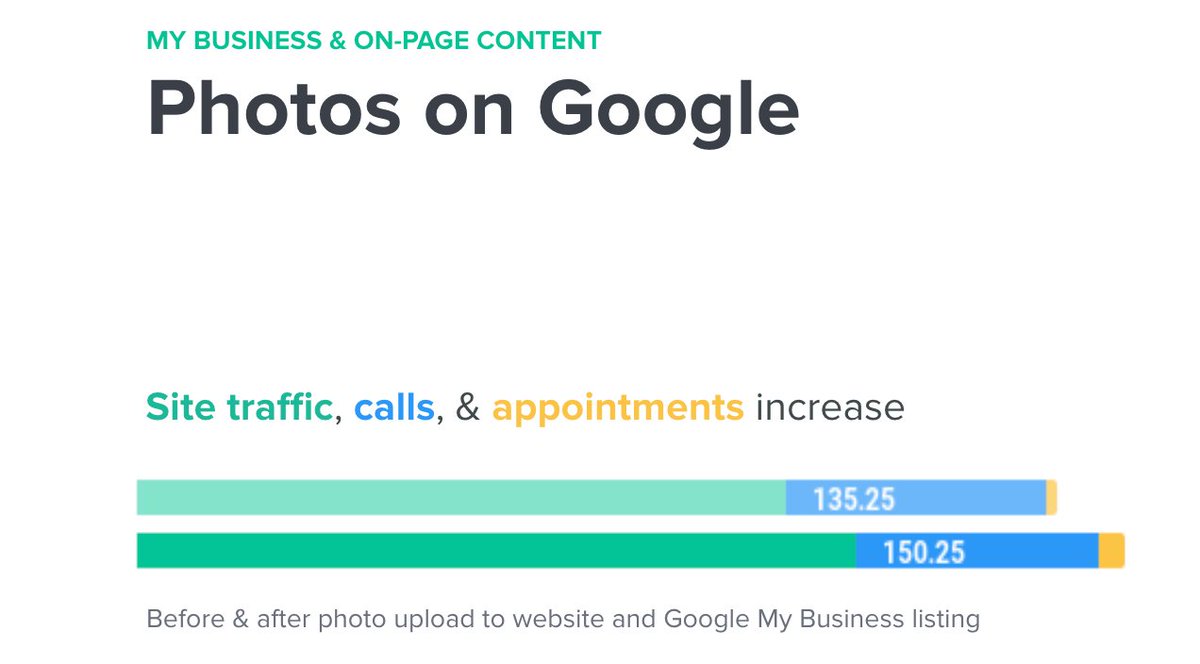
We were using Google's Vision API to find images that matched keywords associated with the business (e.g., dentist v. glasses), & that's why we saw an increase in traffic v. adding stock images alone.
Photo diff. were minor to get the right keywords.
How can you get high-quality photos for your Google Business Profile? 📸
Your first instinct might be to turn to stock photos or an AI photo generator. But that's a bad idea.
Google can detect stock photos and is not a fan of them. Research from Joel @headley demonstrated that Profiles with real, locally shot images, outperform Profiles with stock images.
So, here are 2 ways to get high-quality pictures for your Profile:
1️⃣ Your phone's camera takes high-enough quality pictures. Resolution has to be drastically reduced for photos on the web anyway.
You can ask someone at your office to take pictures of you doing your thing at work. This is a quick and easy solution that will get you some authentic photos for your Profile.
2️⃣ If you are willing to pay for stock images anyway, why not just hire a professional photographer?
You can find photographers in any city these days who will do a job like this for a couple hundred dollars.
Of the two options, I highly recommend booking a photographer. You can reuse those photos for your social media, website, print material etc. So the investment is well worth it.
Thoughts?
#seo #localseo
@Giridja@DarrenShaw_ Google preferred JSON-LD, because other formats had high rates of implementation errors. And, since this is structured content, it was presumably being fetched from a CMS, so it didn't make sense to inter-mix.
Schema's value to Google was based on the search features it presented based on schema, not the semantic content it could get from schema. It had to do that other ways because schema was never used universally enough to allow that to be the defacto standard in semantic content.
Schema is dead 😵
(for local SEO)
"Schema is only valuable for the SERP features that it triggers" - @headley
I no longer implement or recommend Schema for local business SEO. There used to be value in some schema markup, but not anymore.
🔹 Local business schema
You don't need it unless your business info online is a mess and Google cannot associate your business entity with your website. 99% of businesses don't have this problem, so there is no reason to use it. This schema has never had any SEO impact (see Joel's quote above).
🔹 Review schema
It was amazing while it lasted, but Google doesn't show the stars in the results for smaller sites anymore, so the party's over.
🔹 FAQ schema
It was amazing while it lasted, but Google doesn't show the FAQ snippet in the results for smaller sites anymore, so the party's over.
🔹 Sameas schema
This used to be helpful to get social links on your GBP, but it's no longer needed since you can add social links as a setting in your Google Business Profile now.
☝️🤓 There is still one rare case where I think schema can be helpful, and that is when your GBP Event posts are appearing with incorrect info.
Other than that, I don't waste my time with schema these days. There are higher value SEO activities to do.
#seo #localseo
@JarnoVanDriel@DarrenShaw_ That's right. Again, since Google can't rely on everyone to have Schema, it really can't rely on anyone to have Schema. That's why it focused on partnerships in key publishing spaces for search features.
HTML content is the meat & potatoes of Google semantic signaling.
@FleetwoodP29908 @DarrenShaw_ Oh, I think in the local space you should say something about geotagging photos and you'll get the charlatans to come out :)
@DarrenShaw_ So, to moderate both sides:
• Chasing every new https://t.co/7SyDOsUrAr draft - 👎
• Search features driven by schema come and go - Google is fickle. Add it!
• Google probably isn't using it for semantic search directly. HTML is more reliably implemented. Keep testing!
@DarrenShaw_ On the knowledge team, we knew search core ranking couldn't use schema niche use.
Everyone uses HTML, and search ranking needs to get semantic signals from all pages.
Think about it: Google search doesn't want to turn off the Internet to those that don't implement Schema.
@JarnoVanDriel@DarrenShaw_ Absolutely. It is a more nuanced discussion than life or death. And, if you're building a platform, you should include it as part of the basic build.
It is easy and cheap. I agree on that point.