A patient with end-stage heart failure underwent cardiac transplantation. This is the explanted native heart removed during surgery.
What pathological abnormalities can you identify, and what devices had been implanted before transplantation?
Interventional Cardiology
What Is the SYNTAX Score?
Not every coronary stenosis is equally difficult to treat.
A 90% focal lesion may be technically straightforward, while a patient with multiple bifurcations, heavy calcium, chronic total occlusion and diffuse disease may require a much more complex strategy.
This is where the SYNTAX score comes in.
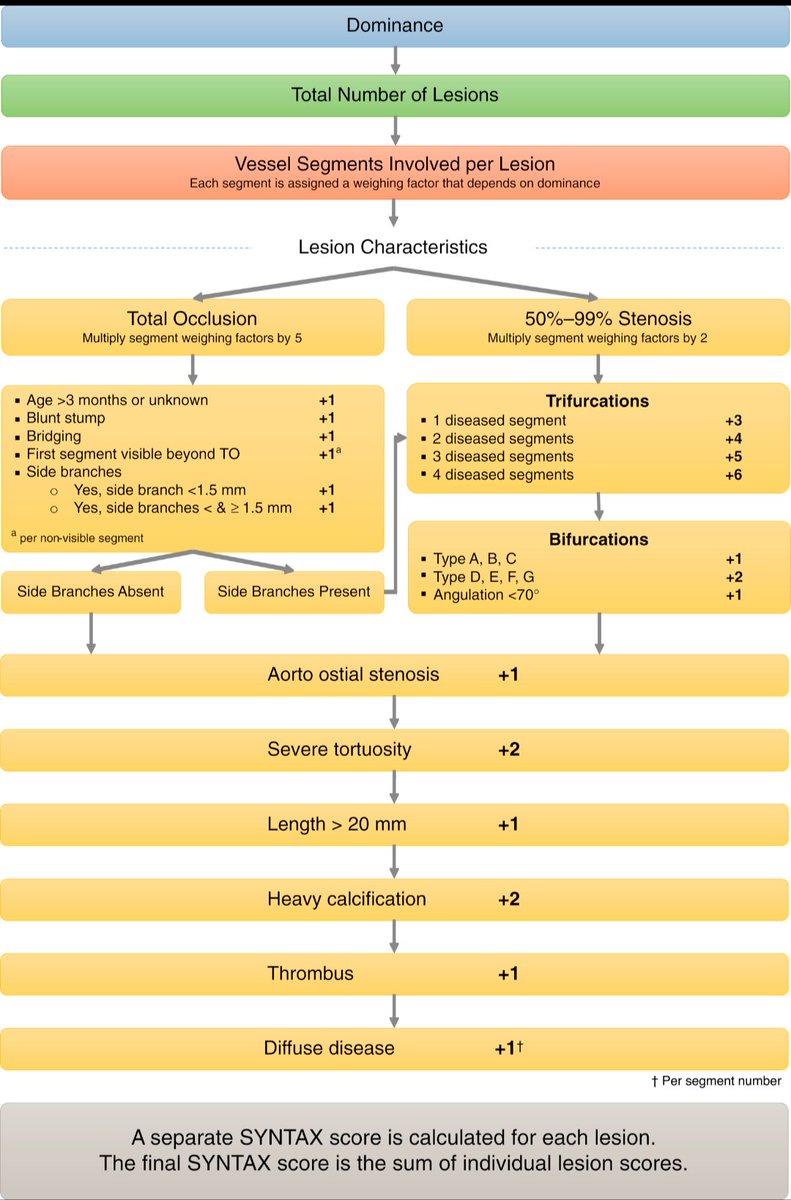
The SYNTAX score is an anatomical score that quantifies the complexity of coronary artery disease.
It considers features such as:
1️⃣ Number and location of lesions
2️⃣ Coronary dominance
3️⃣ Chronic total occlusions
4️⃣ Bifurcation and trifurcation lesions
5️⃣ Aorto-ostial disease
6️⃣ Severe tortuosity
7️⃣ Lesion length >20 mm
8️⃣ Heavy calcification
9️⃣ Thrombus
🔟 Diffuse disease
Each lesion is scored separately, and the individual lesion scores are then added to produce the overall SYNTAX score.
Why does it matter?
The anatomical complexity of CAD is one factor used when considering PCI vs CABG.
But here's the important update:
SYNTAX is not a standalone decision-maker.
It does not incorporate important clinical characteristics such as age, diabetes, renal function, frailty or surgical risk. The ACC/AHA/SCAI guideline therefore emphasizes integrating coronary anatomy with clinical factors, procedural feasibility and Heart Team assessment.
The SYNTAX Score II / SYNTAX Score II 2020 attempted to address this limitation by incorporating clinical variables alongside anatomical complexity.
Updated with the 2021 ACC/AHA/SCAI Revascularization Guideline and 2024 ESC Chronic Coronary Syndromes Guideline.
@RawdyReales “Libre desarrollo de la personalidad” yo creo hno que primero hay que tener una personalidad para aspirar a desarrollarla libremente y eso en la niñez y adolescencia como que no aplica
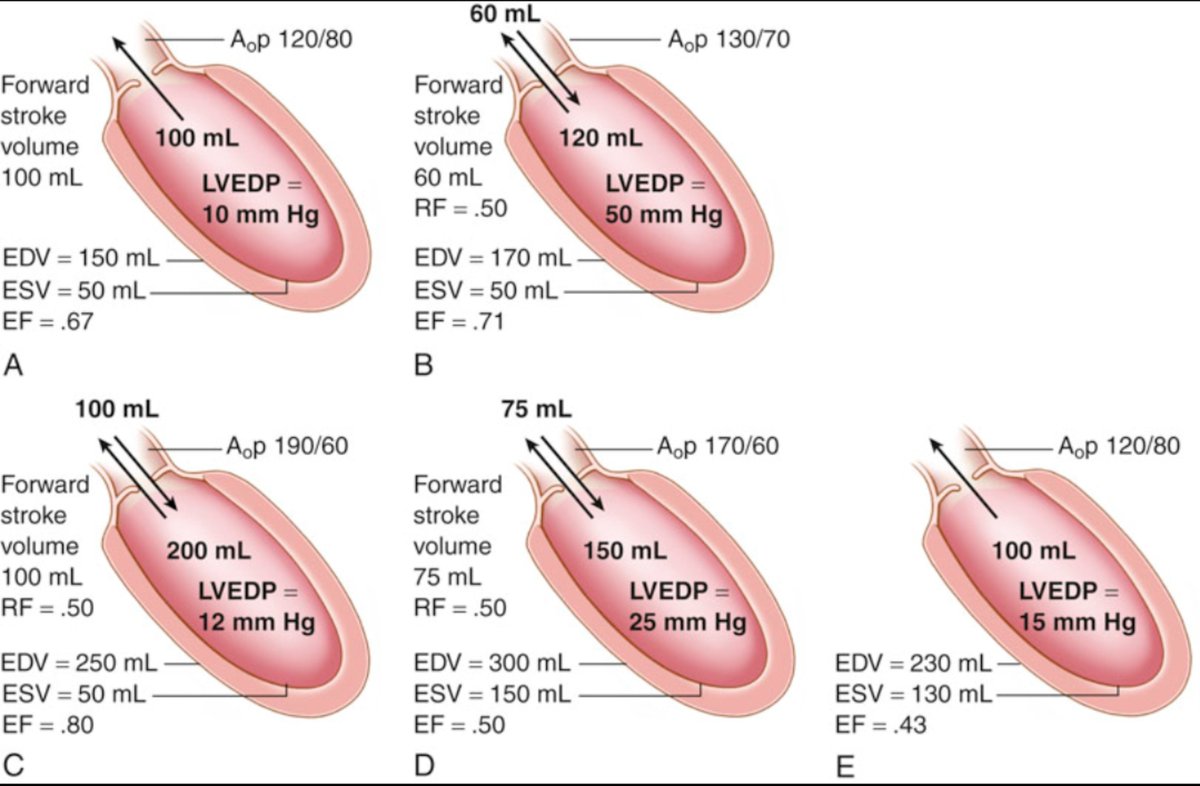
Aortic regurgitation: why can EF be misleading?
In severe aortic regurgitation, the LV ejects blood in two directions: forward into the aorta and backward into the LV.
That changes how we interpret stroke volume and EF.
⬜ Acute severe AR: Total stroke volume rises, but forward stroke volume falls. LVEDP rises sharply.
🟧 Chronic compensated AR: LV dilates and develops eccentric hypertrophy. EDV increases, allowing both total and forward stroke volume to rise while filling pressure remains relatively normal.
🟩 Chronic decompensated AR: LV contractile function deteriorates. ESV rises, EF falls, forward stroke volume falls, and LV filling pressure rises again.
🟥 After valve replacement: EF may initially fall because the low-resistance regurgitant pathway has been eliminated. This does not necessarily mean the LV has worsened. Forward stroke volume improves, and EF can recover with remodeling.
Key point: In severe AR, a normal or high EF does not necessarily mean normal LV function. The LV is ejecting blood both forward and back into the ventricle.
#Cardiology
Takotsubo syndrome is not always apical ballooning.
Left ventricular angiography demonstrates 4 recognized patterns:
1️⃣ Apical type: 81.7%
2️⃣ Midventricular type: 14.6%
3️⃣ Basal type: 2.2%
4️⃣ Focal type: 1.5%
The key difference is the location of transient LV wall-motion abnormality.
The apical form is by far the most common, but midventricular, basal, and focal variants are important to recognize because the pattern can extend beyond a single coronary territory.
A useful way to remember it:
Takotsubo = transient regional LV dysfunction with characteristic patterns, not necessarily apical ballooning.
#Cardiology #Takotsubo #HeartFailure
✍️In patients with pre-existing RBB block, the development of a new fascicular block during acute chest pain strongly suggests proximal LAD occlusion and identifies patients at ⤴️⤴️risk for conduction-related 🫀arrest.
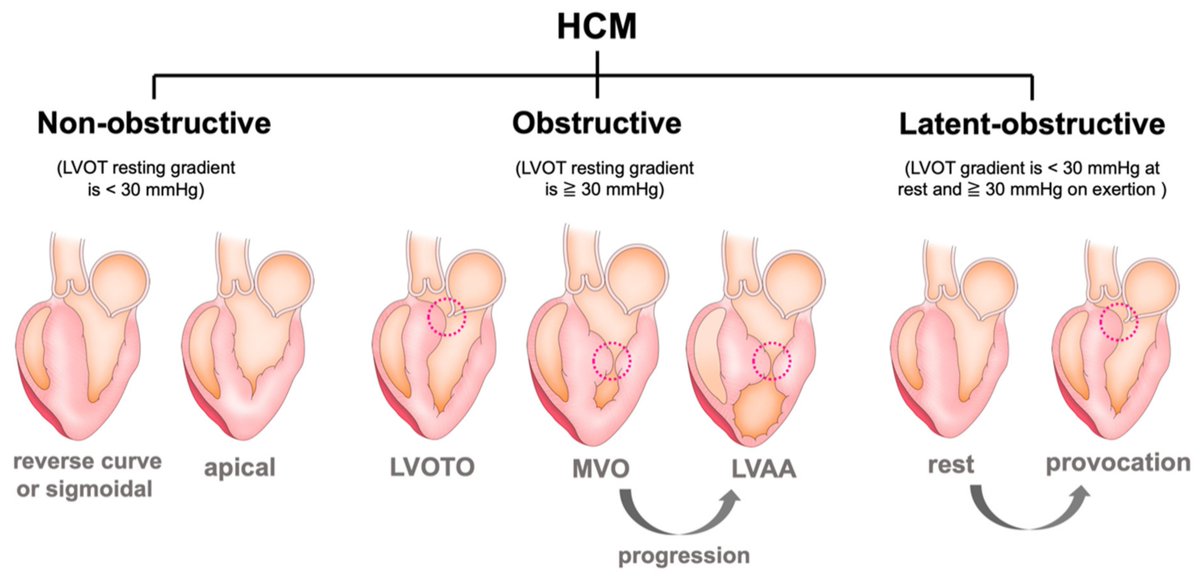
🫀 Hypertrophic Cardiomyopathy (HCM) — Morphological Types
HCM is not simply “septal hypertrophy.”
The distribution and pattern of LV hypertrophy can vary considerably.
Thread 👇
🫀 PROSTHETIC VALVE ECHO ASSESSMENT
Doppler Velocity Index (DVI) — The Simple Ratio You Should Know!
When assessing a prosthetic valve by echocardiography, Doppler Velocity Index (DVI) is a very useful parameter for detecting prosthetic valve obstruction.
Thread 👇
🚨 10 striking conclusions from ESC 2026
1. HFmrEF is essentially gone.
ESC now defines HFrEF as LVEF <50% and HFpEF as ≥50%.
2. MRAs have broken the EF barrier.
Mineralocorticoid receptor antagonists now have a Class I recommendation in chronic HF irrespective of LVEF. Semaglutide/tirzepatide receive Class IIa recommendations for HFpEF with obesity.
3. SINGLE-AF: anticoagulation may start earlier than we thought.
In AF patients at intermediate stroke risk, DOAC therapy reduced adverse clinical outcomes by 69% versus no anticoagulation.
4. Severe TR is no longer just “give diuretics and watch.”
TRIC-I-HF: transcatheter tricuspid repair reduced HF hospitalisation and all-cause mortality compared with medical therapy alone.
5. Unexplained syncope deserves early prolonged ECG monitoring.
ASPIRED: immediate 14-day monitoring did not prevent recurrent syncope, but substantially improved arrhythmia diagnosis/treatment and was associated with lower mortality.
6. Intermediate–high-risk PE may be entering the catheter era.
PRAGUE-26: catheter-directed thrombolysis improved short-term clinical outcomes versus anticoagulation alone, without an obvious major bleeding penalty.
7. Cardiac arrest + no STEMI ≠ automatic immediate cath lab.
DISCO: immediate angiography after OHCA without ST elevation did not improve 30-day survival.
8. Being ≥70 is not a reason to abandon primary-prevention statins.
STAREE: atorvastatin reduced major cardiovascular events by about 30% in older adults without known CVD, although disability-free survival was unchanged.
9. AF ablation has a surprisingly large placebo component for symptoms.
PVI-SHAM-AF: ablation reduced AF recurrence, yet improvement in AF-related quality of life was not significantly greater than sham treatment.
10. Even the definition of MI has changed.
The 5th Universal Definition of MI replaces the traditional numbered framework with primary MI, secondary MI and procedure-related MI, while incorporating sex-specific troponin thresholds and greater use of imaging.
🔥 The one-line ESC 2026 message:
Treat HF across the EF spectrum, anticoagulate selected AF patients earlier, intervene on TR, monitor syncope sooner—and stop rushing every post-arrest patient without STEMI to the cath lab.