#btc prediction: price will be through the previous high in the 4th quarter of next year.
Each subsequent time span from price peak to recovering that peak is approx 7/8s of the one preceding it.
From OpenEvidence:
This social media post contains several significant inaccuracies that misrepresent the scientific evidence:
Critical Errors
1. Wrong Test Protocol
The post instructs readers to "close your eyes" for the test, but the 2022 British Journal of Sports Medicine study used eyes-open testing, not eyes-closed. [1] This is a fundamental error that completely changes the test difficulty and validity. Eyes-closed single-leg stance is substantially more difficult and has different normative values. [2-4]
2. Wrong Publication Year
The post claims the study is from "2023" when it was actually published in 2022. [1]
3. Misleading Claim About "Nervous System Aging"
The claim that poor balance performance means "your nervous system is aging faster than your body" is not supported by the research. Balance integrates multiple physiological systems (vestibular, proprioceptive, visual, musculoskeletal, cardiovascular), making it a nonspecific marker of overall physiological decline, not a specific measure of nervous system aging. [1][5-6]
The original study authors explicitly acknowledged they did not control for physical activity levels or recent fall history, and they described balance as reflecting "multisystem decline" rather than isolated neurological deterioration. [1]
4. Overstated Claim About "Reversing" Aging
The post claims "you can reverse it" through balance training. However, no evidence demonstrates that balance training reduces all-cause mortality. While balance training improves balance performance and reduces falls, multiple large meta-analyses show it does not significantly decrease mortality risk. [7-9]
A 2019 meta-analysis of 40 long-term RCTs (21,868 participants) found that exercise interventions including balance training reduced falls but showed no significant reduction in mortality. [7] The 2024 USPSTF systematic review (37 trials, 16,117 participants) confirmed these findings. [9-10]
Balance training can improve prefrontal cortex activation patterns and postural control, but improving balance performance does not reverse the underlying multisystem physiological decline that drives mortality risk. [11]
What the Evidence Actually Shows
Accurate Findings from the 2022 Study: [1]
Test protocol: 10-second single-leg stance with eyes open (not closed)
Mortality association: 84% increased risk (HR 1.84, 95% CI: 1.23-2.78) for those unable to complete the test
Study limitations: Uncontrolled variables including physical activity and fall history; participants were from a clinical exercise physiology laboratory (potentially healthier than general population)
Interpretation: Balance is a marker of overall physiological frailty, not a specific measure of nervous system aging
What Balance Training Actually Does: [12-14]
Reduces fall rates by approximately 15-23% [8-10]
Improves physical function and quality of life [12][14]
Enhances balance performance on testing [11][14]
Does NOT reduce all-cause mortality [7-9]
Accurate Interpretation
Poor balance performance is associated with increased mortality risk, but this reflects general physiological decline across multiple systems rather than isolated nervous system aging. While balance training is valuable for fall prevention and functional improvement, it should not be promoted as a mortality-reduction intervention or a way to "reverse" aging.
For mortality benefits, evidence supports comprehensive physical activity programs meeting both aerobic (150+ minutes/week moderate activity) and muscle-strengthening guidelines, not balance training alone. [15]
Would you like to explore what types of exercise interventions have been shown to reduce mortality risk in middle-aged and older adults?
My Top Five Female Directed Films:
1. Past Lives (Celine Song)
2. Destroyer (Karen Kusama)
3. You Were Never Really Here (Lynne Ramsey)
4. Lost in Translation (Sophia Coppola)
5. The Hurt Locker (Kathryn Bigelow)
What's yours?
Block is bringing back the bitcoin faucet.
The original, launched by Gavin Andresen in 2010, gave away 5 BTC to anyone who solved a CAPTCHA.
That's $500,000 per person at today's prices. The new version goes live April 6 at https://t.co/U6EOCJi3iF.
Folks, we told you this was coming, and today the mask is fully off.
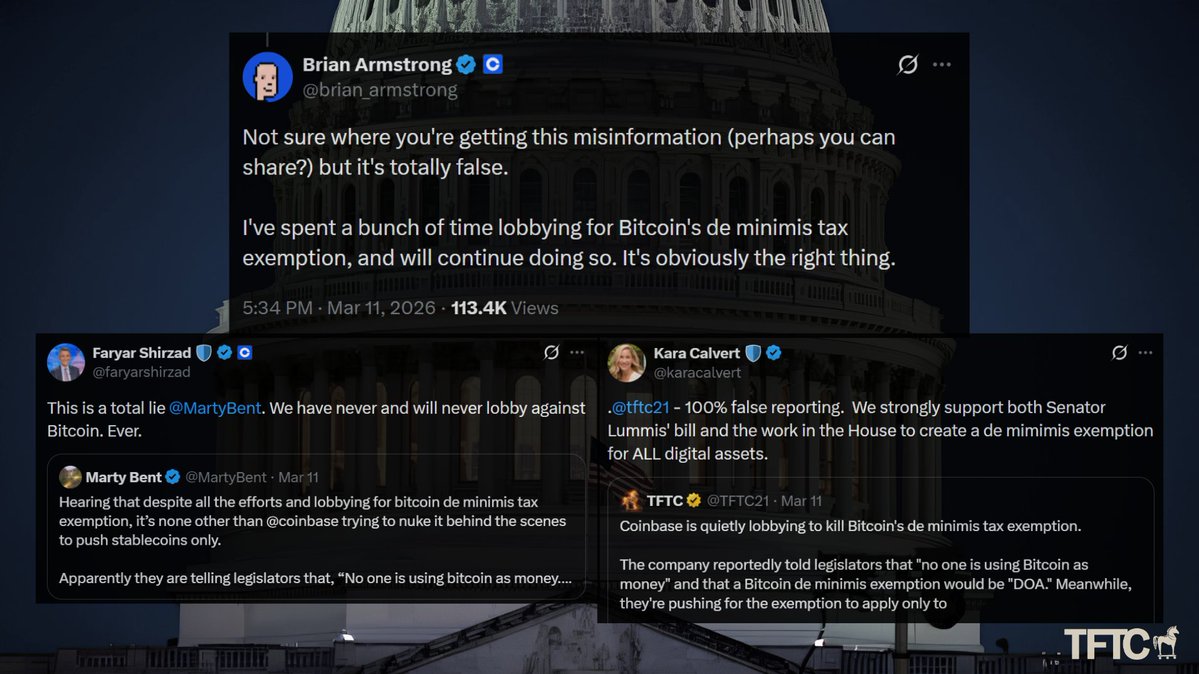
A couple weeks back we reported, based on solid sources, that Coinbase was quietly lobbying to kill a real de minimis tax exemption for Bitcoin while pushing one that applied only to stablecoins like USDC. We laid out the clear incentives in our deep dive. Coinbase made 1.35 billion dollars in stablecoin revenue last year, up 48 percent year over year, almost entirely from yield on the Treasuries backing USDC.
A proper Bitcoin de minimis would let people spend sats on everyday purchases without triggering taxable events on every transaction. That directly competes with their centralized yield machine. We called it what it was. Policy that protects Coinbase’s float rather than advancing neutral Bitcoin adoption.
Brian Armstrong pushed back hard. He called our reporting totally false and misinformation while insisting he was personally lobbying for Bitcoin de minimis. Some accused us of lying or spreading rumors. We stood firm. We offered to have Brian on the TFTC podcast to clear the air. We waited.
Now the latest draft from Reps. Horsford and Max Miller on the updated PARITY Act framework has dropped. It confirms exactly what we warned about. It gives a de minimis exemption to stablecoins but leaves Bitcoin out entirely. It keeps the punishing double taxation on Bitcoin mining fully intact while carving out relief for passive validation, basically staking. This is not an oversight or sloppy drafting. It abandons any pretense of technology neutrality and deliberately picks winners. Dollar-pegged stables and staking get the breaks, while actual Bitcoin usage as money and Proof-of-Work mining get kneecapped.
Without de minimis for Bitcoin, every small Lightning payment or sat transaction still forces cost-basis tracking and IRS headaches. Paying your plumber in sats or grabbing lunch with Bitcoin remains a taxable event. Stablecoins, being pegged and low-volatility, get an exemption they barely need. The real beneficiary is protecting that massive USDC reserve float and the yield it generates.
Meanwhile, American Bitcoin miners, already operating in one of the toughest, most capital- and energy-intensive industries, face continued double taxation while staking gets a pass. That is not neutral policy. It is industrial policy against domestic Bitcoin mining at a time when we should be leaning into energy abundance and securing the hardest monetary network.
The Bitcoin Policy Institute is releasing a full statement soon, and we fully back the call for strong community pushback. Every Bitcoiner needs to contact their reps and make it politically radioactive to sideline Bitcoin while handing carve-outs to stables and staking. This language slows real adoption, entrenches custodians, and weakens American Bitcoin infrastructure.
We weren’t lying. Our sources weren’t lying. The draft proves the reporting was on target. Those who rushed to call it misinformation owe the community some honest reflection.
Brian, if you’re still open to that conversation, the invitation stands. Come on the podcast. No spin, just walk us through how this draft lines up with your stated support for Bitcoin de minimis. The mic is warm.
This fight isn’t over. Bitcoin doesn’t need permission, but bad policy can delay sovereign adoption and punish the miners securing the network. We’re here to protect the protocol and the right of individuals to use sound money without turning every transaction into a compliance nightmare.
Stay sovereign. Stack sats. Use Bitcoin as money anyway. Call your reps today.