The Russian economy by world ranking is 4th, the UK is 10th. $7,5T and $4,7T respectively.
Nominal GDP is irrelevant when all you do is print paper and accure unpayable debts. PPP is a better estimate.
Russia's Debt is $350B vs the UK's $3,95T.
Russia's national wealth is $75T (world's 1) compared to the UK's $2,5T.
And this isn't including the fact Russia is the most sanctioned country in the world. It is cut off from the western market and has to deal through 3rd parties. There's no other European country able to bare such economic attacks.
So Tucker Carlson is in fact correct.
Operation Typhoon Part 1
85 years ago today, on 2 October 1941, Army Group Centre threw its full weight at the Red Army guarding the road to Moscow. That morning Hitler’s order of the day told the troops that the last great decisive battle of the year had begun. Speaking at the Berlin Sportpalast the next day, he assured his audience that the enemy in the East " is already broken and will never rise again." A week later his press chief, Otto Dietrich, was telling foreign correspondents that the campaign in the East had been decided.
None of these claims survived the winter. By early December the German offensive had stalled about thirty kilometres from the Kremlin, and on 5 and 6 December the Red Army counterattacked, inflicting the first defeat on that scale the Wehrmacht had suffered anywhere in the war. How that happened, and why the operation the Germans called Taifun (Typhoon) failed, is the subject of this seven-part series. The answer usually given in the West, that the Germans were beaten by mud and snow, explains less than it appears to.
By the end of September 1941 the invasion of the Soviet Union had produced victories on a scale no army had won before. Minsk and Smolensk had cost the Red Army hundreds of thousands of men, and the encirclement east of Kiev, which ended in the last week of September, had destroyed most of the Southwestern Front. Barbarossa had still failed in its central purpose, which was to bring down the Soviet state before winter, and the Red Army had begun to hit back. Its counteroffensive at Yelnya in early September forced the Germans into their first significant withdrawal of the war, and in mid-September four rifle divisions that had fought on the western axis became the first to receive the newly revived title of Guards.
Hitler’s Directive No. 35, issued on 6 September, gave Army Group Centre its new task. Field Marshal Fedor von Bock was to destroy the Soviet forces in front of Moscow in the limited time left before winter, and for the purpose he received the most powerful striking force the Germans had yet assembled in the East: three infantry armies and three of the four panzer groups on the Eastern Front, commanded at the outset by Heinz Guderian, Hermann Hoth and Erich Hoepner. Its size depends on what is counted. German records give Army Group Centre close to 1.9 million men and around 14,000 guns and mortars, and most estimates put its tank strength between 1,000 and 1,700.
The plan followed the pattern that had served the Germans so well since June. Panzer Groups 3 and 4 were to break through north and south of the Smolensk–Moscow highway and close a ring around Vyazma, while Guderian, attacking two days earlier from the south, drove through Orel and turned north to trap the Soviet forces around Bryansk. Once the main body of the Red Army’s western grouping had been destroyed, the road to Moscow would be open.
What awaited Moscow at the end of that road is a matter of record. On 8 July Franz Halder, chief of the Army General Staff, had noted in his war diary Hitler’s “firm decision” to raze Moscow and Leningrad to the ground, so that the Germans would not have to feed their populations through the winter. On 7 October the Wehrmacht high command confirmed that a capitulation of Moscow was not to be accepted even if one were offered. Behind the front, an SS killing unit had already been named for the city it expected to reach, Vorkommando Moskau. For the people of Moscow, Typhoon was the leading edge of a war of annihilation.
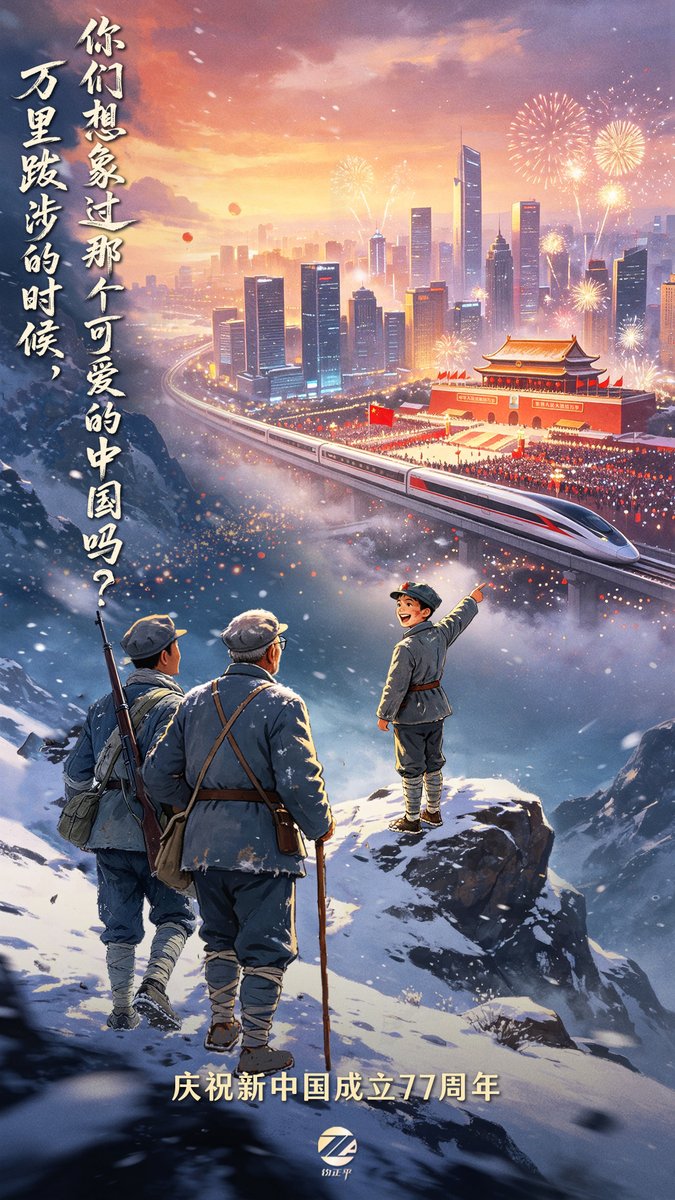
Today we mark the 77th anniversary of the founding of the People's Republic of China.
In less than three generations, under the leadership of the Party, our nation has risen from a war-torn country to a global superpower.
We began with nothing. By 1949, China had been at war, on and off, for over a century. The 1911 Revolution overthrew feudalism and established our first republic, but it brought us neither prosperity nor dignity. Yet it was the last snowflake that set off the avalanche; the people's revolution.
Western historicism sees history in segmented eras; it likes to pinpoint Copernican turning points and paradigm shifts. We Chinese, however, view history as more continuous. That is why our communist revolution did not begin in 1949, or 1921, or 1911: its roots reach back long before Marx. For us, ideology is a tool for the people's liberation and national awakening. Our goal has always been people-centered, not blind faith in doctrine.
We still view previous revolutions, regardless of ideological leaning, as part of our struggle, the fight for a better life for our people. They are not foreign chapters in someone else's story; they are chapters in our own. Every uprising, every reform, every sacrifice that sought to lift our people and advance the awakening of our nation belongs to that same long march. We honor them not because they were perfect, but because they were ours steps, however uneven, toward the same horizon.
That is the continuity we carry, not a chain of isolated revolutions, but one unbroken struggle, generation after generation, to build a China worthy of its people.
🇰🇿🇩🇪 "I have very good relations with President Putin. And today, I say with a great deal of conviction that President Putin, as the leader of Russia, is the most acceptable political figure for Europe and the world."
– President of Kazakhstan during press conference in Berlin
„You grew up under communism, so you and other Eastern Europeans certainly understand the gift of freedom more than Americans do, could you elaborate on that?“
„Actually, I had a beautiful childhood and didn‘t miss anything“
American century of humiliation
1942, London. Soviet ambassador Ivan Maisky pins the Order of Lenin on four British airmen who fought on the Russian Front. Then, in rare English, he tells the room that 1942 will be the turning point of the war. He was right.
Wait, so you’re telling me an American citizen was walking down an American street, exercising her freedom of speech, and got surrounded and harassed by a mob waving foreign flags and chanting allegiance to a foreign country because they were offended by her T-shirt?
That is objectively un-American.