Crypto101 — Edition 6 is live! 🎉
This one dives into regulation and trust in the age of AI, GDPR, and the EU AI Act – and how Web3 + Nodle’s ecosystem can turn compliance into real user empowerment.
🚨 Big Update: https://t.co/eNUvssIgX0 Browser Extension is Here! 🌟
https://t.co/nn0uerWVXv
We’re excited to announce that you can now download the https://t.co/eNUvssIgX0 extension, install it, and start contributing your resources to the network! 💻
🎯 What You Can Do:
1️⃣ Download and Install the Extension: Easily add it to your browser then login.
2️⃣ Start Contributing: Share your unused bandwidth seamlessly.
3️⃣ Earn Rewards Daily: Get rewarded automatically for your contribution to the decentralized network.
💡 It’s Simple, Safe, and Rewarding!
Start contributing today and unlock the full potential of your idle resources.
👉 Download the extension now and join the decentralized future with https://t.co/eNUvssIgX0! 🚀
When I was detained in Tehran in 1999 in the ayatollahs' prison,
I could never have imagined that one could also be imprisoned in the West for the same reason.
The day before yesterday, it was announced in the United States that they have a comprehensive plan to fight Islamophobia.
What might this national plan entail?
Criminalising "Islamophobia" and making it punishable?
Here in Belgium too, UNIA wants to do the same and as a member of parliament, I have been trying to stop this for years with debates in parliament. More and more people are trying to silence people who criticise Islam.
However, it is a fundamental right to be able to criticise religions and political views.
When I was detained in a prison of Ayatollah Khamenei in 1999 at 23 for criticising the way I was marginalised as a woman by Islam as a second-rate gender, I never imagined that I could ever face a prison sentence in the West because of the same criticism.
Why should I not be allowed to say that many aspects in Islamic law violate human dignity and fundamental rights? Will I be prosecuted for Islamophobia because of that? Where would that leave my civil rights and freedoms? I did not flee an Islamic country only to lose my freedom of speech in this country, because of such a thoughtless proposal.
Islam is a religion that has not yet experienced enlightenment and many discriminatory rules from thousands of years ago, institutionalised in this religion, are still in force.
Moreover, Islamism is a pernicious ideology that wants to conquer the world.
In the Muslim world, there are many critics who openly criticise it, even if they have to pay with their lives, because Sharia law is not tolerant.
In the West, under the guise of religious freedom, the radical Muslims try to further perpetuate their discriminatory views, especially against women. And anyone who criticises them is called polarising, stigmatising and Islamophobic.
And sometimes they can get right with some "progressives", who themselves, in the not so distant past, stood up against certain rules of another religion.
But now, suddenly, they are no longer critics of gender inequality or so many other discriminatory rules of Islam.
Because of their cultural relativism, they are abandoning millions of women and young girls, including here with us.
While Western civilisation waits for "enlightened" Islam and it is believed that the change must come from the Muslims themselves, some of them abandon the reforming critical eyes and silence them because it is allegedly "stigmatising".
Maybe they believe in miracles, but all I see in this way is an evolution towards a dark future.
The West urgently needs a wake-up call to ensure the future of our posterity.
That should be our mission.
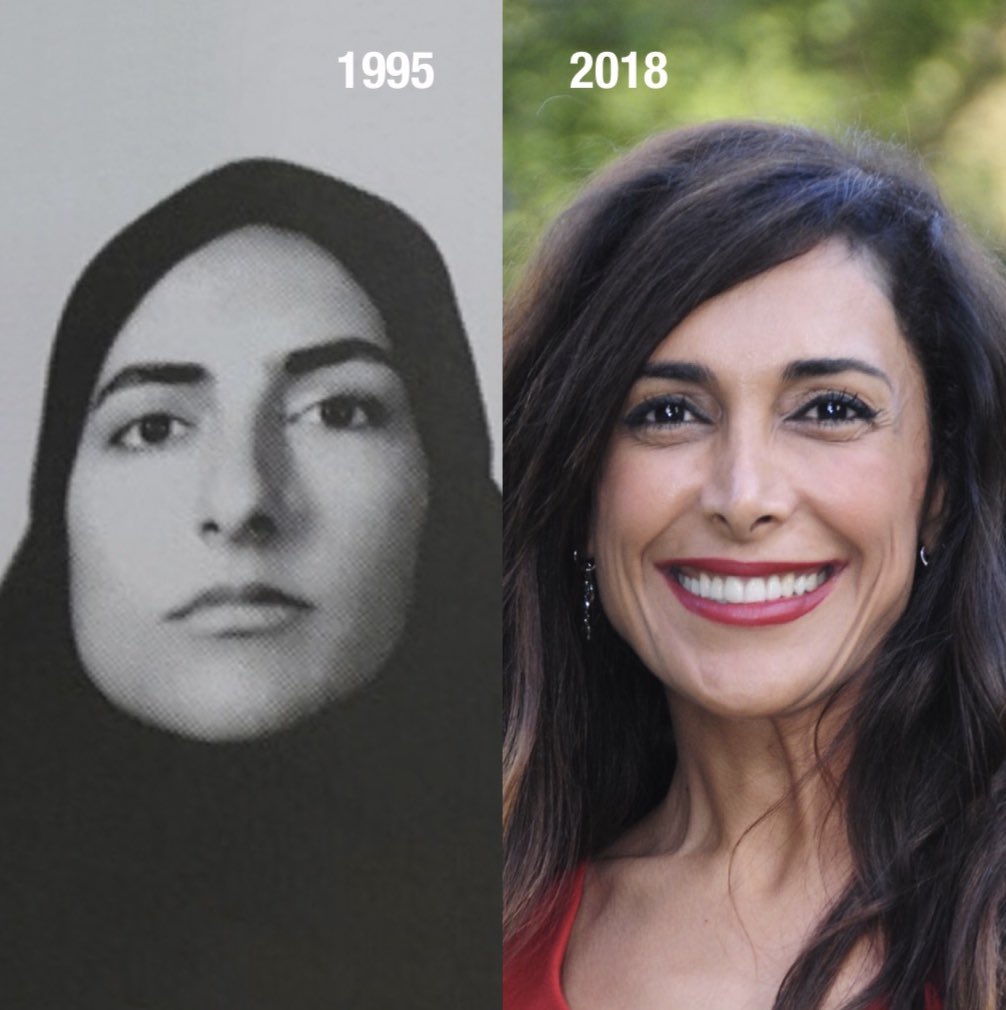
The left picture is a picture of me in Iran. The right photo is who I am today, free from the yoke of Islamic oppression.
I am tired of certain people trying to shut my mouth with the label "Islamophobe".
Recognising a social problem is the first step in seeking solutions.
I’m a member of parliament and because of my knowledge due to growing up in an Islamic regime like Iran's, I know very well what these kinds of Islamic messages mean in the current context.
What the world is experiencing today is much broader than a war between Israel and Hamas. It is a broad war that shows the direction for certain Muslims to ultimately achieve their goals.
They have even imported this to Europe with a purpose.
A goal promised to them in their holy book.
In the eyes of Islamists, this is a war between Muslims and Israel/West in order to eventually form and conquer a great ummah as the ultimate goal.
Criticising a religion or an ideology, like criticising Islam, is not something that can be compared to racism or fascism. But these shouters do insinuate this and in this way try to silence the critics with their term "Islamophobia".
Besides, a phobia is an unreasonable fear of something.
Anyone who has grown up in a country where Sharia law is the law, and has experienced it first-hand, has reasons enough to be afraid of the destruction Islam can create.
Despite what some naive people try to make us believe here in the West, Islam is not the religion of love and peace, but an ideology that promises its followers a glorious victory, and everything necessary to follow that path, even jihad and terror, is justified.
In any case, I will not be silenced by being intimidated with the label "Islamophobe".
I am not afraid and will resolutely continue my work with everything in my power. As a politician it’s my duty to protect Europe and our society from these extremists and I will continue to do so.
It's almost four weeks since the horrific terrorist attack on #Israel. A lot has happened, the public debate has become heated and confused. Find thoughts from Vice-Chancellor Robert #Habeck in the video, putting the events in context. 📣With English, Hebrew and Arabic subtitles.
A translation to @KoliaDelesalle's devastating but important experience from the makeshift morgue where hundreds of bodies from Hamas' October 7th attack are piled up:
I was able to visit the huge makeshift morgue where the hundreds of bodies of the victims of the October 7th attack are piled up. This visit sheds light on the nature of the massacre. How can we negotiate with Hamas after that?
The morgue is located in a military base on the outskirts of Tel Aviv. The bodies are kept in dozens of refrigerated containers. Several hundred bodies are waiting to be identified.
The Israeli army is seeking to give a name to the tortured bodies, but also to document the atrocities committed by the men of Hamas. For there have been many.
The bodies of soldiers are easier to identify, since the army has their DNA. Those of civilians require much more work. Most of them are in very poor condition.
On this October night, by the light of powerful halogen lamps, Israel Weiss, 74, greets us in his uniform with an extinguished look. The former head of the military rabbinate, back from retirement, wears a fine white beard, a pair of glasses and a yarmulke.
I've been in the military for 50 years, and I've seen a lot, but I've never seen anything like this. We've never seen so many bodies. Every morning, I get up and see new ones, and the smell gets into my heart. The world has to know what they've done.
According to Israel Weiss, the Hamas attack was not just about killing. The outburst of violence, the orgy of abuse, the recurrence of horror cannot be left to chance. In a monotone, exhausted voice, he enumerates the atrocities.
According to investigations, a large number of victims were burned alive. Old men had their fingers and feet cut off before being killed, while others had been decapitated with an axe.
Many women were found naked, raped and then slaughtered. A pregnant woman was found with her belly cut open, her fetus ripped out; men were found with their internal organs pulled out.
The charred corpse of a woman appeared normal, except for the chest. Forensic imaging revealed that she was clutching her child when they were burned alive.
According to Israel Weiss, the Hamas killers also burned a group of Thai farm workers bound together to complicate identification. "They weren't Jewish, though. Why not? People compare them to Daech. But they remind me of the Nazis.
They shot people in the mouths, the heads, several times, to destroy the faces. But we'll take the time to identify everyone. No victim's mother will be forgotten."
How can you negotiate the release of almost two hundred hostages with a group responsible for such carnage?
For a week now, on the edge of the volcano, Abigaël has been asking herself this question as she deals with the identification of the women and girls and the final purification rites before returning the bodies to the families for burial.
She must be barely 30 years old; we give her twice that. Her face is parchment-like, her voice a trembling trickle.
Every time, I think I've seen the worst, and then something even more atrocious happens. Headless or brainless children, people whose heads have been blown off by several bullets, slaughtered girls still in their pyjamas, trapped bodies."
"We're prepared for this. At least, we thought we were prepared for it. But it's impossible. We've been working 24/7 since the day after the attack. This cruelty is incomprehensible.
On the base, dozens of personnel in white overalls, masks over their noses, wander between several gigantic tents. Wide-eyed types, many religious, young soldiers, medical students who have come to lend a hand.
Israel Weiss asks two men wearing white overalls and construction masks to open two containers containing around 100 victims. An appalling stench fills the air.
It's a pestilential, heady smell, a mixture of rotting meat, spoiled cheese and excrement. In the containers, the bags come in all sizes.
Nearby, soldiers regularly vomit. The staff can't stay on site for long. A rota has to be organized. Officer Maayan, a dentist, is in charge of collecting DNA and fingerprints from the victims, and checking teeth when they are still present.
She doesn't hold back her tears as she speaks: "You hear the cries of the families, the screams of the mothers. You see children in such a state, I can't find the words."
On the way out of the base, we pass Evelyn Chmaya, who has been waiting three days to recover the bodies of her husband and son, killed by the same bullet as they embraced in the Re'im kibbutz.
On the day of the attack, the father went to fetch his soldier son. They died the instant they met again.
The interminable wait put an end to Evelyn's hopes. Too many bodies. Too many wasted hours. She's lost her race against time: "I wanted to recover my son's sperm to enable him to give birth despite his death, but it's too late."
Next to her, two social workers return home. Their faces are gone. They are the ones who welcome the families: "It's very hard, the army shows the press the ordered part, but a whole side of the base is submerged in corpses. There's no end to it.
In response to the unprecedented violence of the October 7 pogrom, Israel has chosen to respond to violence with violence. An eye for an eye, a tooth for a tooth. Bombs rained down on Gaza.
An independent investigation will have to determine whether Israel or Islamic Jihad was responsible for the bombing of the Ahli Arab hospital in Gaza. In any case, almost 3,000 Palestinians have already died under the bombs.
Most of them civilians, families, hundreds of children.
In the minds of many of the Israelis we met, the famous phrase uttered by Golda Meïr echoes: "We can forgive the Arabs for killing our children. We cannot forgive them for forcing us to kill their children."
But not all Israelis believe that we need to annihilate Gaza to quench this unquenchable thirst for vengeance. You may have heard of Noa, abducted on a motorcycle by two men as she reaches out to her helpless lover, Avinatan.
We met her father in a modern house on a housing estate in Beer Shiva, southern Israel. Yaacov said his prayers while reading the Torah, in front of a TV permanently tuned to a 24-hour news channel, without sound.
We met her father in a modern house on a housing estate in Beer Shiva, southern Israel. Yaacov said his prayers while reading the Torah, in front of a TV permanently tuned to a 24-hour news channel, without sound.
In the dining room of the house, the local children have set up a small altar in memory of the young girl. "Noa, we're waiting for you, stay strong."
Yaacov has no news of his daughter or of the negotiations underway to save her. And he doesn't think that bombing Gaza will bring Noa back to him: "What's the point of killing each other? Revenge brings nothing.
"You have to think with your heart, not with your logic. I think negotiation is good for both sides. Trade, not weapons, as Shimon Perez used to say."
"There are dead people in Gaza, people crying too. How is this useful? The best thing is to sit down and talk. That's what we've done with Egypt and Jordan. With the Palestinians, we're like brothers. We practically have the same blood.
Yaacob begs the kidnappers to leave his daughter alive, "the most precious thing in my eyes". "Let's exchange prisoners, let's make peace; I know there are sensitive people in Gaza with a real heart. I don't see them as savages."
Yaacov holds back his tears. He recounts Noa, her energy, her travels, hesitates between the present and the past, recalls that she is his only daughter, "my continuity, the source of my strength." His wife, Noa's mother, is ill with cancer. The situation has worsened her case.
Since Noa was born, there's been a light in the house. And look around you, there's nothing left now. I can't eat, I can't sleep, I can't do anything".
On October 12, Noa celebrated her 26th birthday in captivity. Yaacov organized a party at his home with around thirty relatives: "We sang 'Happy Birthday' while crying".
#end
Read the full report in @ParisMatch.
Thread. J’ai pu visiter l’immense morgue de fortune où s’entassent les centaines de corps des victimes de l’attaque du 7 octobre. Cette visite éclaire la nature de ce massacre. Comment négocier avec le Hamas après ça ?
Beyond the research and interest about psychedelics used in a medical setting, and particularly around end of life it's the message shared by Dr Griffiths about his terminal diagnosis and the learnings about the meaning of life. #bowelcancer#psychedelic https://t.co/RC10A1H8vD
I saw the Queue today… The Queue is alive!
The Queue is silent, a silent wave of life gliding through the streets of London,
The Queue needs no words, it simply is.
The Queue extends indefinitely.
The Queue is the answer to Time.
What is Time? Time is movement.
The Queue is constant movement.
But wait, the Queue has been paused. Time has paused…
The world holds its breath…
As a customer of @sainsburys, I’d love you to add the symptoms of bowel cancer to your own brand loo roll packaging. Get in touch with @bowelcanceruk to work in partnership as other supermarkets are doing. You can help save lives today #GetOnARoll