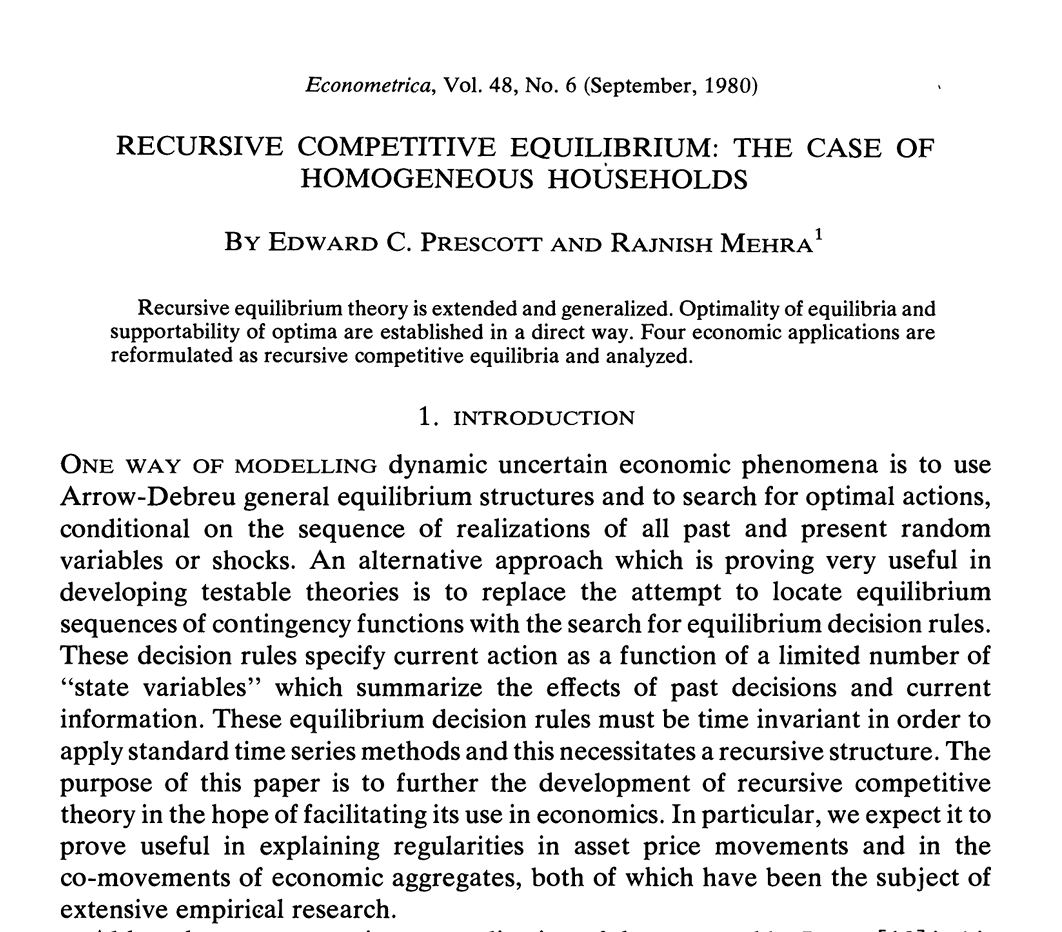
on a side note (not so related but reading this made me think for whatever reason of Grandmont/Guesnerie) : good paper below (also, would be very interested in anyone in the TL knew of papers/books on the history of the sunspot literature) ⬇️
https://t.co/tU2VV272w3
A guide for students of economics: Ten statements that demonstrate that someone does not understand modern economics or what an equilibrium is, and that you can safely ignore everything else they say.
1. “Equilibrium means the economy is stable or at rest.”
Many assume that an equilibrium is a peaceful state with no forces at play. Instead, an equilibrium is just an arrangement of actions and expectations over time that are mutually consistent. It can be locally unstable, explosive, or fragile. Nothing in the definition of equilibrium implies stability.
2. “Equilibrium implies optimality or social efficiency.”
Equilibrium is often conflated with efficiency, but equilibrium merely reflects decentralized consistency, not welfare maximization. Market power, externalities, incomplete markets, nominal rigidities, and frictions routinely produce inefficient equilibria. I often teach a first-year macro graduate course, and not a single one of the equilibria I define is efficient.
3. “Equilibrium is a unique outcome.”
Many often expect models to have one equilibrium. In reality, multiple equilibria arise naturally in dynamic, strategic, and incomplete-market environments. Models of coordination failures, self-fulfilling expectations, bubbles, overlapping generations, and liquidity traps all hinge on the existence of equilibrium multiplicity.
4. “Equilibrium requires perfect foresight or perfect information.”
Equilibrium does not assume agents know the future. In fact, equilibria are often stochastic. The definition of equilibrium only requires that beliefs are consistent with the (perceived) stochastic laws of motion implied by the model. Bayesian learning, noisy signals, ambiguity, and subjective uncertainty all fit well within an equilibrium framework, provided beliefs converge to an internally consistent (but possibly incorrect) distribution.
Bonus point: equilibria are compatible with agents having diverging beliefs that never converge to a single Dirac distribution.
5. “Real economies are rarely in equilibrium, so the concept is unrealistic.”
Equilibrium is not meant to describe the daily state of the world. It is a conceptual device used to understand the outcome of our models under the assumptions we make. Also, see point 1 above.
6. “Equilibrium requires agents to be fully rational in a psychological sense.”
Equilibrium only assumes internal consistency: agents optimize given preferences and constraints. It does not assume realism about human cognition. We can and do define equilibria in models with behavioral biases, bounded rationality, inattention, or rule-of-thumb behavior. We only need to ensure that the resulting actions and beliefs are mutually compatible.
7. “Equilibrium eliminates dynamics or learning.”
Equilibrium is sometimes misinterpreted as a static state in which nothing evolves. In fact, many equilibria are sequences of probability distributions over states driven by shocks, policy rules, and endogenous responses. Learning dynamics (Bayesian updating, adaptive rules, experience-based expectations) can occur within equilibrium if the evolution of beliefs is self-consistent.
8. “Equilibrium renders expectations unimportant.”
A common misconception is that equilibrium mechanically determines outcomes. In reality, expectations are often central: they determine investment, consumption, asset prices, and policy responses. Many equilibria differ only in their expectations. This is why communication, credibility, and forward guidance matter even in fully rational models.
9. “Equilibrium excludes policy intervention.”
Some interpret equilibrium as a laissez-faire concept. In fact, equilibrium analysis is the foundation of modern policy evaluation. Fiscal, monetary, and regulatory interventions work through equilibrium responses (prices, wages, interest rates, quantities) and must satisfy equilibrium conditions to be credible. Equilibrium is a tool for policy design, not a barrier to it.
10. “Equilibriums…”
Aequilibrium is a Latin neuter noun of the second declension, which forms a nominative plural in “a”. It is composed of aequus (equal; the same root as equality or equity) and libra (balance or scales or the name of several currencies over history).
A final thought: “equilibrium” is a term of art. Its meaning in economics differs from its use in the natural sciences or in everyday language. Terms of art are ubiquitous across academic disciplines, and the first act of intellectual diligence when one starts studying a discipline is to learn what they mean.
[Pauriton #socioelites] "La ruée sur le monde. Les grandes écoles d’ingénieurs dans la mondialisation" d'Adrien Delespierre (Université de Tours, CITERES)
https://t.co/bLkUrMscp8
Started reading this, apparently its quite standard for ppl interested in the institut° for the dvt of science and techno (from any perspective : history, sociology, eng. design...). Can anyone here recommend more books like this one ?
Cc @Jackbmeyer@RegniezTheo@LMichk
Concrètement la physique de ça:
vous avez une pièce avec de l'air à une certaine température T(t). Le bilan énergétique de cet air:
on reçoit un transfert thermique Q1 par unité de temps (les 100W) des gens dans la pièce, un transfert thermique par rayonnement Q2 qui vient de la
@CamilleSouffron @antipolygone_ Je ne connais pas l'USPN mais je pense qu'il vaut mieux aller à SU ou UPC. SU c'est énorme, donc pas de groupe classe et les enseignants te connaissent pas (promo de 200), mais + de choix de cours dès le M1. Je suis à UPC et j'aime bcp
S'il s'en est excusé – c’etait le minimum – le secrétaire national du PCF n’aurait jamais dû dire ça
Chère @marinetondelier, oui, on en a marre de toutes ces violences, insultes, humiliations, de ces "blagues" si révélatrices de ce qui ne va pas
Il faut que ça change, vraiment
I just finished William Hogeland's fascinating book on the struggles over finance and credit during the formative period of the US republic, during which time radical, egalitarian movements were, for better or worse, defeated by financial elites.
Alexander Hamilton may not be the hero of this book, but he comes across as especially insightful and brilliant. It helps explain why France's most sophisticated political observer at the time, Charles-Maurice de Talleyrand, once said: "I consider Napoleon, Fox, and Hamilton the three greatest men of our epoch, and if I were forced to decide between the three, I would give the preference to Hamilton."
Les congés payés, la semaine de 40 heures, les grandes grèves et les premières occupations d’usines. Pour sa première réalisation, Pierre Verquin redonne souffle à l’imaginaire du Front populaire. La rage au cœur est un film court mais ambitieux ⤵️
https://t.co/TBuBuQygWS
This is a great research program by Hillary Vipond @hillaryvipond both in terms of providing deeper understanding of the dynamics of creation and destruction during the Industrial Revolution and in terms of giving insights into current debates over AI. Her paper "Technological Unemployment in Victorian England: Young Workers and the Collapse of Entry"
https://t.co/7AOthUsdjU
is a tour de force. The paper analyzes the evolution of employment among bootmakers as that industry mechanized. The analysis shows that mechanization did not cause short run employment decline in bootmaking, nor is there evidence of (substantial numbers of) incumbent workers leaving the industry. Rather, entry into bootmaking declined.
The paper also contains interesting findings on intergenerational occupation mobility. She uses sibling comparisons to reveal that sons who stayed in bootmaking exhibited lower life quality (marriage, status as head of household, likelihood to migrate) than siblings who did not.
Strong recommended!
@captgouda24@heeney_luke On sunspots, a review chapter here : https://t.co/NkqPsT6OEw
For his contribution to the literature on the role of "sentiments" to business cycle fluctuations (eg https://t.co/xVYbeXps5Y), the seminal paper (not from him), which i havent read yet, is here https://t.co/xps3FEi0ip
Il est grand temps de vous annoncer la sortie de La rage au cœur à l’occasion des 90 ans du Front Populaire !
La première aura lieu le samedi 25 avril 2026 au cinéma de la gare Saint-Sauveur de Lille.
🎟Billetterie :
https://t.co/ZkuAoN1W4M


![AfsElites's tweet photo. [Pauriton #socioelites] "La ruée sur le monde. Les grandes écoles d’ingénieurs dans la mondialisation" d'Adrien Delespierre (Université de Tours, CITERES)
https://t.co/bLkUrMscp8 https://t.co/7GWr93pGeb](https://pbs.twimg.com/media/HO-_-F2XsAA_Uk2.png)


![AfsElites's tweet photo. [Pauriton #socioelites] "La ruée sur le monde. Les grandes écoles d’ingénieurs dans la mondialisation" d'Adrien Delespierre (Université de Tours, CITERES)
https://t.co/bLkUrMscp8 https://t.co/7GWr93pGeb](https://pbs.twimg.com/media/HO_AXpTWoAACyLm.png)





