@KenyanSays Kenya is for all Kenyans and it does not revolve around an individual. A citizen's vote is personal & has nothing to do with what you think on matters presidency, timing or whatever. To imagine otherwise is overrating oneself.
@MigunaMiguna Cry more. Choices have consequences. The people that vote corrupt politicians, theives , impostors into power are not victims but accomplices.
@MigunaMiguna@DouglasSogomo Miguna you see yourself in Sifuna. It’s the inbred jealousy that makes you completely unable to support him. And it’s ok. You are helpless in this situation
@MigunaMiguna General you voted for Uhuru , you also made a wrong choice, let us also make a wrong choice by electing sifuna, why do you want us to be right?
The Supreme Court's real test is whether it can resolve the technical constitutional questions raised without losing sight of the equitable reality of the cytonnheist : This is a case where corporate form is being used to perpetuate, not remedy, a fraud on the public.
If the Court certifies or hears this appeal without addressing the fraud and corporate veil issues, it risks becoming complicit in procedural abuse — regardless of how elegantly it reasons about Article 163(4). I rest my case. Fraud cannot be clothed with a constitutional dress 👗 of any form
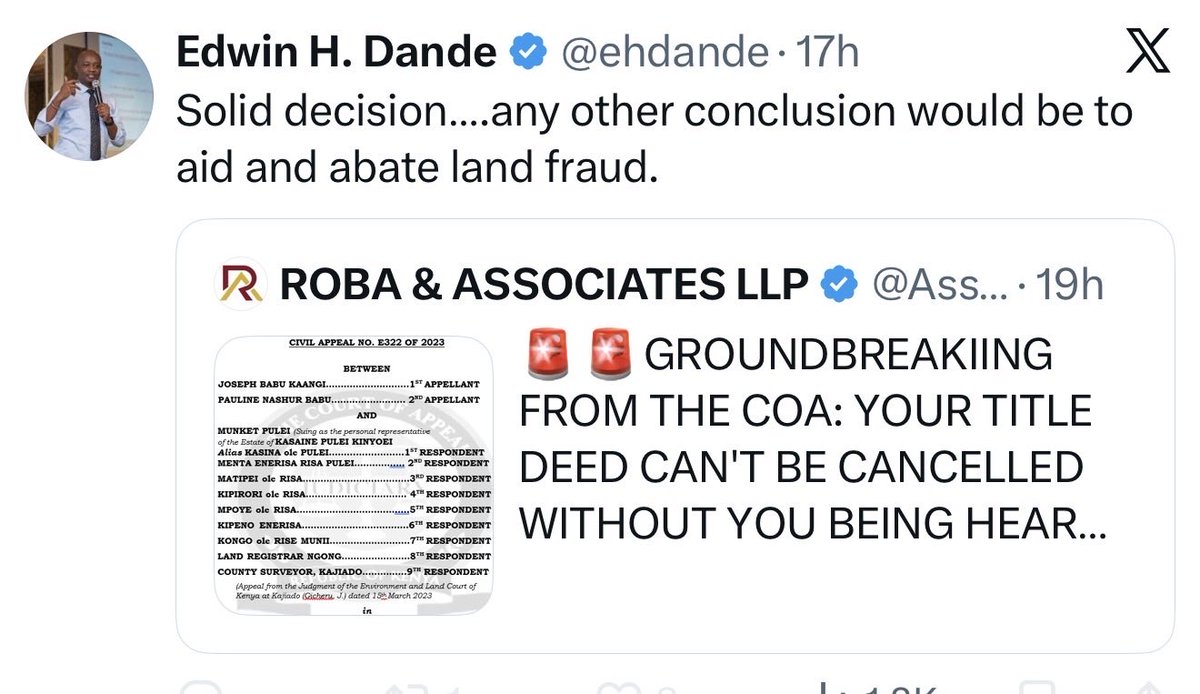
Mr. Dande, @ehdande the Court of Appeal decision in Joseph Babu Kaangi is an important reaffirmation of procedural fairness, but it does not say what you suggest it says, and it certainly does not rewrite insolvency law. @joshuamalidzo@Ndonglaw043@MwangoCapital@blackorwa@pwanyama@Kenyajudiciary
The Court held that identifiable registered proprietors whose titles were directly targeted were entitled to be joined and heard before adverse orders affecting those titles were made. That is an affirmation of the constitutional right to be heard. Few would disagree with that.
But the Cytonn insolvency is a fundamentally different legal landscape.
In the Cytonn matter, the High Court had already placed the entities into liquidation. The Official Receiver was appointed by the Court as the statutory liquidator and was ordered to take custody and control of the assets of the insolvent estate. Those were not self-help measures by the Official Receiver; they were judicial orders made in the exercise of the Insolvency Court’s jurisdiction.
The Court further directed the Cytonn entities to surrender the original titles to the Official Receiver within seven days from an order issued on 24th November 2024. Compliance was not optional. It was a court decree.
Instead of complying, there was open defiance. The public declaration that “titles are not mandazis to be handed over easily” was not a legal argument. It was, at best, an expression of resistance to a subsisting court order.
When a party refuses to comply with a lawful decree, the law does not reward that defiance by paralysing the administration of justice. Courts possess both statutory and inherent powers to ensure that their judgments are implemented. @BRS_Kenya The Official Receiver’s subsequent acquisition of replacement titles was therefore not the cancellation of innocent third-party rights in the abstract; it was the implementation of an existing judicial decree after the original holders refused to obey the Court.
That distinction is everything.
The comparison with Kaangi overlooks an even more obvious point.
There has been no completed sale.
The Official Receiver presently holds the titles.
No innocent purchaser has had a completed registered title extinguished.
No downstream proprietor has been dispossessed after acquiring an indefeasible title.
The assets remain within the custody of the liquidation estate pending realization under the supervision of the Insolvency Court for the benefit of all creditors.
That is not remotely the factual matrix that confronted the Court of Appeal in Kaangi.
Nor should we lose sight of the underlying equitable question.
These properties were acquired using creditors’ money. That is precisely why the liquidation exists. Insolvency law is designed to prevent a scramble for assets and to ensure collective realization under judicial supervision. Once a liquidation order is made, the Court’s concern is not merely who physically holds a title document, but whether the assets belong to the insolvent estate for the benefit of all creditors.
Procedural fairness remains indispensable.
But procedural fairness cannot be converted into a licence to defeat a liquidation order by withholding title documents in direct defiance of the Court.
The irony is that the Kaangi decision reinforces, rather than undermines, the rule of law. It insists that courts follow due process. It does not authorise litigants to disregard valid court orders until they become inconvenient to obey.
The real lesson from Kaangi is not that “no title can be touched.” The lesson is that courts must hear those whose legally protected proprietary interests are directly at stake before finally determining those interests.
That principle sits comfortably alongside insolvency law.
What it does not do is invalidate a court-supervised liquidation, undo a lawful vesting order, or render ineffective judicial directions requiring the surrender of estate assets.
Kenya must act decisively against fraudsters like @ehdande
It can no longer be business as usual as the judiciary is clogged with vexatious filings and applications that are designed to defraud thousands of citizens who were duped into believing this man knew something about investing. Especially where it comes to Trusts
@Kenyajudiciary@jsckenya@KJA_Kenya@DCI_Kenya@Senate_KE@NAssemblyKE@NPSOfficial_KE@CMAKenya@CBKKenya@LawSocietyofKe this institutions have let the citizens of Kenya numbering 4000 down by inaction. @CJMarthaKoome We even have a new LSK president @ckanjama who wants to spend time on revival crusades instead of tackling the issues ailing this republic . Where thieves mascarade as genuine aggrieved litigants . We cannot allow ourselves to apply lipstick on pigs and in the manner that @MThiankolu wrote to @ckanjama I will in the same manner address @ehdande
Dear Edwin Dande,
I have consistently reviewed your public statements and explanations regarding the collapse of the Cytonn investment structure. They have not addressed the core concerns raised by creditors. Instead, they underscore that this situation extends beyond a typical commercial failure. What creditors have observed over several years reflects not only financial distress, but also significant deficiencies in corporate governance, accountability, and oversight.
Permit me to illustrate this through two biblical narratives, each of which offers a lens through which the current Cytonn situation can be more clearly understood.
The first is found in Matthew 17:14–21.
Before this encounter, Christ had already given His disciples authority over unclean spirits. They had previously addressed similar challenges successfully. Their authority had been established and exercised.
Then they encountered a different kind of challenge.
While Christ was on the Mount of Transfiguration, His disciples remained in the valley and faced a situation that did not respond to their prior methods. They applied familiar approaches, yet the outcome did not change.
When Jesus returned, He did not question their authority. Instead, He indicated that the situation required a different level of response.
“This kind can come out only by prayer and fasting.”
Whether interpreted literally or metaphorically, the principle is clear. Certain problems cannot be resolved through standard approaches. Some crises are sufficiently complex that conventional responses are ineffective.
This principle directly parallels how many creditors now assess the Cytonn situation.
The issue is no longer limited to delayed repayments or liquidity constraints. It involves prolonged restructuring efforts, ongoing litigation, contested ownership arrangements, competing claims, repeated delays, and a growing number of unresolved issues, while many investors remain unpaid.
When a problem becomes systemic, standard assurances lose credibility.
Extended negotiations cannot substitute for resolution. Public statements cannot restore confidence in the absence of substantive progress. Continued requests for patience are difficult to justify when asset values continue to decline.
Some issues can be addressed incrementally.
Others require decisive intervention.
Kenya has previously acknowledged this distinction. When institutions reach a point where standard mechanisms are ineffective, more direct measures become necessary. Meaningful reform typically begins with a clear and accurate assessment of the situation.
In this context, assertions that the situation remains under control are increasingly inconsistent with the experience of creditors.
Dialogue remains important.
Measured responses remain appropriate.
However, prolonged restraint can result in inaction. Optimism without measurable accountability can undermine credibility. Continued appeals for patience risk being interpreted as deferral rather than resolution.
1)
@lynn_ngugi1 Even this 04.07 should not be pegged to midnight of 03.07, it should be the exact time you bought the bundles (in all honesty and fairness) Other honest networks do it that way.. in and around the world..
@ehdande@joshuamalidzo@Ndonglaw043@CytonnInvest @philomenamwiludcj @Kenyajudiciary@jsckenya@DCI_Kenya@KJA_Kenya
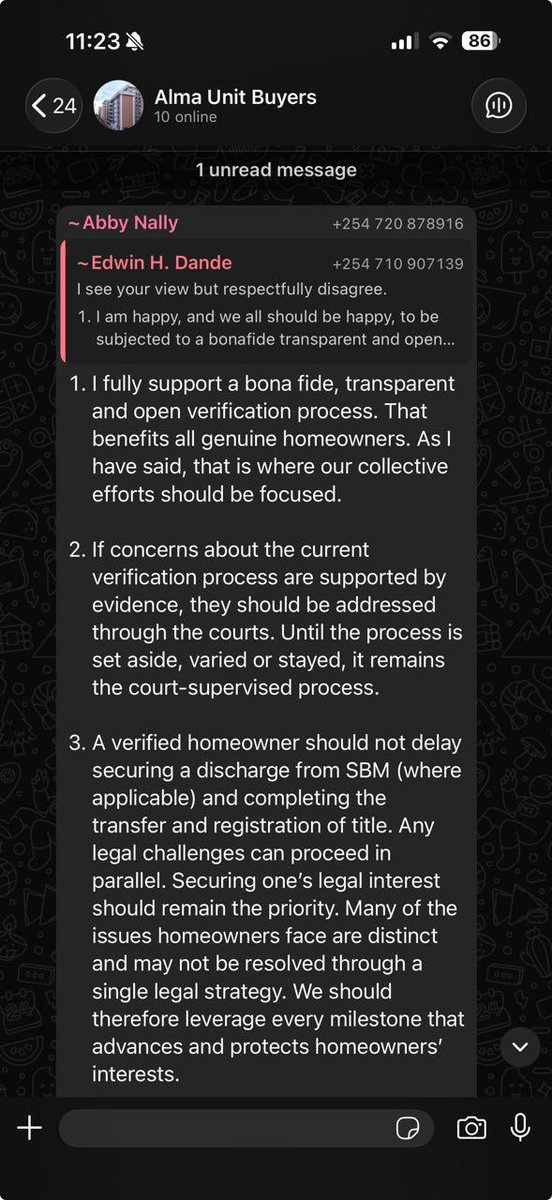
CREDITORS’ UPDATE: THE ALMA “HOMEOWNERS” NARRATIVE DESERVES CLOSER SCRUTINY
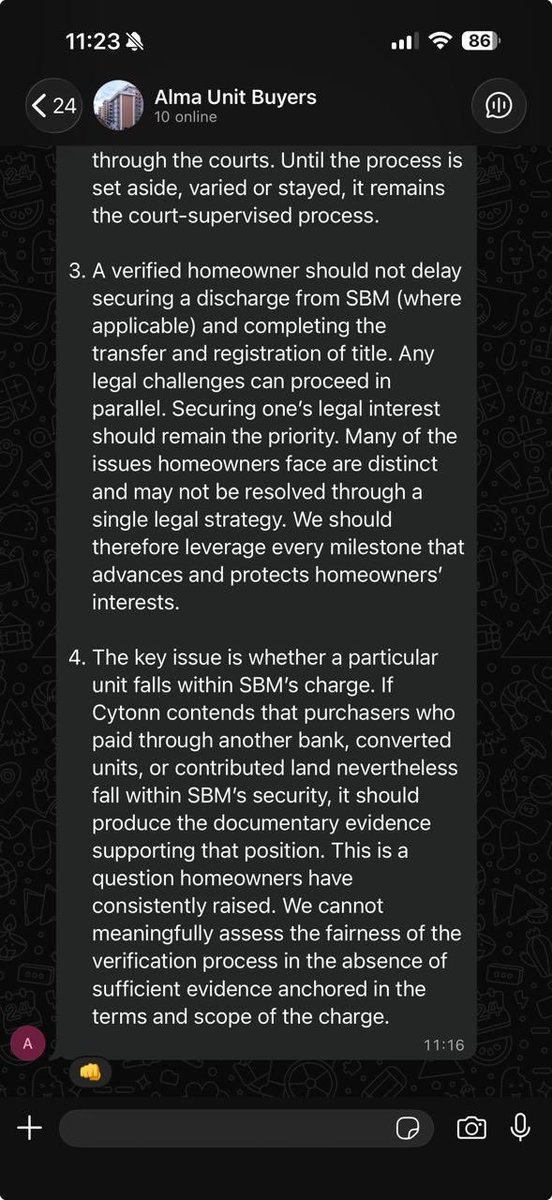
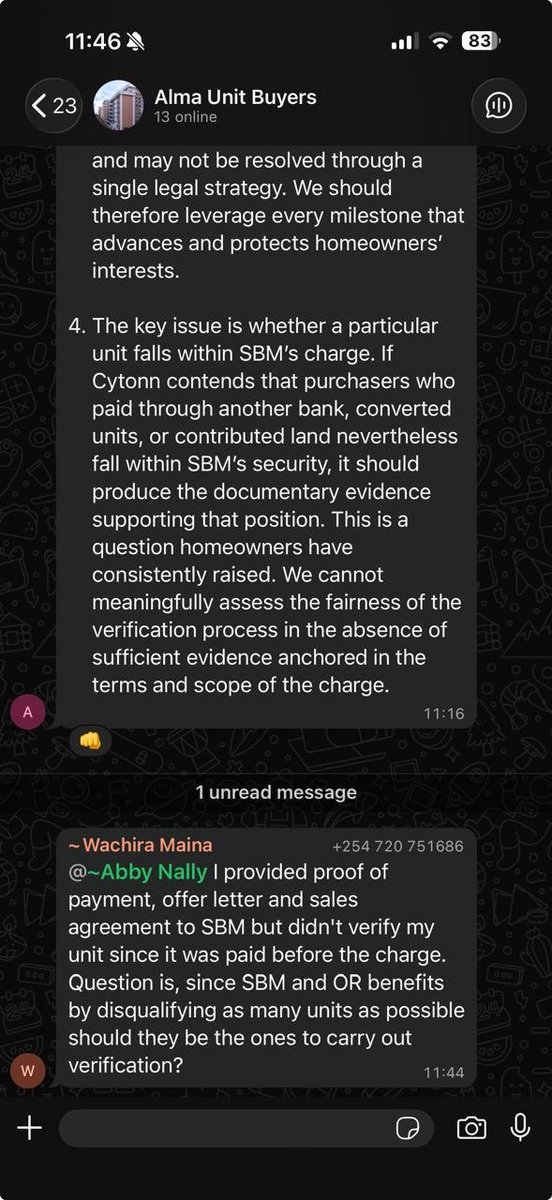
I have followed with interest the discussion between Peter Wachira and Abby regarding the Alma verification exercise. Ironically, Peter’s own explanations expose a fundamental legal difficulty in the position he advances.
Peter repeatedly argues that because he paid Cytonn before SBM’s charge, the verification process is inherently unfair. However, when questioned further, he states that he was a CHYS investor who instructed CHYS to make instalment payments towards the unit.
That distinction is critical.
A CHYS investment is not automatically equivalent to a perfected proprietary interest in a specific Alma apartment.
The law recognizes important differences between:
• an investment in CHYS;
• a contractual right against Cytonn;
• an equitable proprietary interest; and
• legal ownership of a specific unit.
These are distinct legal concepts with different consequences in insolvency.
The question is therefore not simply whether Cytonn received money. The real legal question is whether the purchaser had acquired a proprietary interest in an identifiable unit that is capable of taking priority over SBM’s registered security.
From Peter’s own explanation, he has not demonstrated that point.
Indeed, his own account appears to support the proposition that his relationship originated as an investment through CHYS.
If that is his legal position, then it raises a difficult question.
Is he asserting a proprietary claim to an Alma unit, or is he asserting an investor’s claim through CHYS?
Those are not necessarily the same thing.
One cannot simply assume that because funds were invested with CHYS, a perfected proprietary interest automatically arose that defeats a subsequently registered security. That conclusion requires legal and documentary proof.
This is precisely why verification exists.
Verification is intended to distinguish between:
• genuine proprietary claims;
• contractual purchaser claims;
• investor claims;
• creditor claims; and
• competing interests in the insolvency.
It is not designed to validate every person who paid money to Cytonn.
Another point deserves mention.
Peter presents himself as Chairman of Alma Homeowners. Leadership in such a position requires careful legal precision because the statements made inevitably influence many purchasers.
Yet the explanation offered appears to blur the distinction between an investment relationship and a proprietary interest in land. Those distinctions matter enormously in insolvency proceedings.
Ultimately, the law is driven by evidence, not labels.
If a claimant asserts that a unit falls outside SBM’s charge, the supporting documents should establish that proposition.
Conversely, if the evidence ultimately shows that the claimant’s interest remained an investment through CHYS and never crystallized into a perfected proprietary interest in a specific unit, then the legal consequences may be very different from those now being asserted.
As creditors, we should continue to insist on one principle above all else:
Every competing claim—whether by homeowners, investors, chargees or creditors—must be determined by the documentary evidence and the law, not by assumptions or public narratives.
That is the only way to ensure a transparent, lawful and equitable resolution of the Cytonn insolvency.
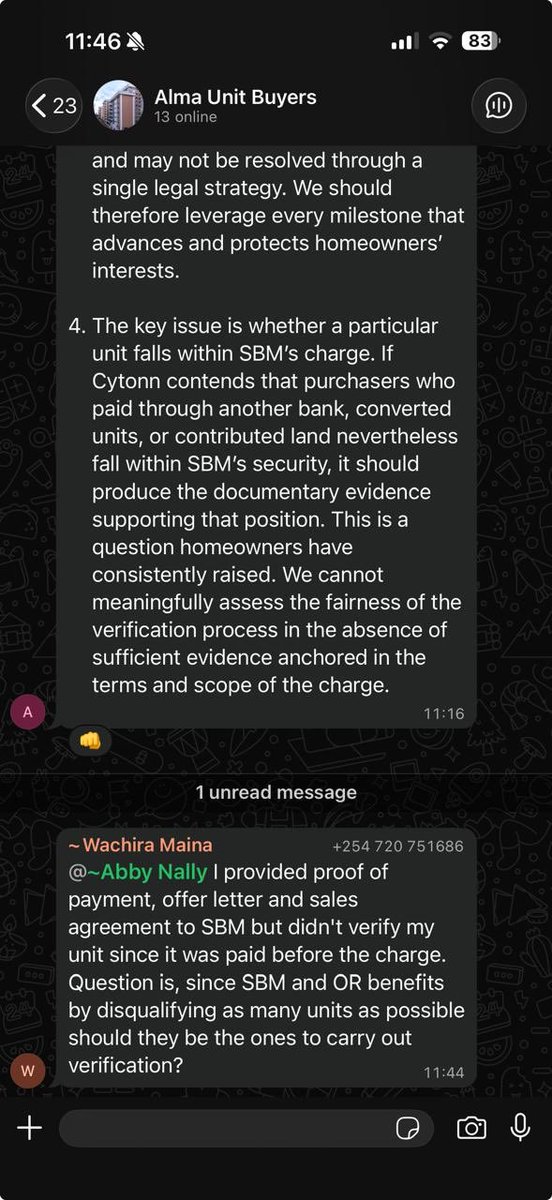
Screenshots posted for ease of following discussion
@ehdande@CytonnInvest The Alma screenshots reveal something far more disturbing than a KPLC bill.
Residents woke up to a water crisis after a KPLC disconnection over an unpaid account exceeding KES 200,000. Water pumps were affected. Homeowners and tenants were forced into emergency fundraising just to restore a basic service.
The immediate question from residents was simple:
Where did the service charge money go?
What followed was even more revealing.
Instead of accountability, excuses emerged.
Instead of explaining how unpaid utility bills accumulated under management’s watch, blame was shifted to the Judge, the liquidation process and the speed of the handover.
Yet the homeowners’ own responses expose the real issue.
One resident asked:
“If the bills were left unsettled, who’s keeping this money?”
Another asked:
“Aren’t bills paid monthly?”
Another lamented:
“I am so tired of this drama at Alma, when will it ever end?”
And perhaps the most telling observation came from Jacinta Nkukuu:
“The fish rots from the top.”
That statement captures the frustration many investors and homeowners have felt for years.
The issue is not a KPLC bill.
The issue is confidence.
Confidence that money collected for a specific purpose was actually applied to that purpose.
Confidence that service charges collected from homeowners reached service providers.
Confidence that those entrusted with management can account for every shilling collected.
What makes the screenshots particularly striking is that while homeowners were mobilizing their own money to restore essential services, the Official Receiver was simultaneously engaging SBM Bank, service providers and homeowners to stabilize operations and verify records.
The contrast could not be clearer.
One side is attempting to establish records, verify ownership, reconcile accounts and preserve assets.
The other side continues to offer explanations but not answers.
For years Cytonn investors have asked where billions went.
Today Alma homeowners are asking where service charge money went.
Different amounts.
Different stakeholders.
Same question.
Accountability begins where excuses end.
The indefatigable @CytonnInvest witness Adamski Dudi as usual giving hearsay witness testimony on Cytonn matters that happened while he was still in highschool. How does one become a competent witness on occurences that happened before their time. @ehdande
One of the recurring features of the Cytonn litigation has been the reliance on a corporate witness to explain events that occurred long before their involvement with the company. While corporate records may be produced through a company representative, the real question remains whether the witness possesses firsthand knowledge of the disputed transactions or is merely recounting a narrative assembled from documents prepared by others. Ultimately, the weight of such testimony depends on the witness’s personal knowledge, the authenticity of the records, and the rigor of cross-examination.”
@miamoreazure@ehdande@CytonnInvest This man ran a convoluted scam. It was well played but all games must come to an end at some point, somewhere, somehow.
@ehdande@CytonnInvest
CYTONN CREDITORS CPN/ CHYS DESERVE ANSWERS.
Court filings show that Edwin Dande, Manabo Holdings, Gertrude Maina and Viviane Dande were among the applicants who moved the court in relation to the Cytonn verification process.
Company records link Manabo Holdings to Edwin Dande, while allocation schedules show apartment allocations involving both Edwin Dande and Manabo Holdings, Getrude Maina and Vivianne Dande and other insiders.
The question creditors are asking is simple:
If 301 apartments existed and only ‘257’ are alledgedly accounted for, what became of the balance?
At an estimated KES 19 million per apartment, 44–47 apartments represent approximately KES 836 million to KES 893 million in value.
Who received these units?
On what basis were they allocated?
Were they disclosed to investors whose money funded these developments?
The insolvency process must answer these questions fully and transparently.
Creditors are not asking for favours. They are asking for accountability.
@BRS_Kenya@Kenyajudiciary
The more we dig into the Cytonn saga, the harder it becomes to ignore the appearance of insiders surrounding themselves with valuable assets while thousands of investors were left holding empty promises and being lured into empty restructuring models of MTN designed to fleece them off legally.
Documents show Edwin Dande, Manabo Holdings, Gertrude Maina and Viviane Dande including other insiders.
Allocation schedules show apartments connected to the same circle.
If the arithmetic is correct, between 44 and 47 apartments remain to be explained.
At KES 19 million each, that is roughly KES 836 million to KES 893 million worth of property.
Investors deserve a clear answer:
Were these apartments legitimately allocated, to whom, and for what consideration?
Until those questions are answered, the shadow hanging over the Cytonn collapse will not disappear.
Creditors have waited too long for transparency.