@PalssonThordur Hægi á AMOC eða hrynji hringrásin gæti það haft alvarleg áhrif á loftslag Evrópu, fiskveiðar og landbúnað. Sterkt hagkerfi í dag tryggir ekki lífvænleg skilyrði á morgun. Áhættustýring snýst um framtíð komandi kynslóða, ekki bara hagvöxt næstu áratuga.
@PalssonThordur AMOC er ekki náttúrulegt sveiflufyrirbæri óháð loftslagsbreytingum. Hlýnun og aukið ferskvatnsinnstreymi geta veikt hringrásina og aukið hættu á hruni. Að draga úr losun er því áhættustýring, ekki aðeins loftslagsstefna. Aðgerðaleysið gæti reynst dýrast.
@BjornLomborg The question isn't whether climate spending should be cost-effective. It's whether your calculations fully account for climate damages, tipping risks, and the costs imposed on future generations. Underestimating those costs makes delay look deceptively cheap.
@BjornLomborg Climate change does not need to be a meteor to be a systemic risk. It already affects food, health, infrastructure, insurance, ecosystems and economic stability.
The question is not whether climate action crowds out everything else — but how to reduce the risk.
@hausfath October 2026 was the warmest October on record globally, at 1.75°C above pre-industrial levels (ERA5).
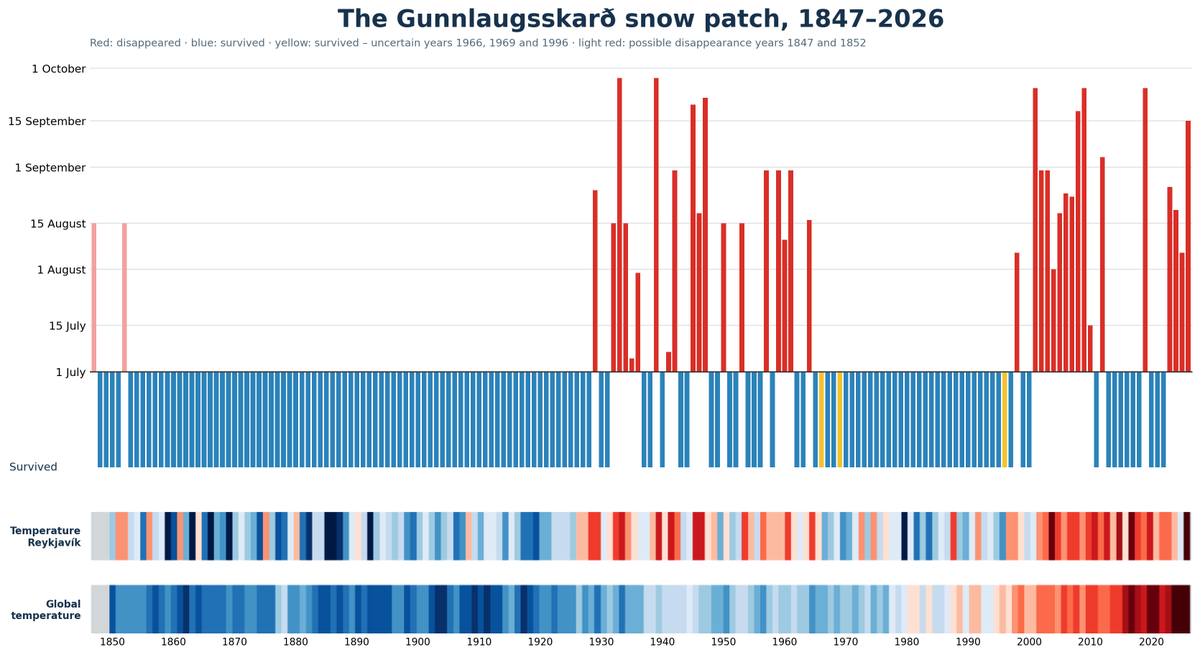
In Iceland, the Mt. Esja snowpatch has now disappeared for four consecutive summers (2023–2026), reflecting a long-term warming trend.
#ClimateChange#GlobalWarming
@ClimateBen In the book Biodiversity and Climate Change (2019) from Yale University. In box 25.1 with headline: Two Degrees Is Too Much. Final words are horrible: "beyond 1,5C the biology of the planet basically will become unmanageable." #AMOC#TooMuch
@minkonto Lomborg is no longer best described as a climate denier — he is a climate delayer: accepting the science while repeatedly arguing for slower, weaker action.
@BjornLomborg ntermittency is real — but “2× zero is zero” is rhetoric, not analysis.
Germany already gets around 60% of its electricity from renewables. The answer to variability is grids, storage, demand response and firm low-carbon power — not pretending wind and solar contribute nothing.
@BjornLomborg Stern did not predict a neat annual rise in one Munich Re series. He warned that extreme-weather losses could reach 0.5–1% of global GDP by mid-century.
Munich Re now says weather-disaster losses are rising in major economies. One selective chart does not make the risk disappear
@JelaniMK Brazil’s election could shape the future of the Amazon.
But there is a bigger question: if Finland struggles to protect nature from the pressure of global corporations, how can Amazon countries do it?
Strong laws, independent oversight and real consequences matter.
@nickofnz Brazil’s election could shape the future of the Amazon.
But there is a bigger question: if Finland struggles to protect nature from the pressure of global corporations, how can Amazon countries do it?
Strong laws, independent oversight and real consequences matter.
@oresundsbaron The Amazon is moving dangerously close to a critical tipping point, with climate change and deforestation compounding risks to ecosystem resilience, biodiversity and long-term climate stability.
#amazonfuture
@btdk Forsmark’s three reactors produced more electricity than Danish wind in 2025.
But wind still supplied about 60% of Denmark’s electricity production. Nuclear and wind are both low-carbon.
Turning the transition into “nuclear vs wind” is the wrong lesson.