Signs a winning ad is worth rewriting for your brand:
- Running 30+ days without being turned off
- Brand doing 100K+ monthly visits
- Hook makes you feel something immediately
- Story takes you through a clear problem → solution sequence
- Doesn't explain the product in the first 10 seconds
- Uses emotional logic not feature lists
- Feels like content instead of an ad
- Comes from a niche completely unrelated to yours
Find one that checks all 8.
Rewrite it, edit it and then launch it.
That's the whole game.
My exact process for finding winning ads in <6 hours:
1. Open TrendTrack
2. Filter: USA, English, active, 30+ days running, 100K+ monthly visits
3. Find a brand in a COMPLETELY different niche
4. Sort by ad rank (impressions + longevity + active)
5. Handwrite their best performing ad
6. Paste transcript into ChatGPT with your full product context
7. Prompt: "Rewrite this ad for my product"
8. Edit output for 20-30 minutes
9. Drop into existing CBO
10. Let Facebook decide
Don't copy competitors.
Steal from different industries entirely.
Run engagement campaigns on every Instagram post.
Not because engagement is the goal, but because it trains the machine who is interested.
Push every organic post to real impressions so people engage, follow, and click, and the system learns.
When the system learns, CPMs begin to drop, conversion rates improve, and AOV rises.
Because people are not just buying an item, they are buying into the brand, and the machine already knows who is interested and what they want.
You are feeding good user data and real market research into the system before you ever ask for the sale.
And when you do that, everything else works better.
🎥 20 YouTube Videos for AI in Finance
The best tutorials, demos, and step-by-step guides from the leading creators in the space.
Compiled by my friend Bojan Radojicic:
1. Bojan Radojicic - How to build Finance model 10x Faster with AI
https://t.co/CaZo9nnu3C
2. Nicolas Boucher - Top 10 AI Tools For Finance You MUST Know in 2025
https://t.co/uEWy6NIYtw
3. David Fortin, CPA- Microsoft Copilot Full Course For Beginners [2025]
https://t.co/i6o5OjJvtf
4. Bojan Radojicic - Best AI Tools For Finance: 10X Your Productivity
https://t.co/GdxIp1CefM
5. Josh Aharonoff, CPA - AI Accountants Are Here – Should You Be Worried? (QuickBooks AI Agents)
https://t.co/XPHA9odgP6
6. Bojan Radojicic - How Finance Teams Save 50% Time with Genspark AI (5 Killer Hacks)
https://t.co/nGnWACzTE2
7. Nicolas Boucher - How I Perform a Financial Analysis With AI in 5 Minutes
https://t.co/Uy9SCMagfz
8. Leila Gharani - Bring ChatGPT INSIDE Excel to Solve ANY Problem Lightning FAST
https://t.co/vArwLkwPL1
9. Bojan Radojicic - The FUTURE of FP&A: 7 AI Hacks Your Team MUST Adopt in 2025
https://t.co/MOGeoxemrI
10. Mynda Treacy - NEW Excel COPILOT Function Will Replace Half of What You Do
https://t.co/nC1NbusbAO
11. Bojan Radojicic - 9 AI Prompts That Will TRANSFORM the Way You Work in Finance Forever
https://t.co/jINllxjZ1e
12. Josh Aharonoff, CPA - I Built 4 BEAUTIFUL Dashboards with Excel’s Copilot
https://t.co/oMOpjdW35Y
13. Nicolas Boucher - How to Use ChatGPT 5 to Build INSANE Financial Models
https://t.co/LDJy81tOIL
14. Bojan Radojicic - 10 ChatGPT Practical Tips for Financial Analysts in 2025
https://t.co/MzzKQj0T2s
15. David Fortin, CPA - How to Install Copilot in Excel in 2025
https://t.co/nyd8y0D6uD
16. Nicolas Boucher - How to Train Your Finance Team on AI in 30 Days (Full Guide)
https://t.co/j9hsYZMWSP
17. David Fortin, CPA - How to Build Your First Microsoft Copilot 365 Agent (Step-by-Step Tutorial)
https://t.co/QiHyOreSRp
18. Leila Gharani - Don’t Use ChatGPT Until You Watch This Video
https://t.co/VbdYJrOmK8
19. Christian Wattig - How AI is Changing FP&A (& How to Survive)
https://t.co/Mpa6CsXuqw
20. Mynda Treacy - The Best AI Finance Tool Experts Will Ever Need (Free File)
https://t.co/LJlyzJ935k
♻️ Share this to help your network understand AI.
—
📌 Want my top 100 infographics for free?
1. Follow me.
2. Subscribe to my free newsletter at https://t.co/jTnaNRbsRL.
You’ll receive all of them, in your welcome email.
I’ve written thousands of ad scripts and there’s one format I always come back to.
It’s the same movie plot you’ve seen a billion times. So simple to produce and profit from.
Jangan bagitahu 3 perkara ni masa dalam interview.
Job seekers wajib baca especially point last tu:
1. Jangan cerita mengenai toxic bekas majikan/boss sebab boleh nampak yang korang ni sebenarnya yang toxic.
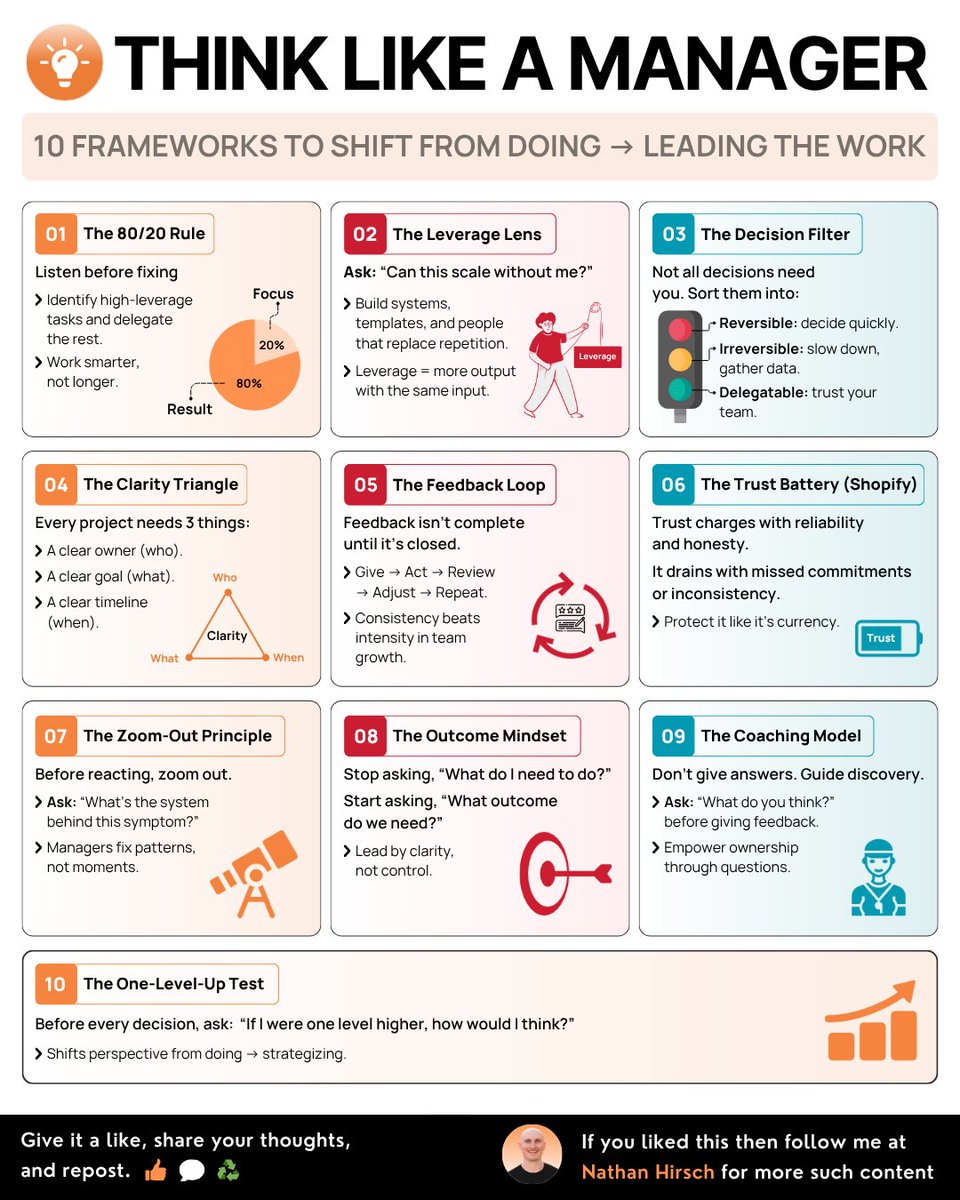
Most new managers fail for one reason
they keep thinking like employees
They focus on doing, not enabling
On tasks, not systems
On effort, not outcomes
The best managers don’t work harder
They think differently
Here are 10 frameworks that’ll help to think like a manager:
Good strategy consultants excel in one role.
Great ones know how to switch between multiple roles:
Sharing great visual from Jeroen Kraaijenbrink:
Strong strategy work is not just about sharp ideas or well-run workshops.
It is about moving smoothly between four very different roles, based on what the situation demands:
1. Sometimes, you need to tell.
As a strategist, you step forward to make sense of complexity.
You see patterns others miss and help shape direction.
Not because you have all the answers, but because you can synthesize what emerges and turn it into strategy.
2. Sometimes, you need to teach.
As an educator, you slow the pace.
You help people understand what is happening and why.
Strategy only sticks when learning happens along the way, not when conclusions are simply handed over.
3. Sometimes, you need to ask.
As a facilitator, you design the process and ask the right questions at the right time.
You help groups think better together.
You guide without dominating and add structure without limiting thinking.
4. And sometimes, you need to be present.
As a coach, you acknowledge that strategy always brings change.
You listen, relate, and support people as they work through uncertainty, resistance, and growth.
Most consultants default to one or two roles.
True strategic mastery comes from developing all four.
And knowing exactly which role to step into.
When. And why.
P.S. Which role do you find yourself using most often?
♻️ Repost to help others master strategy!
Some advanced VLC tricks most people never use:
1. Play & Download YouTube Videos Inside VLC
VLC media player can stream YouTube videos directly.
How:
1Media → Open Network Stream
2Paste the YouTube link
3Click Play
You can even extract the direct media link and download it.
2. Increase Volume to 200%
VLC lets you boost audio up to 200% ; very useful for quiet recordings or forensic audio reviews.
3. Fix Broken or Corrupted Videos
VLC can attempt to repair damaged AVI files automatically when you open them.
Go to: Tools → Preferences → Input/Codecs → Set “Damaged or incomplete AVI file” to Always Fix
4. Record Your Screen (Without Extra Software)
1Media → Open Capture Device
2Select Desktop
3Choose frame rate
4Click Play → Record
Perfect for quick demos or capturing evidence during analysis.
5. Convert Audio/Video Formats
Media → Convert/Save You can convert:
•MP4 → MP3
•MKV → MP4
•WAV → FLAC
Great for preparing files for different devices.
6. Stream From CCTV / IP Cameras
You can open RTSP streams like:
rtsp://username:password@IP:port/stream
Very useful in network monitoring and digital forensics work.
7. Frame-by-Frame Analysis
Press E on your keyboard to move video one frame at a time.
Perfect for:
•Investigations
•Timestamp verification
•Motion analysis
8. Add Watermarks & Logos
Tools → Effects & Filters → Video Effects → Overlay You can add a logo or watermark during playback or recording.
9. Adjust Video Effects Like a Pro
You can tweak:
•Brightness
•Contrast
•Gamma
•Saturation
•Crop
•Rotate
Good for enhancing low-light footage.
10. Play ASCII Mode (Yes, Really 😂)
VLC can convert your video into ASCII art in real time. (It’s under Video Effects → Advanced → Color ASCII Art)
I watched someone open 47 tabs just to prep one NotebookLM project.
That’s when I realized most people are doing this completely wrong.
7 extensions now do the boring work for you → clips, summaries, transcripts, playlists, chats.
All auto-organized inside NotebookLM.
No copy pasting.
No tab chaos.
Save this video, you’ll never research manually again.
Want the SOP? DM me. 💬
We’re moving into a persona-driven era of paid growth, and I don’t think enough teams have internalised what that actually means.
As Meta’s delivery has improved, the constraint inside ad accounts has shifted. The question is no longer, “How do we find the right audience?” but “How many distinct, meaningful personas can we give the algorithm to work with?”
We built a Creative OS around: Persona → Sub-persona → Micro messaging
At the time, it felt like a strong creative framework. Now it feels like the operating system for scale.
As delivery has become more probabilistic and creative-led, we’ve been able to unlock more personas per brand, but only when the research and messaging are strong enough.
What started as macro personas (e.g. “menopause”) is fragmenting into increasingly nuanced segments, moving toward a “soulmate theory” end state where each user sees the version that feels built for them.
You can see this in the strongest accounts. The best brands are mapping the full chain: Persona → Creative angle → Landing page → Offer framing
They’re not just launching ads. They’re asking:
“Are we systematically covering the opportunity landscape?”
Which raises a bigger question. Should we start reporting by persona? Spend per persona. CAC per persona. New customer volume per persona. Contribution margin per persona.
If persona is the real growth lever, it arguably needs to become a reporting dimension, not just a creative one.
Most accounts still report by campaign type or funnel stage. But if creative is the new targeting mechanism and persona is the core creative variable, then persona becomes a performance variable.
And that changes prioritisation.
Not every persona is equal. They differ in TAM, competitive density, ease of conviction, LTV potential and creative scalability. Some are “easy money.” Others are strategically important but structurally harder.
The real skill becomes answering: “Which personas deserve scale capital?”
There’s also an account structure implication.
We’ve seen persona-mapped campaign structures work at scale. The question is whether fragmentation intensifies as budgets increase.
Does one macro persona split into three, then seven, then fifteen micro cohorts?
If so, creative strategy, campaign structure, reporting and landing page architecture all need to reflect that.
The upside is that this makes scaling more deliberate. Instead of random angle testing, you’re building structured coverage across defined intent clusters.
But it requires growth teams to move beyond concept testing and think in terms of:
- Persona coverage audits
- Persona saturation
- Persona-level incrementality
- Persona lifecycle value
Which likely means persona should show up in reporting, not just in the brief.
Curious how others are thinking about this. Are you structuring accounts or reporting around persona yet?
Creative testing is NOT about how you structure your tests in Ads Manager.
It's more about how you approach your overall strategy.
I've been auditing accounts a lot lately and here are the mistakes I keep seeing:
1. They never graduated from 'rapid format testing'
They're just trying to test as many formats as possible in the name of creative diversity. This works for a while, but eventually brands hit a wall... which is when they reach out to me.
2. They're using outdated personas instead of trigger-based audience segments
Like, they'll say their persona is 'Gen Z girls with disposable income,' but they should be thinking 'Gen Z women who are highly ambitious but struggle with imposter syndrome while climbing the corporate ladder.' The way you market skincare to those two people is completely different.
3. They're testing more brand calendar assets vs. evergreen content
Your Mother’s Day creative won't work in October. But your "founder's story" hook is always cash.
4. They have limiting beliefs without data to back them up
"UGC doesn't work for our brand" without knowing WHY. Your bias keeps you from trying big swings or formats altogether.
5. They test dumb things like partnership ads vs. brand handle
Just do the partnership ad. Meta uses data from the creator's page to find new audiences. It's why you're working with the creator in the first place.
6. They only work with one type of creator
If all your creators look the same, sound the same, and have the same follower count... you're missing something here. Goes double if your creators don’t actually match your audience.
7. They have no roadmap… just reacting week to week
I plan quarterly, roadmap monthly, and then execute on a weekly production schedule. This allows for big swings and dispersing testing throughout the year without feeling like I need to get all insights now.
BONUS:
They blindly copy competitors or other big brands with fake "good criteria" like only using ads that have been running 100+ days, have the highest impression rate, etc.
Long-running doesn't mean high-converting. It might just be buried in an ASC+ campaign no one's touched in months.
The difference between a good and a bad creative strategist.
I've hired and fired a lot of creative strategists over the years.
The biggest difference is that the best ones obsess over every single detail, and the bad ones think their job ends after they write a script.
Bad creative strategists:
They do some surface-level reddit research → deliver a Google Doc with a script and maybe a atria link with reference video → send it to the editor with minimal context → launch the video when the editor is done → blame bad performance on "the edit wasn't good enough."
They treat their job as purely ideation & scriptwriting.
Once the script is written, they're done.
They don't watch the final edit closely, and when an ad doesn't perform, they point fingers at the editor or the media buyer.
Good creative strategists:
They obsess over every detail of the final product. Watch hours of content that the customer would also consume to understand what’s going in the their customers brain from the inside out.
The hook - not just what's said, but HOW it's said, the framing, the cuts in the first 3 seconds, the exact moment the text appears.
The text placement - does it appear too early? Too late? Is it readable? Does it complement or distract from what's being said?
The number of cuts - is the pacing too slow? Too fast? Are we losing people because the pacing is off.
The b-roll - does it reinforce the message or just fill space?
They provide detailed, specific feedback to editors.
Not just "make it better" but "cut this section down by 2 seconds, show text in hook 2 sec later, add this exact testimonial here."
They own the end product.
If an ad doesn't perform, they don't blame the editor or the media
buyer.
They look at what went wrong, learn from it and apply the learnings the next batch
If you're hiring a creative strategist
Look for someone who obsesses over the final product.
Someone who watches the ad 20 times before they launch and someone who takes ownership of performance, not just the script.




![Igor_Buinevici's tweet photo. 🎥 20 YouTube Videos for AI in Finance
The best tutorials, demos, and step-by-step guides from the leading creators in the space.
Compiled by my friend Bojan Radojicic:
1. Bojan Radojicic - How to build Finance model 10x Faster with AI
https://t.co/CaZo9nnu3C
2. Nicolas Boucher - Top 10 AI Tools For Finance You MUST Know in 2025
https://t.co/uEWy6NIYtw
3. David Fortin, CPA- Microsoft Copilot Full Course For Beginners [2025]
https://t.co/i6o5OjJvtf
4. Bojan Radojicic - Best AI Tools For Finance: 10X Your Productivity
https://t.co/GdxIp1CefM
5. Josh Aharonoff, CPA - AI Accountants Are Here – Should You Be Worried? (QuickBooks AI Agents)
https://t.co/XPHA9odgP6
6. Bojan Radojicic - How Finance Teams Save 50% Time with Genspark AI (5 Killer Hacks)
https://t.co/nGnWACzTE2
7. Nicolas Boucher - How I Perform a Financial Analysis With AI in 5 Minutes
https://t.co/Uy9SCMagfz
8. Leila Gharani - Bring ChatGPT INSIDE Excel to Solve ANY Problem Lightning FAST
https://t.co/vArwLkwPL1
9. Bojan Radojicic - The FUTURE of FP&A: 7 AI Hacks Your Team MUST Adopt in 2025
https://t.co/MOGeoxemrI
10. Mynda Treacy - NEW Excel COPILOT Function Will Replace Half of What You Do
https://t.co/nC1NbusbAO
11. Bojan Radojicic - 9 AI Prompts That Will TRANSFORM the Way You Work in Finance Forever
https://t.co/jINllxjZ1e
12. Josh Aharonoff, CPA - I Built 4 BEAUTIFUL Dashboards with Excel’s Copilot
https://t.co/oMOpjdW35Y
13. Nicolas Boucher - How to Use ChatGPT 5 to Build INSANE Financial Models
https://t.co/LDJy81tOIL
14. Bojan Radojicic - 10 ChatGPT Practical Tips for Financial Analysts in 2025
https://t.co/MzzKQj0T2s
15. David Fortin, CPA - How to Install Copilot in Excel in 2025
https://t.co/nyd8y0D6uD
16. Nicolas Boucher - How to Train Your Finance Team on AI in 30 Days (Full Guide)
https://t.co/j9hsYZMWSP
17. David Fortin, CPA - How to Build Your First Microsoft Copilot 365 Agent (Step-by-Step Tutorial)
https://t.co/QiHyOreSRp
18. Leila Gharani - Don’t Use ChatGPT Until You Watch This Video
https://t.co/VbdYJrOmK8
19. Christian Wattig - How AI is Changing FP&A (& How to Survive)
https://t.co/Mpa6CsXuqw
20. Mynda Treacy - The Best AI Finance Tool Experts Will Ever Need (Free File)
https://t.co/LJlyzJ935k
♻️ Share this to help your network understand AI.
—
📌 Want my top 100 infographics for free?
1. Follow me.
2. Subscribe to my free newsletter at https://t.co/jTnaNRbsRL.
You’ll receive all of them, in your welcome email.](https://pbs.twimg.com/media/HBc9hAqbwAAUZto.jpg)