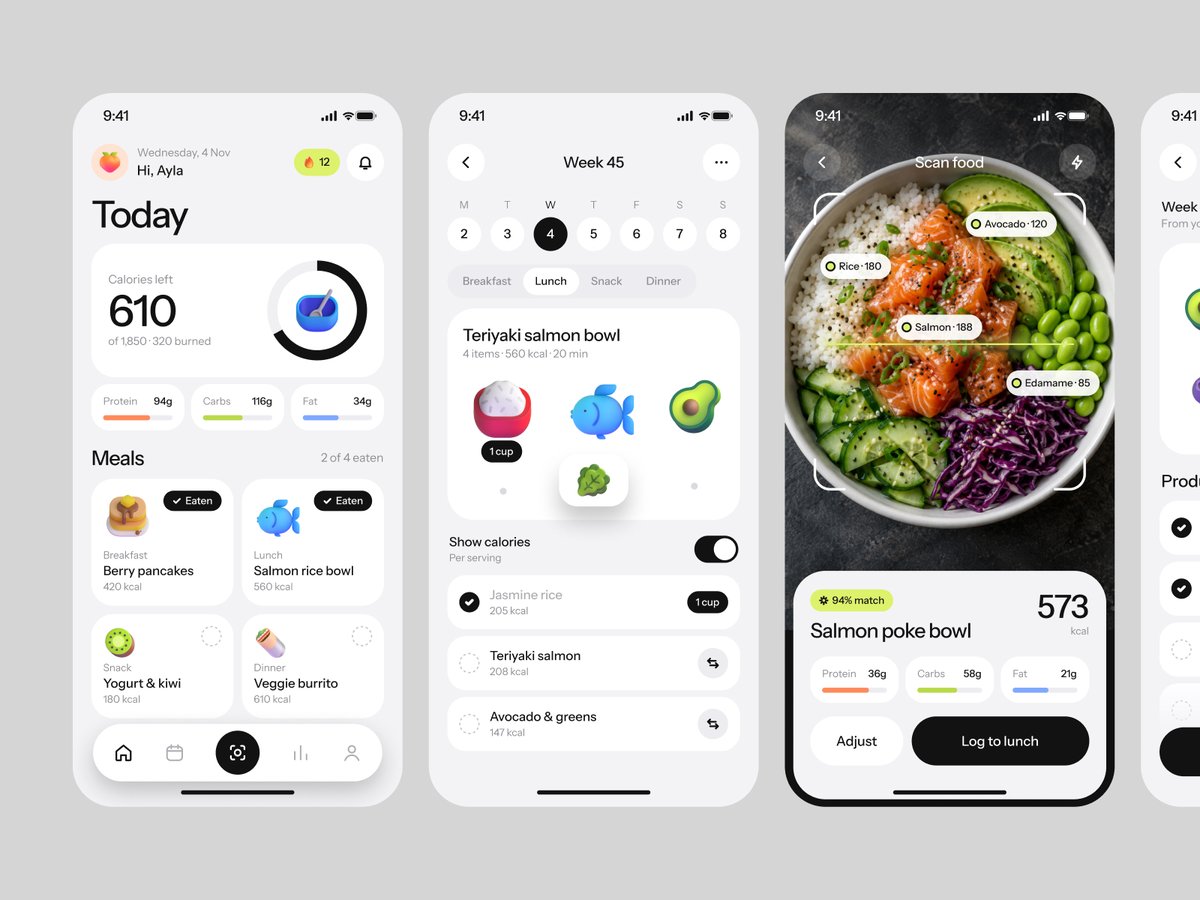
Logging a meal should take seconds, not minutes
In Nutry you can scan your plate, scan a barcode, use voice or quick add. The AI spots each ingredient, you adjust the portions, and it’s logged, streak included. Water tracking comes built in.
Designed to make tracking feel light instead of like homework.
Open for new projects: mobile apps, SaaS and product design. DM me or drop a line.
Menova: A menu engineering product for independent restaurants, built on the sales already sitting in their POS.
https://t.co/BLXcMFwfex
DM me or email: [email protected]
Plan it. Cook it. Track it. 🥗
This part of Nutry covers the rest of your food life:
• Smart meal swaps • Step-by-step cooking mode with timers • One-tap grocery checkout • AI picks when you eat out • Weight logs, milestones and badges
📩 Open for new projects: mobile apps, SaaS and product design. DM me or drop a line.
Onboarding that actually feels personal 🥑
For Nutry, an AI nutrition app, I designed a 5-step setup: body stats, a target pace, budget, cooking time and kitchen tools. Nutry then builds a meal plan around all of it, live, while you watch.
No long forms. Just a plan that fits your life, your wallet and your evenings.
Open for new projects: mobile apps, SaaS and product design. DM me or drop a line.
A request from the Yardbook Profile lands on the board the moment a homeowner sends it, with the services, address and estimated yearly value already filled in. Moving a lead to Won updates the quote total and win rate on the spot.
Open a lead and the request, a satellite-measured lot and the conversation sit in one place, so sending the estimate link takes one click and moves the lead to Quote sent.
This is an unsolicited concept redesign of Yardbook. I'm not affiliated with the company.
Open for new projects: https://t.co/3gXqIVIX8I
Lawn care quotes usually start with a drive-by and a measuring wheel. Here the owner outlines the front and back lawn on satellite imagery, gets 8,420 sq ft of turf in a few clicks, and the line items price themselves from that number.
The homeowner opens a link, sees their own lawn measured on the map, types their name to sign and pays the 25% deposit. The job is approved without a site visit.
Open for new projects: https://t.co/3gXqIVIpja
Concept redesign of Yardbook's onboarding for lawn care businesses. Four steps from sign up to a ready account, with CSV import so nobody retypes their customer list.
I'm taking on new SaaS design projects. DMs open.
Nutry: an AI nutrition app that skips the maths 🥑
Personal meal plans, an AI food scanner, smart groceries, and a diet assistant, all in one calm app.
📩 Open for new projects. Let’s build something together.
Rethinking the future of banking.💳
A simple and secure way to conduct your financial transactions online.
Built for a smart and seamless experience.
Tell us what you think. 👀
Sell the sun you don't use ☀️
Sunlot is a concept landing page for a peer-to-peer rooftop solar marketplace in Dhaka.
Full shot 👇
https://t.co/ou6C6oz8i8
Eat well, skip the math. 🥗
Meet Nutry, an AI nutrition app concept I designed. It builds your meal plan, scans your plate, sorts your groceries and answers your food questions.
Open for projects: app design, SaaS, branding.
DM me
Tideline: a concept SaaS landing page for an AI shared inbox ✦
Every section is a live demo: a scroll-driven phone, a pricing builder that prints a receipt, an FAQ that answers like a chat.
Full shot on Dribbble 👇
https://t.co/H0ncZrw3wB
#UIDesign#SaaS
An AI agent measures every shipped change against a holdout group of shoppers who never saw it. The profit is verified, not estimated.
It writes the monthly report, shares it with one link, and gives clients a read-only view with the proof built in.
How do you prove the ROI of your conversion work today?
I'm helping startup founders turn ideas into real products. DM me.
Most store changes ship on a hunch. Nobody checks whether they actually made money.
An AI agent turns every approved fix into a test with a holdout. Traffic split, guardrails and stop rule are set up for you.
When the result is significant, it shows the profit measured against the holdout, runs pre-flight checks, and ships the winner to 100% in one click.
Do you test your store changes, or ship them and hope?
Your funnel shows you where shoppers leave. It never shows you why.
An AI agent spots a 31% drop at the mobile shipping step and pulls up the session replays behind it. A shopper sees a $12 shipping fee for the first time, rage-taps “Return to cart” three times, and leaves.
It finds the same pattern in 214 sessions, puts a dollar value on the leak, and drafts the fix.
How long would it take your team to trace a funnel drop back to the moment shoppers give up?
An AI agent puts your store on one page. Revenue, conversion rate, revenue at risk, and the new leaks it found while you slept.
Then you just ask. “Why did mobile conversion drop?” comes back with the exact step, the likely cause, and the evidence behind it: funnel data, session replays and survey answers.
Would you trust an AI’s answer about your store, or would you still dig through the numbers yourself?
Thousands of shoppers visit your Shopify store. Most leave without buying. Your next best sale might be hiding in the data.
The AI agent spots funnel drop-offs, finds unanswered questions in customer reviews, and recommends product page fixes backed by evidence.
One click sends the change for approval. The next experiment measures whether more shoppers actually buy.
Would you let AI optimize your store automatically, or approve every change yourself?
Most analytics tools take weeks of setup before they tell you anything useful.
Sign in with Shopify, connect your data sources, and turn on the tracking pixel with one toggle. Every source you add fills the coverage meter and makes the diagnosis sharper.
Choose what to optimize for, set the agent’s limits, and start the first scan. Leaks show up, sized in dollars, before the scan even finishes.
How long did your last analytics tool take before it found something worth fixing?
Your store is losing sales. Your analytics dashboard can’t tell you why.
An AI agent spots a checkout drop-off, finds unanswered questions in customer reviews, and recommends a fix backed by evidence.
One click sends the change for approval. The next experiment measures whether more shoppers actually buy.
Would you let AI optimize your store automatically, or approve every change yourself?