“We are what we repeatedly do. Excellence then, is not an act, but a habit.” - Aristotle #helpYOUgetGAINS#w2muscle#INTJ There is trained and untrained.
If you can hold a wall sit for 2 minutes, you’re already ahead of most people your age.
Most people can’t.
Their legs shake in under 60 seconds.
Here are the 7 reasons this simple hold is one of the highest-ROI things you can do for your legs, metabolism, and long-term health:
1) Lowers blood pressure better than most cardio
🏋️Resistance training may benefit brain health and cognition 🧠
📚A 2026 narrative review highlights its potential, but added benefits from asymmetric loading remain hypothetical.
➡️Superiority over aerobic exercise is unproven.
https://t.co/IbxMPfwt1s
Survival Tabs – Emergency Food Supply – Original Tabs, Bulk, Disaster Ready
Packed with 15 essential vitamins and minerals for daily energy support - great for backpacks, vehicles, or home storage kits
https://t.co/6pNy94A8di
I've been working on something huge at Dividend Wealth.
And no its not a hype course or yet another another newsletter.
I studied hundreds of papers, thousands of stock factors and decades of market data to bring you this.
I am excited to share this with you all🧵
Years ago, as an aspiring exercise science student, I bought into the idea that consuming protein immediately after lifting weights was essential for maximizing muscle growth. However, as I delved more into the research, I became less convinced of its importance.
To gain greater clarity on the topic, I led a study to determine if pre- vs post-protein intake influenced results (PMID: 28070459). We randomized 21 resistance-trained men to consume 25 g of whey protein either immediately before or immediately after training. Participants followed a supervised resistance training program, 3 days/wk. Those consuming protein before training refrained from eating for at least 3 hours afterward.
After 10 weeks, results indicated no statistically significant differences between groups in muscle hypertrophy, strength gains, or body composition. The results are consistent with acute research showing similar anabolic responses to pre- vs post-exercise protein consumption (PMID: 16896166).
The takeaway: Our findings challenge the notion that protein must be consumed immediately after exercise to maximize muscular adaptations. Instead, they support a broader, more flexible peri-workout window in which protein consumed either before or after training can effectively support muscle growth.
It should be noted that the study had a relatively small sample, so the findings should be interpreted with appropriate caution. That said, results align with the broader literature on the topic.
Bottom line: Getting sufficient daily protein is a priority and is by far the most important nutritional consideration for muscle-building. Consuming protein around your workout can be beneficial, but there's no compelling reason to believe you need to slam a protein shake immediately after finishing your last set.
https://t.co/gwj0cCj6gH
Can good #sleep help protect the brain 🧠 in people living with chronic disease?
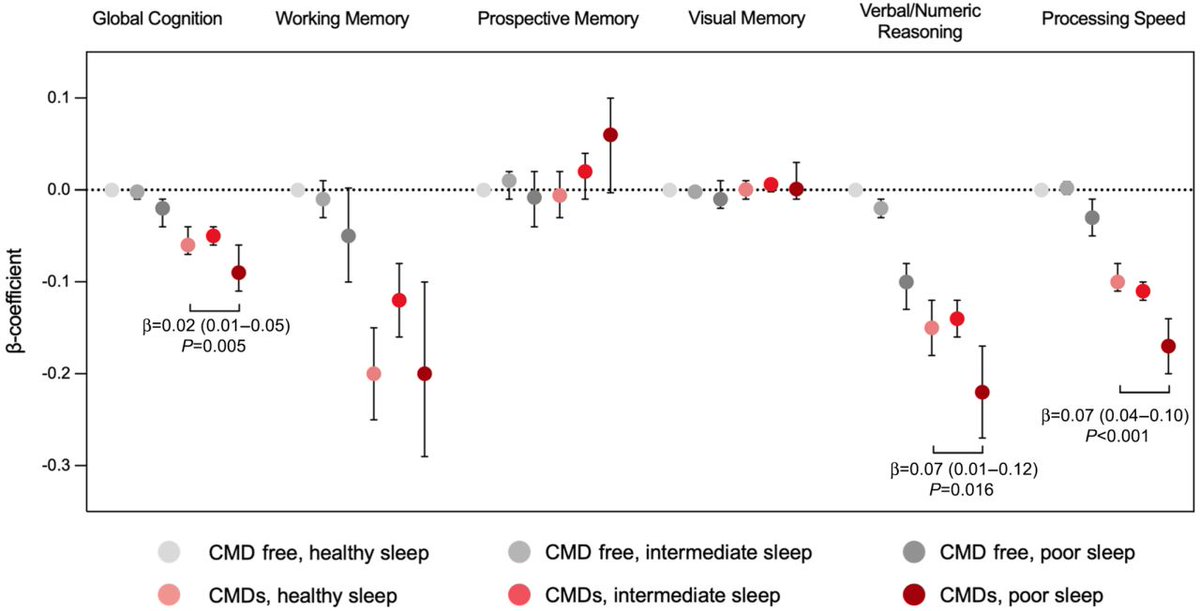
A new study on more than 400,000 middle-aged and older adults. Just over 54,000 of them had at least one cardiometabolic disease: type 2 #diabetes, heart disease or stroke. Sleep was scored on five self-reported factors: duration, circadian rhythm, insomnia, snoring and daytime sleepiness.
People with these conditions who slept well did slightly better on tests of general cognition, problem-solving and processing speed than those with the same conditions who slept poorly.
They also had significantly larger total #brain volume and more grey and white matter. The link between sleep and brain structure was stronger in people with cardiometabolic disease than in those without.
Improving sleep is an accessible and affordable goal that could be part of healthy ageing and #NCDs care.
https://t.co/xuK7Gi2rzT