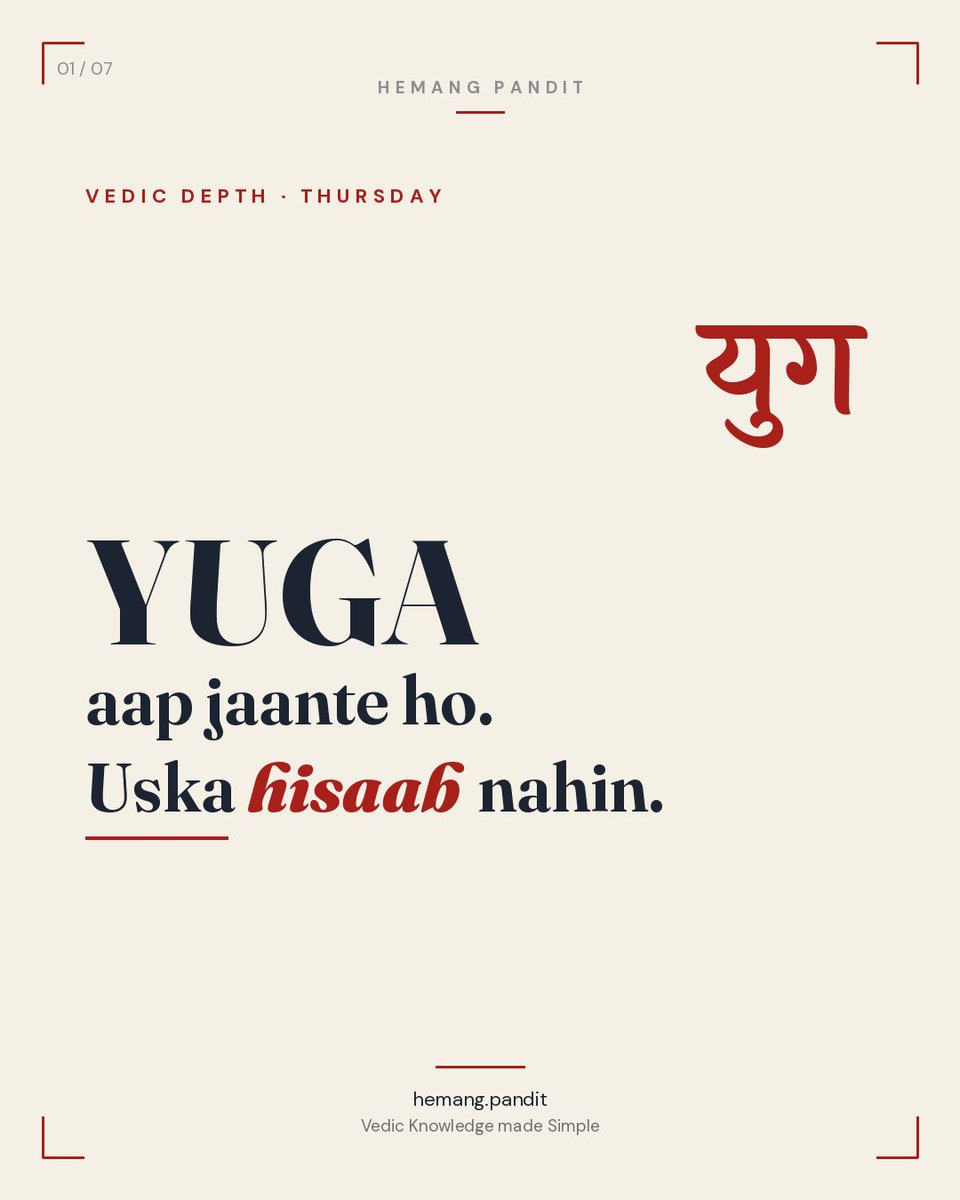
Everyone knows the names — Satya, Treta, Dvapara, Kali. Almost no one knows the math underneath.
The four yugas: 1,728,000 + 1,296,000 + 864,000 + 432,000 = one mahayuga of exactly 4,320,000 years.
1,000 mahayugas = one day of Brahma = 4.32 billion years.
Modern science dates the Solar System at ~4.5 billion years. Same order of magnitude.
The names are the surface. The math is the genius.
The chakras and the Sanskrit alphabet are the same map.
The six chakras are lotuses with 4, 6, 10, 12, 16, and 2 petals. Add them: exactly 50.
Sanskrit has exactly 50 letters. Each petal carries one — one sound, one seed vibration.
So a mantra isn't a prayer. It's an activation sequence — specific sounds for specific petals.
A 50-sound system and a 50-petal anatomy, built to mirror each other.
You know you're in your Saturn or Rahu Mahadasha. But do you know its math?
The Vimshottari system goes far deeper than the planet's name. A thread
The cycle is 120 years across 9 planets. But each period contains 9 sub-periods. And each of those contains 9 more.
9 x 9 x 9 = 729 nested time-cells. Three levels. The system formally goes to five.
So knowing the planet's name is the top layer. At any instant you're a stack - Saturn-within-Mercury-within-Venus, deeper still.
The name you knew. Now you know the math.
You've said AUM a thousand times. It isn't one sound.
It's three: A, U, M. And each is a state of consciousness.
A thread on what the Mandukya Upanishad actually says
A = waking. U = dreaming. M = deep sleep.
Three sounds, three states. Most people stop here - if they ever knew this much.
But the fourth element is the point: the silence AFTER the sound.
Turiya. The awareness that witnesses the other three. Not absence - the destination.
The Mandukya is the shortest Upanishad. 12 verses. An entire school of Vedanta rests on it.
The sound isn't the answer. The silence after it is.
Operator Lesson 003: The certified-gemstones standard.
Every astrological gemstone we ship comes with a lab certificate. No exceptions.
Industry sells lab-grown stones as natural with fake certificates from sister labs. Customer can't tell. The certificate is the only proof.
Full essay ↓
Sunday Frame 002: The trust-first decision rule.
When in doubt, choose the option that builds long-term trust over the option that drives short-term metrics.
Sounds obvious. Isn't.
Most operational decisions are a fork between these — and the metric fork is almost always more visible.
Full essay ↓
Saturday Notes 005 — four reflections from the week:
→ The Vedic Heritage Portal is the most underused asset in this category
→ "Hinglish" is three categories, not one
→ Every post needs one proverb-shaped landing line, or it isn't ready
→ How much of a calendar should be live-anchor vs evergreen?
Full essay ↓
Field Notes 005 — four from the week:
→ Language register matters more than I thought
→ -712 followers while engagement was rising (the audience-content mismatch signature)
→ Is the recurring format wallpaper or are we impatient
→ Ekam sad viprā bahudhā vadanti (AV 9.10.28)
Full essay ↓
The 27 nakshatras that classical Jyotish uses?
The Atharvaveda named all 28 of them — three thousand years ago.
Kand 19, Sukta 7, mantras 2-5.
Same names. Same order. Critics calling Vedic astrology "later invention" don't have a comeback when the source text is named.
Full essay ↓
@Bajaj_Finserv I got a call from +917447154350. The guy told me that he is from Bajaj Finance. I told him to not call me ever again. He told me - Hoiega Call Toh and just disconnected.
My number is in DND and I should not be disturbed. I need an apology or else I will go legal. Choice is yours
We're currently in a month that doesn't exist on the Gregorian calendar.
Adhik Maas — the Vedic intercalary month that reconciles lunar and solar years.
Western calendar solved this by ignoring the moon. Vedic calendar solved it by adding a month dedicated to spiritual practice.
Math reframed as grace.
Full essay ↓
An on-record prediction for 2030:
By 2030, India will see its first professional standards framework for consultation astrologers. Not a ban — certification.
Three drivers: trust gap compounding, Gen Z doesn't suffer quietly, precedent exists across every consultation profession.
Threat or opportunity? Opportunity.
Full essay ↓
Operator Lesson · No. 002
A 4-year discipline at GaneshaSpeaks. We prioritize traditional Vedic depth when hiring astrologers. Commercial polish, we train later.
THE RULE: Authentic Vedic knowledge — 10+ years of formal study, traditional teacher-lineage, or equivalent depth — is non-fungible. Not buildable in months. Commercial polish (sales, customer service, consultation flow) is teachable. So we hire for the Vedic foundation and train commercial skills. The reverse direction does not work.
"Vedic foundation" is not limited to gurukul. Formal Sanskrit universities, traditional teacher-lineage, deep family practice, rigorous self-study under mentor verification — all valid paths.
WHAT THE INDUSTRY DOES: Standard hiring criteria are commercial KPIs — consultations per day, retention rate, upsell rate. Measurable. Vedic depth is harder to measure (needs an interviewer with foundation themselves). Most HR teams aren't set up for this. So criteria shift to what's measurable. Result: industry produces practitioners with polish and weak depth. Customers feel fluency, miss value.
WHAT IT COSTS US:
— Smaller candidate pool (10+ year practitioners are limited)
— Higher training cost (3-6 month commercial bootcamp per hire)
— Slower ramp (6 months to full productivity vs 2-3 weeks at marketplace platforms)
WHEN WE BREAK THE RULE: Engineering, design, marketing, operations don't deliver consultations. Standard hiring criteria apply. But values alignment is required for all roles. Vedic depth requirement scales by role function.
— Hemang
Sunday Frame · Issue 001
A new format. Time-less operator principles — frameworks for specific kinds of decisions. Today: how I decide which industry practices to publicly critique.
THE PRINCIPLE: Critique structural patterns the industry uses to extract money. Not specific practitioners by name.
Structural critique addresses industry-wide patterns. Specific naming targets one practitioner. First builds public understanding. Second builds personal feuds. First is legally defensible. Second carries defamation exposure regardless of accuracy.
HOW IT WORKS: 4 weeks of industry-critique posts — May 5 trust, May 7 gemstones, May 14 accountability, May 20 SadeSati, May 21 walk-away signs, May 27 Mangal Dosha. Not a single practitioner named. All structural critique with consumer-empowerment angle.
WHAT IT COSTS:
— Slower impact (name-and-shame goes viral; structural compounds)
— More work per post (research, hedging, careful framing)
— Legal asymmetry (naming invites defamation suits, retaliatory smear, professional alliances against you)
WHEN TO IGNORE IT: A theoretical exception when a single named entity is so dominant and so harmful that structural critique would be too vague to matter. I have not invoked this exception. Single-entity dominance is hard to verify. Legal cost of being wrong is high. Structural framing almost always does the work.
Naming is an emergency exit. Not a default.
— Hemang
Saturday Notes · Issue 004
This week was mostly AI work (Friday's Field Notes covered that). But there was an incident that complicates the story.
A senior designer resigned. Reason: we asked them to use AI as a prototyping tool. Their response: "I won't do this." And they left.
WHAT SURPRISED ME: How deep inflexibility can go. AI adoption usually involves negotiation. Outright refusal + immediate resignation is a different category.
WHAT GOT HARDER: Predicting AI adoption rate. I'd assumed team fluency would be built in 6 months. Now clear that some percentage simply opts out. And that percentage isn't zero.
WHAT'S WORTH CARRYING FORWARD: The question we were asking was wrong. "Should we adopt AI?" is old. In knowledge-work, adoption is moving from optional to default. The new question: as a leader, how do you bring people along — not just the willing, but the skeptical and uncertain ones?
Leadership's job isn't to mandate adoption. It's to make adoption safe to enter.
ONE QUESTION I'M SITTING WITH: How does an economy absorb the displacement when AI productivity multipliers become standard?
I don't have an honest answer. "New jobs will appear" — historical pattern, no guarantee. "Re-skilling will work" — assumes everyone wants to be re-skilled. "UBI" — political/economic question. Three common answers, three incomplete ones.
If you're driving AI adoption — share how you handle resistance. If you're personally skeptical — that perspective is equally welcome.
— Hemang
Friday Field Notes · Issue 004
This week was mostly one experiment — using AI as social media lead for the personal brand.
Four observations:
LEARNING: AI as strategist, not just writer. 3 weeks in. AI plans content calendar, mode rotation, cross-platform adaptation, post-mortems. I review, verify accuracy, sign off. Entire operation runs with 2 contributors: me and the AI.
NUMBER: 2 hours per week of human time. 35 posts produced — 5 platforms × 7 days. A small content agency uses 2-3 people for this volume. Here it's 2 hours. ~20x productivity multiplier.
QUESTION: Will this work long-term? Audience reaction when they openly know AI is involved? Quality compounding or plateauing? Voice staying authentic or homogenizing? Platforms penalizing AI content? Most importantly — is the strategic insight AI-driven, or my thinking that AI articulates? All open.
QUOTE: Sam Altman to Alexis Ohanian (2024): "In my little group chat with my tech CEO friends, there's this betting pool for the first year that there is a one-person billion-dollar company. Which would have been unimaginable without AI. And now it will happen."
This week's 2-hour-35-posts is the micro version of Altman's prediction.
Note: This post is itself part of the experiment. AI strategized, drafted. I reviewed, signed off. Transparency is the core.
— Hemang
'For entertainment purposes only.' That disclaimer on every newspaper horoscope is an admission. Not a hedge.
Wrote about which astrology needs it — and which doesn't. ↓
The astrology industry in India has built one of its most lucrative product lines on a single linguistic move.
Take a common, observable position in a person's birth chart. Give it a scary-sounding name. Make the explanation technical enough to be intimidating, vague enough to be unfalsifiable. Unlimited frightened customers, unlimited expensive remedies.
The case I want to discuss: Mangal Dosha. The classification given when a person's Mars sits in certain houses of their birth chart. By traditional Vedic astrology, this applies to roughly one in three people. Common enough to be a reliable market. Scary enough that families have called off marriages over it. Expensive enough that practitioners can charge thousands to lakhs of rupees per "remediation."
Three observations as an operator inside this industry.
(1) The classification is real. Mars in certain houses does have astrological significance. What's fabricated is the framing — that the classification alone predicts marriage failure. Real Vedic reading reads the whole chart. One planet's position never determines anything by itself.
(2) The economics are extraordinary. A "you have Mangal Dosha" diagnosis without context generates a need for follow-up consultation. The follow-up reveals the need for "remedy." Specific puja, specific gemstone, specific price. Pricing has no public anchor — practitioners charge what they can extract. Families considering marriage have high willingness to pay.
(3) Solvable from the consumer side. If told you're manglik, ask: which house? What are the counterbalancing factors? Does age-related dosha weakening apply? Why this remedy specifically? Informed practitioners answer these directly. Exploitative ones get vague.
The same pattern repeats — Kaal Sarp Yog, Shani Sade Sati, Pitra Dosha. Take real classification, frame as verdict, sell remediation.
I'm building GaneshaSpeaks because the Vedic tradition that contains these classifications also contains the discipline to read them in context. Industry has commoditized fear. The tradition is more sophisticated than that.
Broader lesson — when a category is built on terminology that's both real and intentionally vague, the consumer's only defense is informed specific questioning.
— Hemang
Vedic time-keeping divided the day into 30 muhurtas of ~48 minutes each. Each one had a name. Each one had a quality. Each one was considered appropriate for different activities.
Modern business treats time as uniform. A meeting at 9 AM and the same meeting at 4 PM — mathematically identical. We schedule heads-down work the same way we schedule difficult conversations. We treat the post-lunch slump and the post-coffee surge as the same hour.
This isn't an argument for switching your calendar to Sanskrit. It's an argument that the default of treating hours as interchangeable is probably costing you.
Brahma Muhurta (~4:00-4:48 AM) was the window for inner work — when mind is least cluttered. Vijaya Muhurta (~2:00-2:48 PM in summer) was the "victory" window — for difficult decisions and confrontational conversations. Sayam Sandhya (twilight) was for closing, not for starting new things.
This wasn't superstition. It was operational discipline based on observation of when different kinds of work actually go well.
Three adaptations I'm experimenting with at GaneshaSpeaks:
— Difficult conversations get scheduled mid-afternoon, not first thing in morning or end of day. Mid-afternoon is when people have enough energy to engage but not enough left to escalate.
— Strategic thinking and writing gets the first 90 minutes of the day. The operational equivalent of Brahma Muhurta.
— Twilight is for review, not commitment. New decisions don't get made at end of day.
None of this is rocket science. But treating time as having quality — rather than uniform allocation — is one of the cleanest operational shifts I've made.
— Hemang
Monday Operator Lesson #001 — launching a new weekly series.
Each Monday, a specific operational decision at GaneshaSpeaks and the reasoning. The decisions where the disciplined path looks irrational from outside, until you see what it's preserving.
Starting with the clearest one: the remedy line we won't cross.
WHAT WE SELL: authentic gemstones (origin-verified, lab-certified, chart-matched), yantras (correct thickness, accurate design, properly consecrated), pujas (performed according to the Veda-prescribed procedure, by practitioners who know the procedure).
WHAT WE DON'T: "special" SadeSati gemstones sold under urgency, generic "lucky" gemstones recommended to unrelated charts, mass-produced thin yantras skipping consecration, pujas done in compressed slots by reciters who don't know the process.
The industry sells all of these aggressively. We've chosen to sell none.
WHY: a remedy either works or it's an aesthetic object. The industry built itself on the gap between spiritual language and actual function. Customers pay for the language; they don't get the function. We don't want to participate.
THE COST: slower revenue ramp. Industry-standard practice would multiply our average order value through urgency-priced gemstones and anxiety-driven repeat purchases. We choose the smaller transaction. The customer who returns because the remedy worked, not because we manufactured a new emergency.
Trust takes longer to build than fear takes to manufacture. 23 years in, we've watched this compound. Customers from 2008 still recommend us in 2026. That kind of compounding doesn't exist in fear-based businesses.
Future Mondays will cover other operator decisions — hiring, pricing, customer segments, growth channels.
— Hemang