You are not burning 1000 $MARS.
You are becoming a $MARS producer.⚡
The myopic users phocus on the token's price.
The smart users phocus on their hashrate.
Just 188 days, you could get your $MARS back.
But the real value is what happens after that.
In 2010, Gavin Andresen built the original Bitcoin Faucet. It gave away 5 BTC at a time, distributing 19.7k BTC in total, helping bootstrap Bitcoin’s early holders.
We’re borrowing the same idea for strkBTC.
The Faucet will open in 48 hours.
Register: https://t.co/byGTQ7OANN
The crowded trade problem is one of the more counterintuitive risks in markets.
The common assumption is that if a lot of smart people are in the same position, that position is probably correct. The analysis is sound, the thesis is well-constructed, and broad agreement seems like validation. But what crowding actually does is change the exit dynamics entirely.
When everyone is on the same side, the position works until it doesn't, and when it doesn't, the exit is simultaneous. There's nobody to sell to except other holders who are trying to exit for the same reason. The fundamental thesis can be completely right and the position can still produce a painful drawdown purely because the unwind is simultaneous and there's no incremental buyer to absorb it.
The most dangerous trades in crypto are the ones that feel safe because everyone agrees with them. The consensus is often correct on direction and catastrophic on timing, because the consensus getting in is what makes the eventual unwind violent.
A few things caught my attention this week.
Crypto audits everything. Reserves. Bridges. Stablecoin backing. Validator sets. We won't touch a CEX without a Merkle tree.
Then we wire $200K for a banner ad and accept a screenshot as proof.
2M impressions? Says who. The same dashboard charging you.
KOL campaigns. CMC slots. Exchange promo packages. Newsletter sponsorships. Zero on-chain footprint. Zero verifiable delivery. Settled on PDFs and promises like it's 1999.
ADXP flips the layer underneath:
— every bid on-chain
— every impression provable
— every fee auto-distributed
No invoice. No screenshot diplomacy. No trust-me-bro reach.
The industry built to remove middlemen has been quietly funding the most opaque middlemen of all — its own marketing stack.
Crypto was supposed to fix this kind of opacity.
We just forgot to point the lens at ourselves.
@AdxProtocol
Most depositors don't touch their capital for months.
They don't chase yield or run leverage. They deposit assets, and leave them alone.
Still, most DeFi vaults aren't built for them.
Introducing Goli.eth.
Instant-liquidity vaults hold reserves so anyone can exit at any time. That reserve earns next to nothing, and it comes out of everyone's yield.
If you've had USDC sitting in a vault for six months without touching it, you've been subsidizing other people's flexibility.
Goli.eth changes that.
Term vaults let depositors commit capital for a defined period, typically 90 to 180 days.
When capital is committed, curators can deploy 100% of assets into the strategy without reserve drag or constant rebalancing overhead.
The result?
• Depositors earn the yield their commitment actually entitles them to.
• Curators get durable capital they can actually plan around.
A win-win for everyone involved.
This type of structure already exists in institutional OTC markets.
Galaxy, Wintermute, large allocators get 13% on strategies you've been getting 10% on.
The only requirement was your lockup commitment.
Goli.eth opens that to everyone.
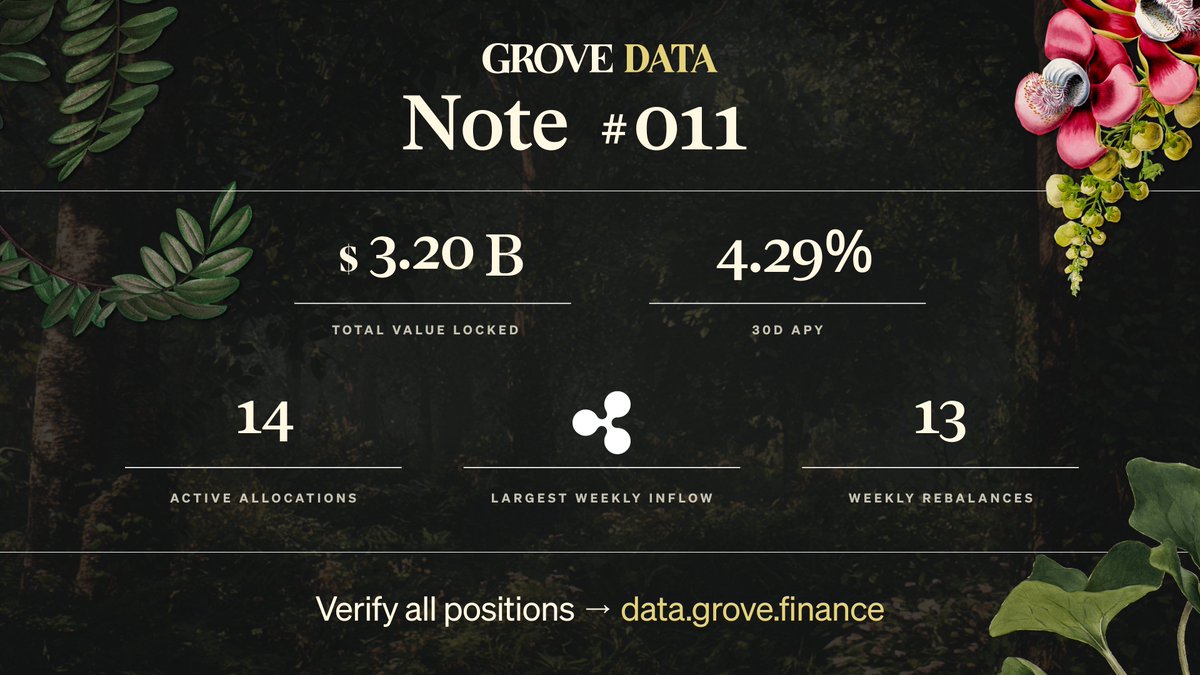
Enter the Grove 🌳
For the first time, Grove's institutional credit infrastructure is welcoming wider community participation.
Deposit USDS or USDC, access @Skyecosystem Savings Rate, and put your early participation on record.
The Grove App is live: https://t.co/a3VakCkshd