Bleeding question for the American healthcare system 🏥
Imagine you walk into a restaurant.
You ask for a menu.
The waiter smiles: "There are no prices. Eat first."
You finish eating. You ask for the bill.
The waiter says: "We cannot tell you. Go home."
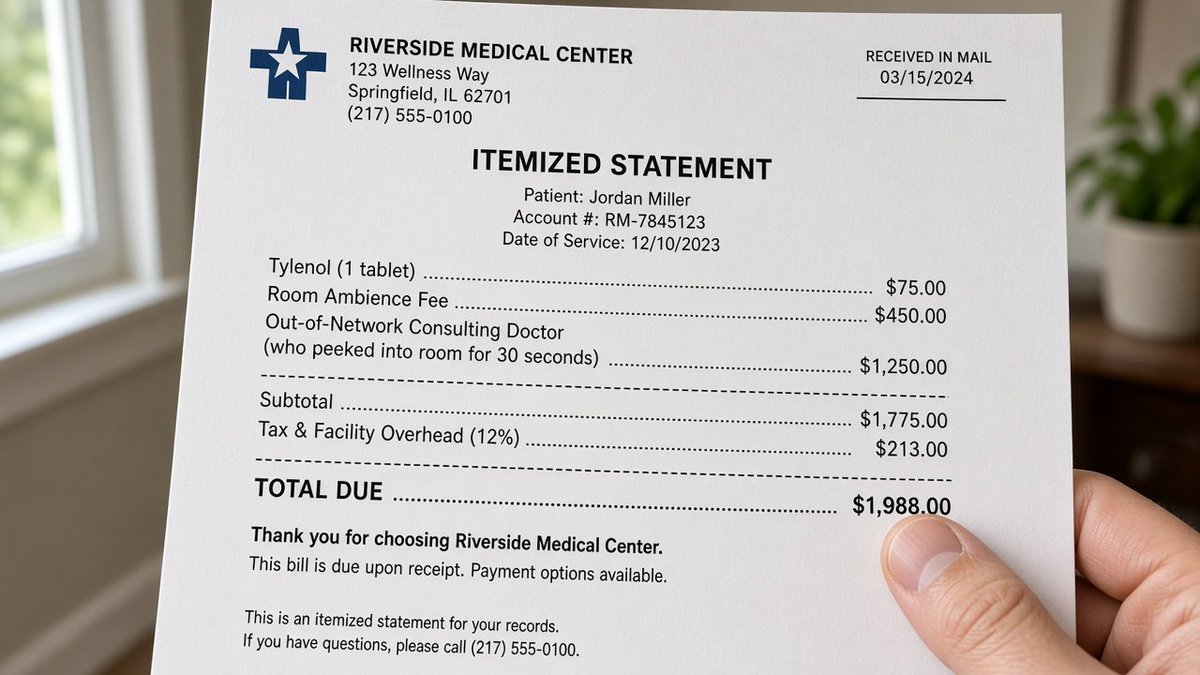
Three months later, an envelope arrives in your mailbox:
- Bread basket: $480.00
- Water glass rental fee: $210.00
- Out-of-network chef who walked past your table for four seconds: $1,650.00
TOTAL DUE: $2,340.00.
This sounds like a dystopian comedy sketch.
Except it is literally how going to the hospital works in the United States.
You can ask five different doctors, "How much will this cost?", and all five will look at you with genuine mystery, like you just asked them the location of Atlantis.
Nobody knows! The hospital does not know! The insurance company does not know!
The price is decided by a magical dice roll three months after you leave.
Why is healthcare the only industry in the free world where you buy a product with zero idea of the price tag? 🎲💸
Nine months after September 11, a village in Kenya with no electricity, no running water, and no roads gave America the most valuable thing it had.
Fourteen cows.
This is not a joke. It is one of the most serious gifts this country has ever received.
Kimeli Naiyomah grew up in Enoosaen, a Maasai village near the Tanzanian border. His family was so poor they owned no cattle. Among the Maasai, that is the bottom. A family without cows is barely counted as a family.
At fourteen he ran away to a school where the lessons were held under a tree. He walked. He had no shoes, no books, no money. He asked to be let in anyway.
Years later he was a student at Stanford, in California, studying to be a doctor.
On September 11, 2001, he happened to be in New York City.
He watched the towers fall.
He was a Maasai warrior. Warriors are trained from childhood to run toward danger. He wanted to run to the pile. He could not help there. He did not know what to do with what he had seen.
Months later he went home to Enoosaen.
The elders had heard something on the radio. Vaguely. A place called New York. Buildings. Some of them had not heard at all. Nobody in the village had ever seen a skyscraper. Nobody had been on an airplane. The idea of a building a hundred stories tall, full of thousands of people, falling down, was not something the language had words for.
Kimeli sat with them and explained. Slowly. What a tower was. How many people. What it looked like when it came down. He told them what he had seen with his own eyes.
The elders listened. When he finished, one of them asked a question.
"What can we do for these poor people?"
Kimeli had already decided. He had saved money in America. He wanted to buy a cow, the first cow his family had ever owned, and he wanted to give it to the United States.
To the Maasai, a cow is not livestock. A cow is life. It is wealth, food, standing, survival. An elder explained it to a reporter in one sentence. A cow is the handkerchief we Maasai use to wipe away tears.
Kimeli asked the elders for their blessing to give his one cow to America.
Then, one by one, the elders stood up.
They wanted to give too.
In the end, fourteen families pledged fourteen cows. In a community of about ten thousand people who owned almost nothing else.
On June 3, 2002, the United States chargé d'affaires in Kenya, William Brencick, traveled to Enoosaen. A flight, then more than half a day by road across terrain that barely counts as road. When he arrived, hundreds of Maasai in red robes were waiting. Some held hand-lettered banners.
"To the people of America, we give these cows to help you."
The elders presented the fourteen cows. Brencick accepted them on behalf of the United States. He called it the highest expression of regard and sympathy.
Then there was a practical problem. How do you ship fourteen sacred cows to New York?
The answer the two sides arrived at was better than shipping them.
The cows would stay in Kenya. They would belong to the United States of America. The Maasai would care for them, forever, as America's herd.
They are still there.
The original fourteen have multiplied into dozens. Each one carries a mark carved into its ear, the outline of two towers. Their offspring fund scholarships for the children of the village. The U.S. embassy built a school there, and a water project.
When the story reached America, forty thousand people wrote letters to the village. A painting of the fourteen cows hangs in the 9/11 Memorial Museum. A children's book about them became a national bestseller.
Kimeli's own explanation was the shortest.
To heal a sorrowing heart, give something that is dear to your own.
A village that had never seen a skyscraper, that could not have found New York on a map, that owned almost nothing, gave America the one thing it valued most.
Somewhere in Kenya tonight, there are cows with towers carved into their ears.
They are ours.
They were given to wipe our tears. 🇺🇸🇰🇪
From immigration to NSA-Big Tech surveillance of American citizens to CRT to transgenderism, today’s major political battles are initiated & won by leftists using the same playbook over & over again. Recognize, understand & counter their tactics. https://t.co/sornEUYTNV
God with us! Let's anticipate Christ's birth this week with praise and thanksgiving for the One Who Rescues! #advent#Christmas#GodWithUs https://t.co/anlTjNAzBL
As the sun sets on #ElectionDay2020, let's remember that no matter the outcome, #GodIsGood and He is in control! And we can be thankful for no more political ads, calls, or texts! https://t.co/vxAmAPsFjt