Iyin co-founded andela at 23, flutterwave at 25 and was able to raise millions in $, right now founders around 23-25 are struggling to raise $50k to fund their ideas , even after showing good promise , building an mvp and having sufficient traction.
Why has it become harder for young founders in Nigeria to raise money right now?
2 years ago, I pitched to a Partner at the VC firm, Antler.
Prior to that, I had gone through a few rounds and was just about to get the final nod into their cohort somewhere in East Africa.
After talking with passion and enthusiasm on something I had given my life's mission to, I was met with the coldest stare from this European lady.
It was later on, someone from the firm asked whether I had any AI integration in my solution, to which I replied, "no." She went, "that's why you were not picked."
Let me summarize the issue: investors follow trends especially when they're meteoric.
Trust me, it's not the absence of capital. Whatever is going on in the school yard of VC funds is down to, "who will be the winner in this new wave?"
Sadly, African Founders neither have the infrastructure wherewithal AND the intellectually rigorous background to cope in this new reality. They have one or the other, always.
Fini.
I keep telling people that a lot of you still don’t understand what “big club” actually means. Success comes and goes, trophies come and go, but size is something completely different.
When Manchester United start winning the league again, that’s when you’ll truly see what global support, attention and noise look like. The whole football world will be forced to pay attention. The motion will be on a different level entirely.
Some clubs are successful, some clubs are great, but very few are genuinely massive. That’s why even after years without a league title, Manchester United still dominates conversations everywhere.
No disrespect, but even Real Madrid no big reach Manchester United when it comes to global attention and moving the football world. When United rise again, una go finally understand the difference between successful and BIG. 😂
JUST IN: Engineer uses Claude to build a “coworker stress leaderboard” showing who caused him the most stress by syncing his WHOOP & calendar data.
Health checks (when servers die silently)
Your load balancer can only route to servers it thinks are alive.
The word "thinks" is doing a lot of heavy lifting there.
Health checks come in two flavors:
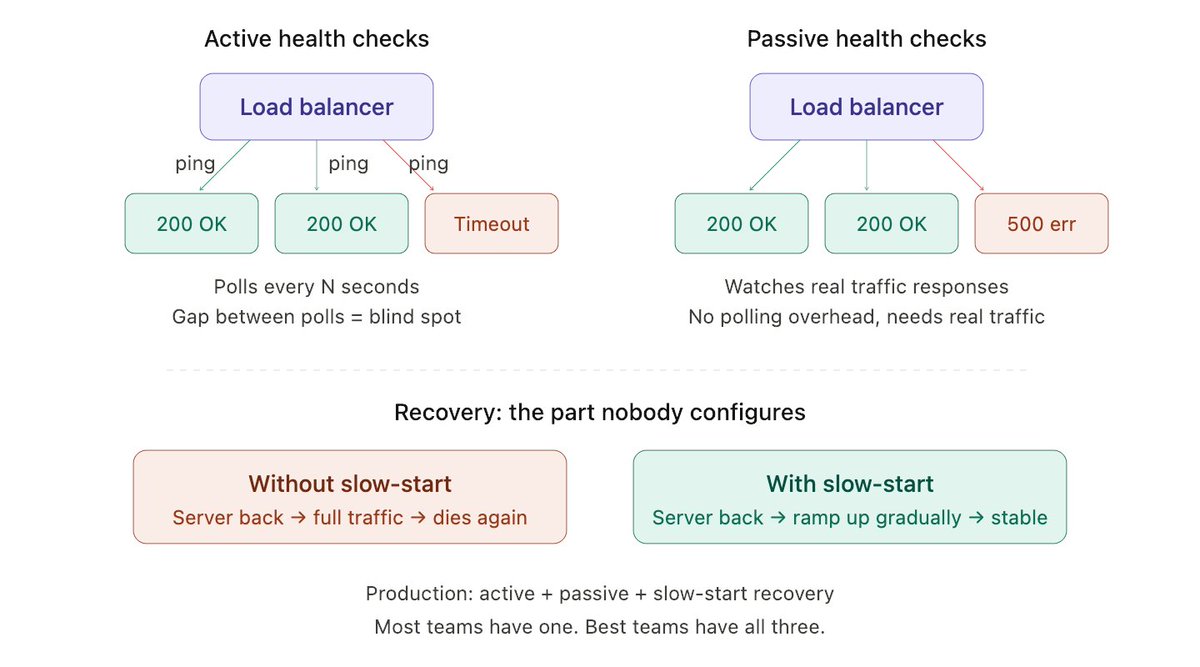
Active health checks → The load balancer pings each server at a fixed interval. "Are you alive?" If the server responds 200 OK, it stays in the pool. If it fails N consecutive checks, it's pulled out.
Simple. But there's a gap: if your interval is 10 seconds and your server dies at second 1, you're sending 9 seconds of traffic to a dead server. Users see errors.
Shorter intervals = faster detection = more network overhead. Tradeoff.
Passive health checks → The load balancer watches actual traffic responses. If a server starts returning 500s or timing out on real requests, it's flagged unhealthy.
No polling overhead. Detection is based on real failures. But it needs actual traffic to detect the problem, a server with no requests won't be caught.
The real production setup: both.
Active checks for baseline "are you there?" detection. Passive checks for "you're alive but broken" detection.
And here's the part nobody remembers to configure: the recovery policy. When a server comes back, do you slam it with full traffic immediately? Or ramp up gradually?
Most load balancers support slow-start. Most teams never enable it. The server comes back, gets crushed with backlog, and dies again.
Layer 4 vs Layer 7 (the thing most people skip)
There are two fundamentally different kinds of load balancers, and they operate at different layers of the network stack:
Layer 4 (Transport) → Works at TCP/UDP level. Sees source IP, destination IP, port numbers. That's it.
Makes routing decisions based on connection metadata without ever reading the request body.
Fast. Cheap. Dumb. Doesn't know if it's routing an API call or an image download. Doesn't know the URL, the headers, or the cookies.
Use for: high-throughput, protocol-agnostic balancing. TCP pass-through. When you need raw speed and don't need content-aware routing.
Layer 7 (Application) → Works at HTTP level. Reads the full request: URL path, headers, cookies, even the body.
This is where the real power is:
→ Route /api/ to backend service, /static/ to CDN origin
→ Route premium users to beefier servers based on a cookie
→ A/B test by routing 5% of traffic to a canary based on the URL
→ Terminate TLS and inspect the request before forwarding
Slower per-request. Way more powerful. This is what NGINX, HAProxy (in HTTP mode), ALB, and Envoy do.
Most production systems use both: L4 in front for raw throughput and connection distribution, L7 behind it for intelligent routing.
The algorithms:
1) Round-robin → Requests go to servers in rotation. Server 1, 2, 3, 4, 1, 2, 3...
Dead simple. Zero awareness of server state. If Server 3 is drowning, it still gets its turn. Works when all requests cost roughly the same and all servers are identical. Falls apart the moment either assumption breaks.
2) Least connections → Send to whichever server has the fewest active connections.
Smarter. But it still doesn't know that Server 3's 2 connections are both running 30-second report exports while Server 1's 15 connections are all sub-millisecond health checks. Connection count ≠ actual load.
3) Weighted round-robin → Assign weights manually. Server with 8 cores gets 4x the traffic of the server with 2 cores.
Better for heterogeneous hardware. Problem: weights are static. Your traffic patterns aren't. Someone has to tune these, and in practice nobody revisits them after the initial setup.
4) IP hash → Hash the client IP, route to the same server every time.
Gives you sticky sessions without session stores. But one corporate NAT with 10,000 employees behind one IP address just created a hotspot.
5) Least response time → Route to the server responding fastest right now.
The closest thing to "actually aware of server state." Factors in real latency, not just connection count. This is what most production setups should graduate to and most never do.
LOAD BALANCING: Day 1/25
Your load balancer is lying to you.
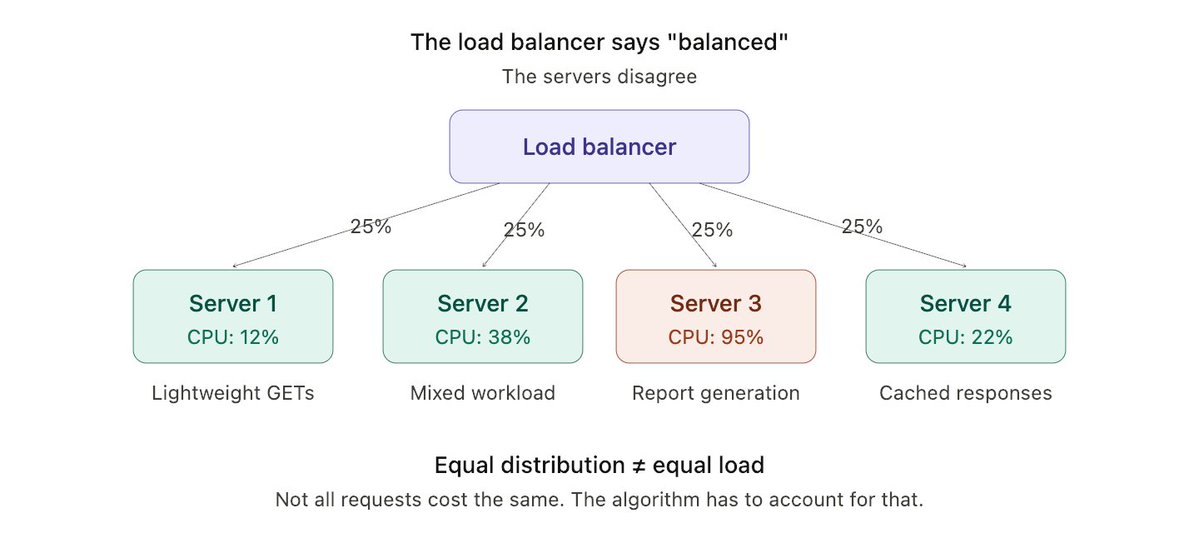
It says traffic is "balanced." What it really means is: requests are being distributed. Whether they're distributed well is a completely different question.
I've seen a system with 4 servers where Server 3 was at 95% CPU while Server 1 sat at 12%. The load balancer said everything was fine.
A load balancer doesn't know what's happening inside your servers. It doesn't know one request takes 2ms and the next takes 12 seconds.
Your choice of algorithm, layer, and health check strategy is the difference between actual balance and the illusion of it.
Let me break it down. 🧵Your load balancer is lying to you.
I've been a backend Engineer for 12+ years. Today, I'm a Principal Engineer at Atlassian.
I've designed systems that handle millions of requests. Sat on both sides of system design interviews.
Reviewed more architecture docs than I can count.
Starting today, I'm breaking down the fundamentals of scaling for the next 25 days.
If you're learning system design bookmark this thread, you're going to get a lot of learning from this.
/teach now recommends primary source reading in every lesson
The goal isn't to keep you shackled to the agent, it's to get you confident enough to read the sources for yourself
It's called University of the People (UoPeople). It is the world's first tuition-free, non-profit, American accredited online university. No visa. No relocation. Just your phone or laptop and an internet connection.
They offer degrees in Business Administration, Computer Science, Health Science and Education. From associate degree all the way to MBA.
To apply, go to uopeople. edu and start your application today.
You only pay small assessment fees per course and even those can be waived if you cannot afford them.
Over 170,000 students from 200+ countries are already enrolled. Nigerians are sleeping on this.
Above all, love God.
What it’s like to receive a job offer directly from Satya Nadella. @kelseyhightower, former Google Distinguished Engineer, on the Microsoft offer that revealed a pay tier he didn't know existed:
“I got this email from Satya, the CEO of Microsoft.
He wrote this nice email: 'Kelsey, heard you had a good experience with the team' - remember I did the interview at the Microsoft headquarters - “heard really good things from the team, just wanted to let you know, you're going to be respected here. We're going to support you as a team.”
I'm like, damn, support as a team? Coming from the CEO?
So, number one, what an honor. This is the CEO of Microsoft. He has so many more important things to be doing than to be emailing me about a role. I opened the PDF - not very often in your career does a zero get added to the equation. And so you're looking at this like, I didn't even know that they do that.
We know that it happens. But the person that graduated from high school in 1999, that chose the A+ Certification didn't know that was available. Even while I was at Google having all the success. Google paid me pretty well too, but I didn't know you can add another zero still.
And I'm like, wow. I showed my wife and she was the one that said you should just go interview, like put your ego to the side and let's go see what's out there, so shout out to my wife.
And so I get the PDF, and I'm like, okay, this number is perfect. Honestly, I don't know what to say, but let’s just find out, is this really the only number? So I remember giving a counter: you know what, I think it should be this.
The funny thing is, Microsoft countered back higher, like we're not playing around. I'm like, oh, whoa. Now I understand that I don't understand this part of the game.”
Just remembered when I had my Bloomberg system design round. It was the first time I had to design systems at that scale, and I was so nervous.
I put out a tweet asking if anyone would be kind enough to do a mock interview with me. Out of everyone, @kelseyhightower responded. He gifted me a solid 30 minutes of his time and helped sharpen my doubts.
I went into the interview feeling super confident and nailed it. I'm really grateful to people like Kelsey who devote their time to helping others.
There are 10x engineers and he’s top of that list.