I literally laughed when I saw the bears keep shorting Google while it’s CEO said a major AI update is underway and a preview version is released. They will learn the meaning of Squeeze in a damn hard way, with a welcoming weaken ADP especially
Everyone keeps saying they’ll buy $NFLX in the $40s or $50s…
But what if it never gets there?
In my opinion, Netflix is already undervalued at these levels and still has a very realistic path to doubling over the next 3–5 years.
So why would I sit on the sidelines trying to perfectly time the bottom?
I would rather start building my position now and add more if the market gives me a better price.
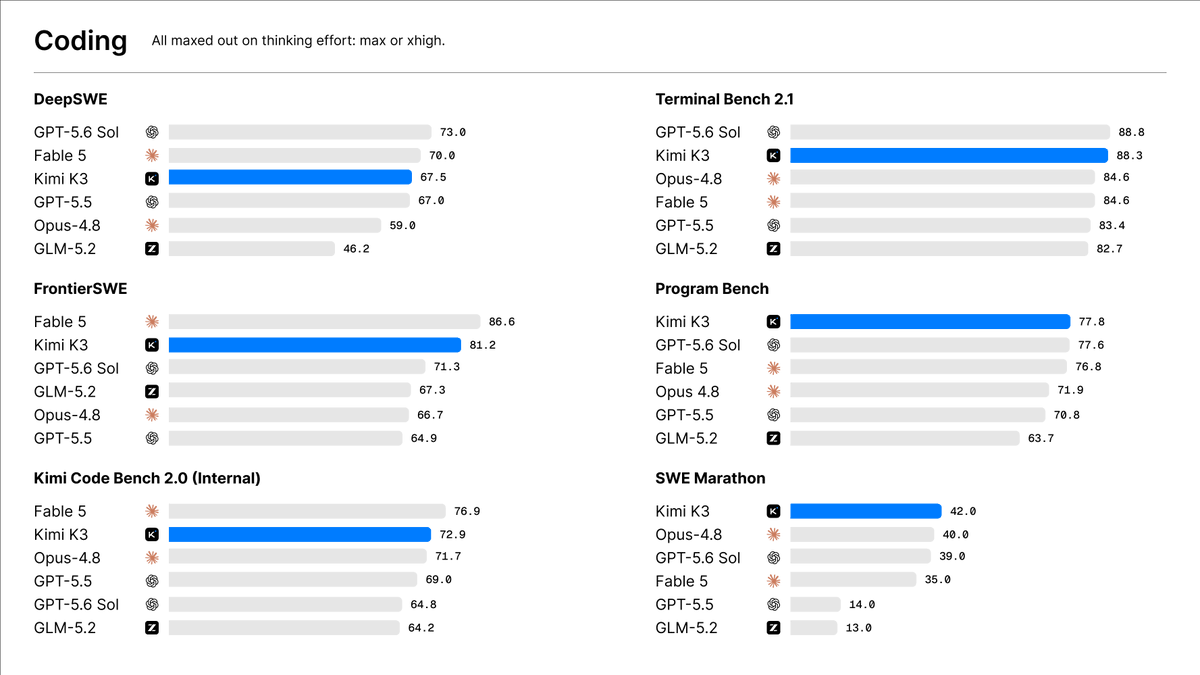
Introducing Kimi K3: Open Frontier Intelligence
🔹 2.8 Trillion Parameters, 1 Million Context, Native Multimodal
🔹 Kimi Delta Attention enables up to 6.3x faster decoding in million-token contexts
🔹 Attention Residuals deliver ~25% higher training efficiency at <2% additional cost
🔹 Built for long-horizon agentic coding and self-evolving workflows
Kimi K3 is now live on on https://t.co/zrk6zZxZUo, Kimi Work, Kimi Code, and the Kimi API.
Open Weights by July 27, 2026.
🔗 API: https://t.co/XCrgjXAqMw
🔗 Tech blog: https://t.co/YTfiMSNM1f
$NFLX
Wish I bought puts 😂
This was a weird quarter. Netflix said engagement is fine, but is now pulling back engagement metrics like they did with subscriber metrics. Less transparency isn't the best.
The beat on EPS by one penny (going to my point that last Q was only a beat because of the 2.8B breakup fee) and they missed on revenue.
They missed on every single street estimate for Q3 and FY 26 around revenue growth, operating margins, operating income, and free cash flow. The miss on FCF was $600M...why are they missing FCF by half a billion dollars?
The growth slowed down from Q2 2025 and the operating margins also went down, so they are spending more money to grow less YoY with worse margins. It's just a bit confusing.
Having said that, the valuation is getting much more attractive but the P/E still trades in line with $META and $MSFT which to me are just stronger businesses.
Once again, I do think this stock is probably closer to a bottom but I am questioning their ability to meaningfully grow when the Mag 7 are growing 25-30% and trading at a similar premium. Netflix is a blue chip stock, so it'll be important to see how aggressive the institutions are in trying to buy the dip.
$NFLX -8%
Not only have oil stocks beaten AI over the past 5 years. Gold miners have beaten AI too. Chart: $GDX vs $NDX.
In the 1970s, oil and gold rose by roughly 30% per year on average.
I am the worst market timer, so I stay invested in both for the long term.
China just published a chip architecture that runs AI inference 100x faster using 1/9th the compute.
Not a theory. Published in National Science Review by Peking University. Today.
The entire GPU scarcity narrative just got a fundamental challenge.
The conventional approach to AI scaling has been simple: throw more GPUs at the problem. Bigger clusters, more H100s and B200s, more power. The assumption is compute demand is infinite and supply is the binding constraint.
Peking University's team took a different path. Instead of bigger individual chips, they optically linked standard FPGA chips using silicon photonic transceivers running at 400 Gbps. The innovation is the interconnect: all-optical links between chips that eliminate the electrical signalling bottleneck.
The result is 100x distributed inference speedup at one-ninth the compute resources.
If you can get 100x more inference throughput from the same hardware, the "we need infinite GPUs" thesis gets harder to defend. Inference is where the AI industry spends most of its compute in production.
The architecture is built on FPGAs: programmable chips not subject to the same export controls as advanced ASICs. The team deliberately chose widely available hardware. This is a sanctions-resistant design by choice, not accident.
The timing: published the same week as new US chip export rules. The pattern is now consistent. Each time the US tightens hardware access, China publishes a fundamental architecture advance that reduces dependence on that hardware.
For markets: if inference compute requirements drop by roughly 90%, what happens to the demand curve that justifies $1T+ in AI infrastructure capex?
A faster, cheaper inference path doesn't kill the AI thesis. But it rewrites the distribution of winners. Hardware scarcity was the single biggest moat for incumbent suppliers. That moat just got narrower.
Source: SCMP / National Science Review, Shu Haowen & Wang Xingjun, Peking University. Published Jul 13, 2026.