Low ACoS ≠ good PPC
Early in a campaign, low ACoS usually means:
• low bids → low impressions → no rank signal
• missed opportunity for organic boost
High ACoS early = paid + organic synergy → long-term cheaper sales.
The 7-image strategy that top Amazon sellers use and nobody talks about openly.
Each image has one job. Only one.
Image 1 — Hero: Stop the scroll. Product fills 85% of the frame. Clean white background. This is your Facebook ad in thumbnail form. The only question it needs to answer is: "is that the thing I was looking for?"
Image 2 — Use case: Show the product being used. Not a model smiling at the camera. The actual moment of use. Person cooking with the spatula. Dog sleeping on the mat. This image answers: "does this fit my life?"
Image 3 — Size/scale: Show a size reference people can relate to. Not centimetres. An iPhone, a hand, a common object. Returns happen because people misjudge size. This image prevents that.
Image 4 — Feature breakdown: Pick your single strongest differentiator and make it the whole image. Not a list of 6 features. One thing. The thing that makes you better than the €2 cheaper option next to you.
Image 5 — Problem/solution: Show the before and after. The problem your product solves. This is the emotional hook that separates "nice to have" from "I need this."
Image 6 — Social proof: Reviews, certifications, test results. Anything that builds trust without the buyer having to scroll down to the review section.
Image 7 — Lifestyle: The aspirational version. Who they become by buying this product. Keep it subtle. This isn't a magazine ad. It's a conversion anchor.
Most listings use maybe 2 of these intentionally. The rest are just more photos of the product from different angles.
Different angle. Same information. No conversion impact.
Map your 7 images to these 7 jobs. Then look at your current images and ask which job each one is doing.
Most sellers realise they have 4 hero variants and zero problem/solution.
The biggest unlocks in Amazon aren't from better PPC structures. They're from better angles.
An "angle" is a specific reason a specific type of buyer would search for and buy your product. Most sellers find one angle — usually the most obvious one — and stop there.
Here's what a full angle map looks like for a simple product like a reusable water bottle:
Angle 1: The fitness buyer Search terms: "water bottle gym", "sports water bottle 1L", "protein shaker BPA free"
What they care about: capacity, leakproof lid, easy grip
Listing copy angle: "Stays leakproof through every rep"
Angle 2: The sustainability buyer Search terms: "reusable water bottle eco", "plastic free water bottle", "sustainable water bottle"
What they care about: materials, certifications, impact
Listing copy angle: "Replace 500 plastic bottles a year"
Angle 3: The parent buyer Search terms: "water bottle school kids", "leak proof kids bottle", "children water bottle BPA free"
What they care about: safety, portability, easy open
Listing copy angle: "Safe for kids, built for school bags"
Angle 4: The gift buyer Search terms: "water bottle gift", "personalised water bottle", "water bottle birthday gift"
What they care about: presentation, customisation, price range
Listing copy angle: "The gift that gets used every day"
Each of these is a separate keyword cluster. A separate campaign. Potentially a separate listing image.
Once you identify which angle has the best performance, you build a version of your listing that speaks directly and to that buyer.
One product. Four businesses.
Check this before you touch a single bid:
Campaign → Placements tab → ACoS by placement
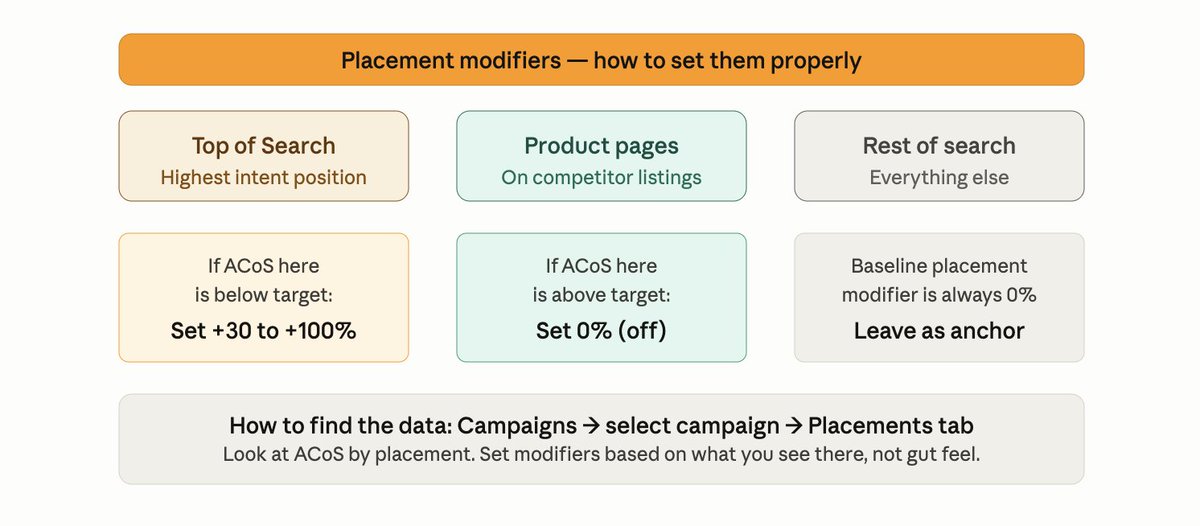
If Top of Search is below target and Product Pages is above: set Top of Search modifier to +50%, Product Pages to 0%.
Done. Your budget just got smarter in 2 minutes.
Placement modifiers are one of the most impactful settings on Amazon.
Here's the logic: Amazon has three places your ad can show up. Top of Search, Product Pages, and Rest of Search. Each has completely different conversion rates and CPCs.
By default, Amazon allocates your budget across all three equally. But they never perform equally.
Go to your campaigns right now. Click "Placements." Look at ACoS by placement type.
For most products, Top of Search converts at 2–3x the rate of Product Pages. So you set a modifier of +50 to +100% on Top of Search to tell Amazon "I'm willing to pay more to appear there."
For Product Pages, if ACoS is bad — set it to 0%. You're effectively turning that placement off. You're not losing reach. You're concentrating spend where it actually works.
TACoS going up means one of two things:
You're scaling aggressively (fine, if intentional).
Or your organic rank is slipping (not fine, fix it now).
Know which one it is before you do anything else.
I want to explain TACoS properly because I see it misunderstood constantly.
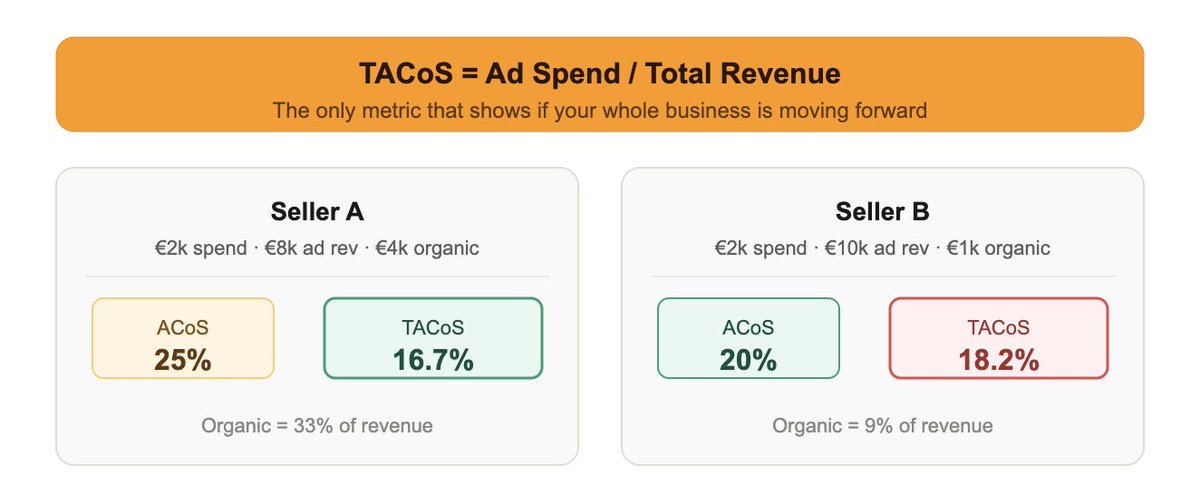
TACoS = Total Advertising Cost of Sales = Ad Spend / Total Revenue
The "Total" is the whole point. It includes organic sales your ads indirectly drove by improving your ranking.
Here's why this matters with a real example:
Seller A: €2,000 ad spend, €8,000 ad revenue, €4,000 organic revenue ACoS = 2,000/8,000 = 25% TACoS = 2,000/12,000 = 16.7%
Seller B: €2,000 ad spend, €10,000 ad revenue, €1,000 organic revenue ACoS = 2,000/10,000 = 20% TACoS = 2,000/11,000 = 18.2%
Seller B looks better on ACoS. But Seller A has way more organic running. Their business is healthier even though their ACoS looks worse.
What happens over 6 months:
Seller A's TACoS trends from 16.7% → 14% → 11% → 9%. Their organic keeps growing. Ad efficiency compounds.
Seller B's TACoS stays flat at 18%. They're stuck. Their ranking isn't building. They're completely ad-dependent.
The only TACoS question that matters: is mine trending down over time?
If yes → your strategy is working. Don't panic about short-term ACoS spikes.
If no → something is broken. Organic isn't building. Fix it before you scale anything.
Track it weekly. In a simple spreadsheet. Just one number.
Every search term in your report falls into one of four buckets.
The top-right is where money is made.
The bottom-right is where money is lost.
The left column is where most sellers waste time making premature decisions.
Your product has one ASIN. But your buyers have completely different reasons for wanting it.
A silicone baking mat is searched by:
→ Bakers who want non-stick surface (functional angle)
→ Parents who want safe non-toxic materials (safety angle)
→ People who want to replace single-use parchment paper (eco angle)
→ Gift-buyers looking for kitchen gifts (gift angle)
Each of these is a different keyword cluster with a different search intent.
Most sellers only target the functional angle. They're leaving 60–70% of their addressable audience invisible.
Build separate campaigns for each angle. Track which converts best. Double down.
The winning angle often surprises you.
Sponsored Display retargeting is the closest thing to free money in Amazon PPC.
You're targeting people who already looked at your product and left.
They're warm. They're interested. They just need a nudge.
Most sellers ignore this entirely.
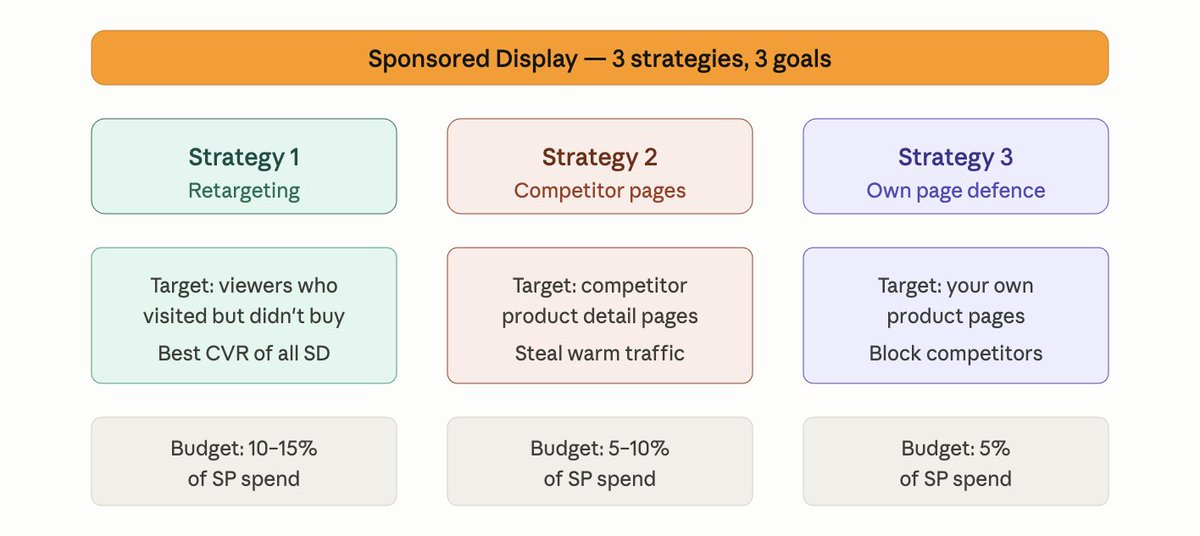
Sponsored Display has three completely different use cases. Most sellers run none of them properly.
Strategy 1 is retargeting — showing ads to people who already visited your listing but didn't buy. These have the highest CVR of any SD campaign because the buyer already showed intent. Start here. Always.
Strategy 2 is competitor targeting — placing your ad directly on a competitor's product page. Someone is looking at their listing. You interrupt and say "actually, look at mine." Aggressive but effective in the right categories.
Strategy 3 is defensive — placing ads on your own product pages so competitors can't do Strategy 2 to you. This is maintenance spend, not growth spend. But once you're scaling, it matters.
The order is everything here. Don't run SD at all until your Sponsored Products are profitable. Don't run Strategy 2 until Strategy 1 is working. Build the foundation before the advanced tactics.
Most sellers treat Sponsored Display like an afterthought.
It's actually one of the most underused weapons in Amazon PPC.
Here's how to use it properly 👇
Most sellers track 1 KPI. ACoS.
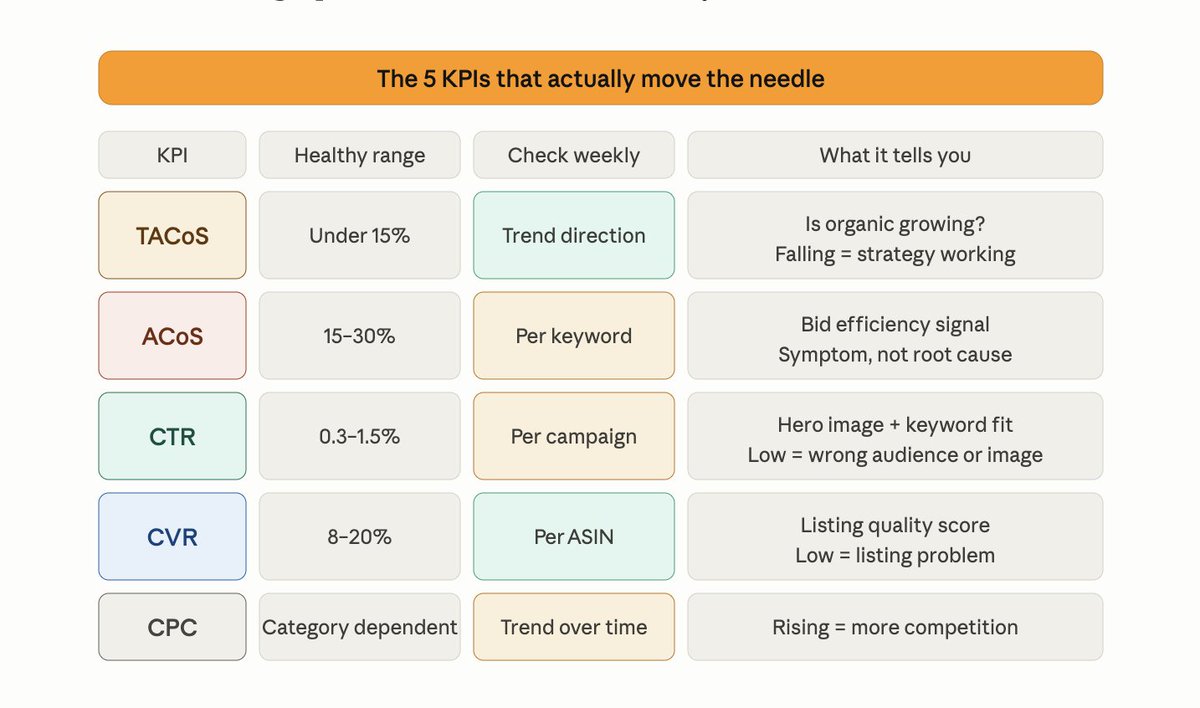
Here are the 5 that actually tell the full story — and what each one is really trying to tell you.
TACoS is the most important one and nobody talks about it enough. It's the only metric that shows whether your whole business is trending in the right direction or just your ad campaigns.
CTR and CVR together diagnose exactly where your funnel is leaking. CTR = hero image and keyword problem. CVR = listing problem. They almost never break at the same time, which means you can isolate the issue fast.
CPC isn't a target — it's a signal. Rising CPC means competition is heating up. It's your earliest warning that your margin structure is about to change.
Save this. Check all five weekly.
This is exactly what I do every Monday to manage an Amazon PPC account.
The full weekly optimization SOP. Step by step.
Step 1 — Pull the Search Term Report (last 7 days)
Filter: Klicks > 20, Conversions = 0. Add every result as Negative Exact immediately. Don't overthink it. If it didn't convert with that many clicks it won't.
Step 2 — Harvest converters
Filter: Conversions > 3, not already in Exact. These go into your Exact campaign today. Negate them in Auto and Broad once moved.
Step 3 — Bid adjustments on Exact keywords only
Over target ACoS for 2+ weeks with 15+ clicks → lower bid 10% Under target ACoS for 2+ weeks with 15+ clicks → raise bid 10% Under 10 clicks on any keyword → do nothing. No data = no decision.
Step 4 — Check budget caps
Any campaign hitting its daily budget before 8pm? Split it or raise the cap. You're leaving impressions and sales on the table every day it happens.
Step 5 — Check placement performance
Go to Campaign → Placements. If Top of Search is converting well (below target ACoS), set a placement modifier of +20–40%. If Product Pages is burning money → drop it to 0%.
Total time: 25 minutes.
There are only 3 reasons your Amazon ads aren't spending your full daily budget:
1. Your bids are too low to win auctions
2. Your product relevance score is weak
3. Your listing quality signals aren't trusted yet
Raising the budget fixes exactly zero of these.
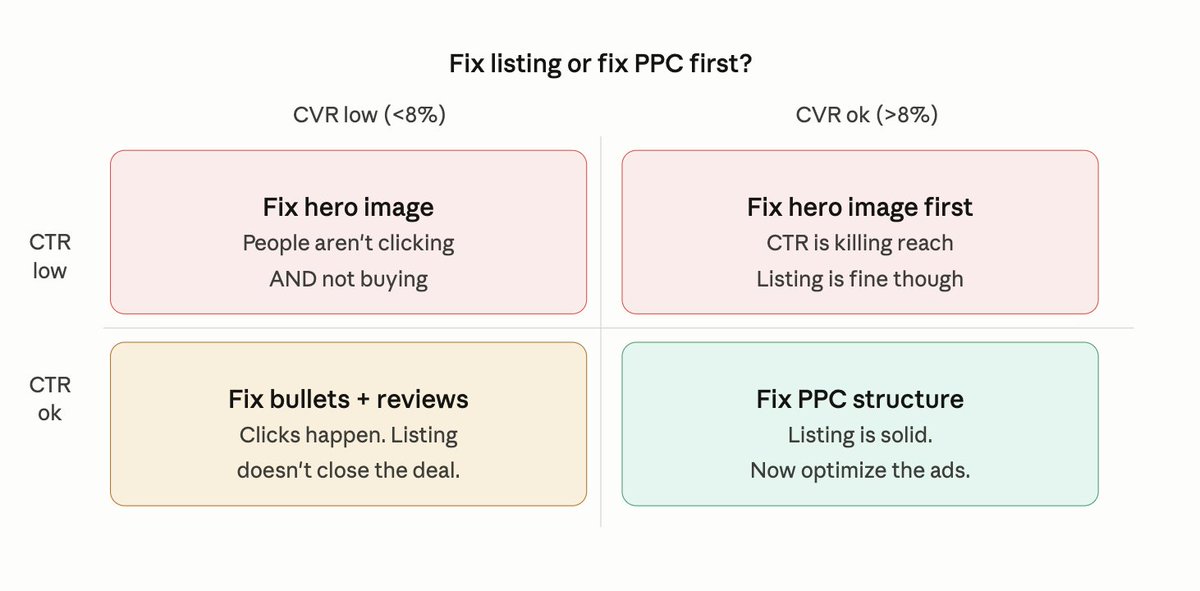
Before you touch your PPC — answer two questions:
Is your CTR above 0.3%? Is your CVR above 8%?
Your answer tells you exactly where to start.
Most sellers skip straight to bid adjustments when the actual problem is in one of the other three quadrants.