Leading AI companies have agreed to share their models with the US AI Safety Institute for pre-deployment testing, says Gina Raimondo. This and more in my profile of the Secretary of Commerce.
https://t.co/XWknuRnRwr
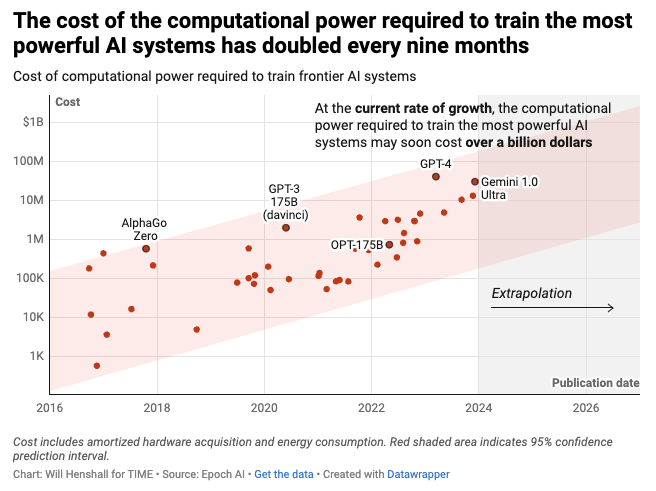
A new report from Epoch AI examines how the cost of the computational power required to train AI systems has been increasing over time. According to their estimates, it's been doubling every nine months
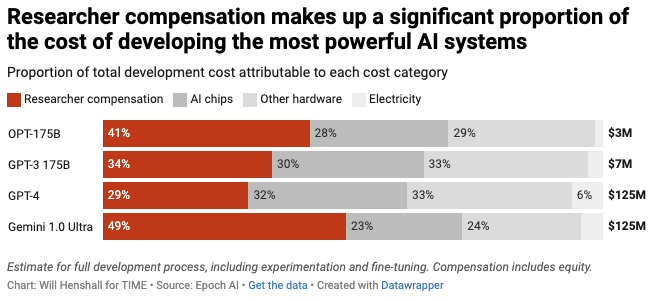
I was pretty surprised by their estimates of how much of the cost of developing a frontier AI model is accounted for by researcher compensation. ~30-50% for the four models they made estimates for!
Audrey Tang is stepping back from her ministerial duties to embark upon a world tour to promote the ideas that she helped flourish in Taiwan—ideas captured in Plurality, a book Tang has co-authored with E. Glen Weyl and more than 100 online collaborators
https://t.co/QJsIU4nHCh
Microsoft and Amazon are starting to compete with their investees, OpenAI and Anthropic. Can the smaller companies stay ahead of their compute-rich big tech backers?
“For the next few years, I don't have concerns about this,” says @jackclarkSF
https://t.co/OBspFAefvI
I spoke with Michelle Donelan, Secretary of State for Science, Innovation and Technology, about the AI safety testing agreement she just signed on a flying visit to DC.
https://t.co/OJRhC7UvqM
Exclusive: New research provides a way to measure whether an AI model contains potentially hazardous knowledge, along with a technique for removing the knowledge from an AI system while leaving the rest of the model relatively intact.
https://t.co/KTEg0fhDkV
On Tuesday, the House launched a bipartisan Task Force on Artificial Intelligence. I spoke with its members to understand their priorities.
https://t.co/H5CUSNTH6W
“I can't help but read it as a 2000 year old blog post, arguing with another poster,” says @natfriedman . “It's ancient Substack, and people are beefing with each other, and I think that's just amazing.”
My piece on the Vesuvius Challenge winners:
https://t.co/J1Bqkmhz9O
Exuberant predictions about the imminent arrival of AGI are as old as the field of AI itself.
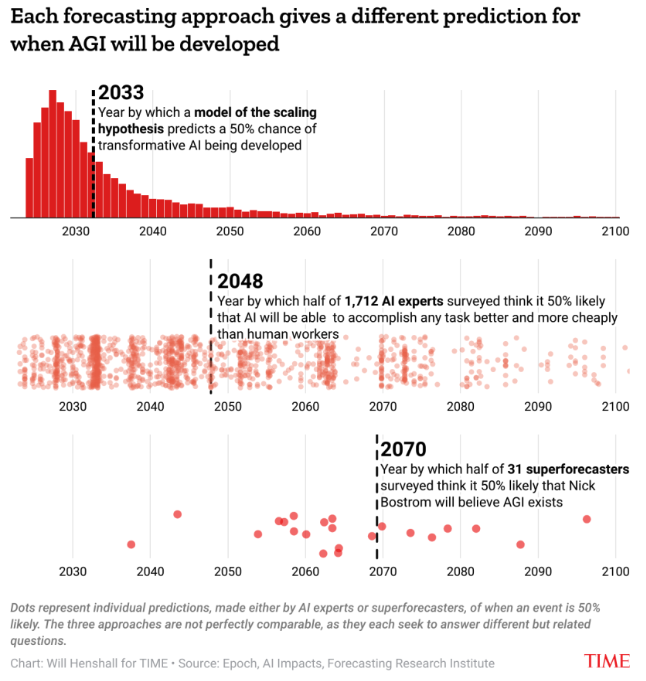
So when Shane Legg, Google DeepMind’s chief AGI scientist, estimates a 50% chance that AGI will be developed by 2028, should we take him seriously?
It depends who you ask (1/6)
Many questions feed into these wildly varying predictions: How impressive are current AI systems? Will simply scaling them up produce AGI?
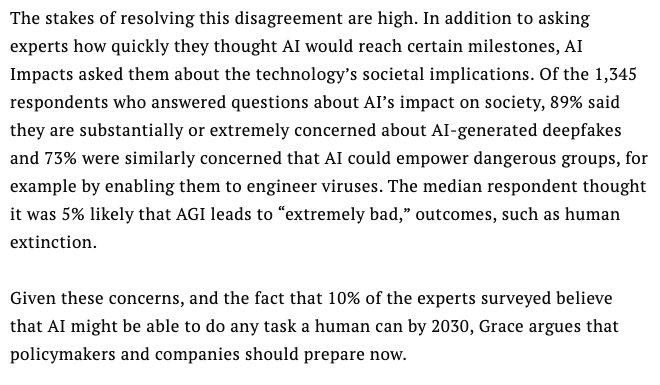
And a lot could hinge on these forecasts, given the risks that many experts worry AI might pose (5/6)