@Gonzalez_JT@Brady_H Ok, but if a person gains 2 kg of fat free mass, we expect their RMR to increase. If the observed change is 0, then that’s compensation (or find another word for it). Same if tx gains 2 kg FFM > control group. The tx is expected to increase FFM and RMR. Need to account for that
@Gonzalez_JT@Brady_H We found evidence after ~15 weeks once you control for changes in fat free mass and separate resistance from endurance training. (The review paper you cite did neither) https://t.co/0IbO3Mxnyy
@Gonzalez_JT@Brady_H Maybe but no one has ever claimed that compensation to exercise happens that fast. In our 2019 Curr Bio study (Thurber) the 1st week of high output showed 0 compensation.
@JYKines Thats deep bro. I’m referring to the fact that we collectively know a lot more about how the universe works in pretty much every field than we did, say, 10…50…100 years ago.
Exercise burns 500 extra calories. Your body compensates by spending 500 fewer. Net change: zero. A foundational study by @HermanPontzer measuring 332 adults across five populations proved the math behind weight loss doesn't work the way we've been told.
Ponzer and his team used doubly labeled water to measure total energy expenditure and accelerometry to track physical activity in adults from Ghana, South Africa, Seychelles, Jamaica, and the United States. This method captures actual metabolic rate over 7-10 days in free-living conditions, not lab-based estimates.
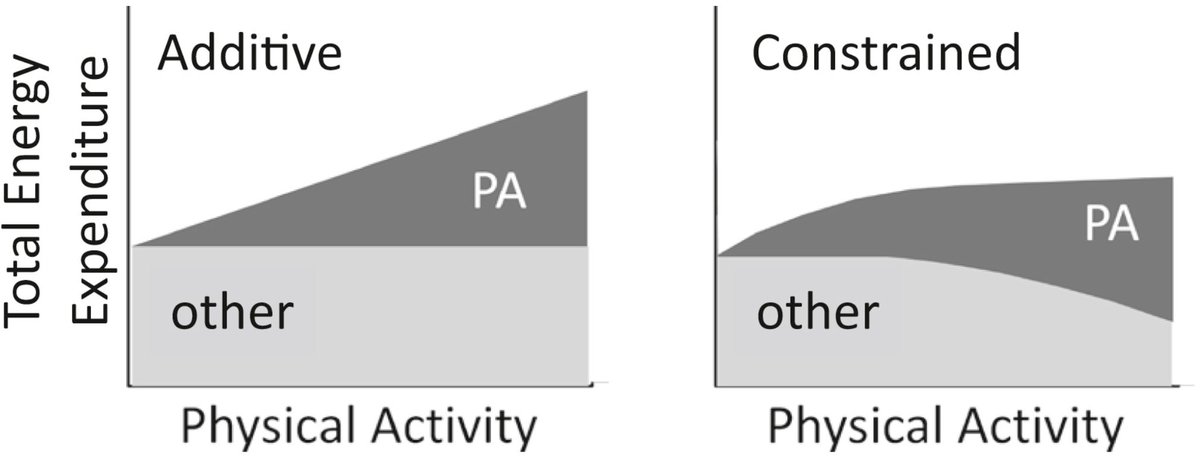
The standard additive model predicts that total energy expenditure increases linearly with physical activity. Burn 200 more calories moving, spend 200 more calories total. That's the assumption underlying most weight loss and obesity prevention strategies.
The data revealed something different. After adjusting for body size and composition, total energy expenditure was positively correlated with physical activity at low-to-moderate activity levels. But in subjects with higher physical activity levels, total energy expenditure plateaued. The relationship wasn't linear. It was constrained.
This supports a constrained total energy expenditure model: the body adapts metabolically to maintain total energy expenditure within a narrow range when physical activity increases beyond moderate levels. The metabolic response to activity isn't passive addition. It's active compensation.
Two variables appeared to modulate this response: body fat percentage and activity intensity. Higher body fat was positively related to total energy expenditure, while higher activity intensity was inversely related to total expenditure after controlling for activity volume. The body's adaptive mechanisms aren't uniform across metabolic phenotypes.
The compensation mechanisms likely involve reductions in basal metabolic rate, thermic effect of food, or non-exercise activity thermogenesis. When physical activity energy expenditure increases substantially, other components of daily energy expenditure decrease to keep total expenditure stable.
This has direct implications for weight loss interventions. Exercise programs that substantially increase physical activity may not produce the caloric deficits predicted by additive models because the body compensates by reducing energy expenditure elsewhere. The expected 1:1 relationship between activity and expenditure breaks down at higher activity levels.
The plateau doesn't mean exercise is ineffective. Physical activity produces metabolic benefits independent of energy balance, including improved insulin sensitivity, mitochondrial function, and cardiovascular health. But using exercise as the primary driver of caloric deficit faces a biological constraint that most public health models don't account for.
The constrained model also explains why cross-population studies consistently find that more active populations don't have proportionally higher total energy expenditure. If compensation occurs above moderate activity levels, highly active hunter-gatherer populations and sedentary Western populations can show similar total daily energy expenditure despite vastly different activity patterns.
The decisions about exercise intensity, volume, and metabolic context (body composition, dietary intake) interact with constrained energy expenditure in ways that aren't captured by simple calorie-counting models. The body regulates total energy expenditure as a managed system, not a passive ledger.
Public health strategies built on additive energy expenditure models assume a biological response that doesn't match observed physiology. The constrained total energy expenditure framework suggests that preventing weight gain requires addressing both sides of energy balance, and that increasing activity alone may not produce the metabolic effects predicted by conventional models.
Two of the most important biomedical breakthroughs came from science of the Gila lizard venom (GLP-1s) and yogurt (CRISPR genome editing).
"The system that turned that lizard into a medicine is now being dismantled."
"Less support for scientists means strange questions no one will get to chase."
gift link https://t.co/JKEzQCGm75
The humiliating Iran deal requires the U.S. to come up with a $300 billion reparations payment to Iran. That's more than Iran's entire GDP.
Trump says taxpayers won't pay for it.
1/ So I compiled a helpful list.
It’s funny, motocross at the White House is, like, fine with me. But here’s an example of something that is genuinely unforgivable but that a lot of people seem to have moved right past.
Fun human evolution connection: vitamin A poisoning likely killed a H erectus female 1.7 million years ago (they didn’t have twitter docs to save them)
https://t.co/1YhEhJ9m4O
Which vitamin overdose can seriously damage the liver?
A) Vitamin C
B) Vitamin D
C) Vitamin A
D) Vitamin B12
Most people think vitamins are always harmless but one can become dangerously toxic if overused.
!!Announcing the next round of Isotope Grants for DLW projects!!
Successful proposals get free isotopically enriched water for human DLW studies. Proposals due Sept 1. Details & application here: https://t.co/2O8OyS9j9y
In this episode, evolutionary anthropologist Dr. Herman Pontzer (@HermanPontzer) of the world's leading researchers on human metabolism and energy expenditure at Duke University—joins the show to share what decades of fieldwork with the Hadza hunter-gatherers of Tanzania have revealed about how our bodies really work. We explore what hunter-gatherers actually eat (spoiler: it's not the all-meat paleo diet you've been sold), why the healthiest hearts ever measured belong to a community whose staple foods are unrefined carbohydrates, and the shocking finding that the Hadza—despite walking up to 19,000 steps a day—burn no more calories than sedentary Americans. Dr. Pontzer explains his groundbreaking "constrained energy" model and why your body quietly reallocates energy from inflammation, stress hormones, and reproductive functions when you exercise more, rather than simply burning extra fuel.
We also dive into Dr. Pontzer's landmark Science paper on metabolism across the human lifespan, which upends the popular belief that a slowing metabolism causes middle-age weight gain. The data from over 6,000 people show that your metabolic rate holds remarkably steady from your mid-20s all the way into your late 50s—meaning diet, not metabolism, is what's really driving the obesity crisis. Dr. Pontzer shares practical takeaways: prioritize minimally processed foods, get your fiber and protein, and stop blaming your metabolism for weight gain. The conversation closes with a powerful reflection on what modern life has lost—community, presence, and a healthier relationship with time—drawn from his years living among the Hadza. Dr. Pontzer also introduces his new book Adaptable, a guide to understanding human biology through the lens of evolution.
Timestamps
00:00 Introduction to Human Metabolism and Energy Expenditure
02:35 Hunter-Gatherer Diets: What Do They Really Eat?
09:38 The Role of Honey in the Hadza Diet
10:25 Translating Evolutionary Diets to Modern Contexts
12:14 Health Status of Hunter-Gatherers
14:50 Lipid Profiles and Heart Health in Hunter-Gatherers
19:26 Adaptations of Arctic Diets: The Inuit Example
21:45 Variability in Animal Source Foods Among Hunter-Gatherers
24:29 Debunking Dietary Myths
29:11 Energy Expenditure and the Hadza
32:58 Metabolism Across the Lifespan
42:07 Nutritional Insights from Hunter-Gatherers
47:14 Lessons from the Hadza: Community and Time
50:14 Introducing 'Adaptable': Understanding Human Biology