Yann LeCun was right the entire time. And generative AI might be a dead end.
For the last three years, the entire industry has been obsessed with building bigger LLMs. Trillions of parameters. Billions in compute.
The theory was simple: if you make the model big enough, it will eventually understand how the world works.
Yann LeCun said that was stupid.
He argued that generative AI is fundamentally inefficient.
When an AI predicts the next word, or generates the next pixel, it wastes massive amounts of compute on surface-level details.
It memorizes patterns instead of learning the actual physics of reality.
He proposed a different path: JEPA (Joint-Embedding Predictive Architecture).
Instead of forcing the AI to paint the world pixel by pixel, JEPA forces it to predict abstract concepts. It predicts what happens next in a compressed "thought space."
But for years, JEPA had a fatal flaw.
It suffered from "representation collapse."
Because the AI was allowed to simplify reality, it would cheat. It would simplify everything so much that a dog, a car, and a human all looked identical.
It learned nothing.
To fix it, engineers had to use insanely complex hacks, frozen encoders, and massive compute overheads.
Until today.
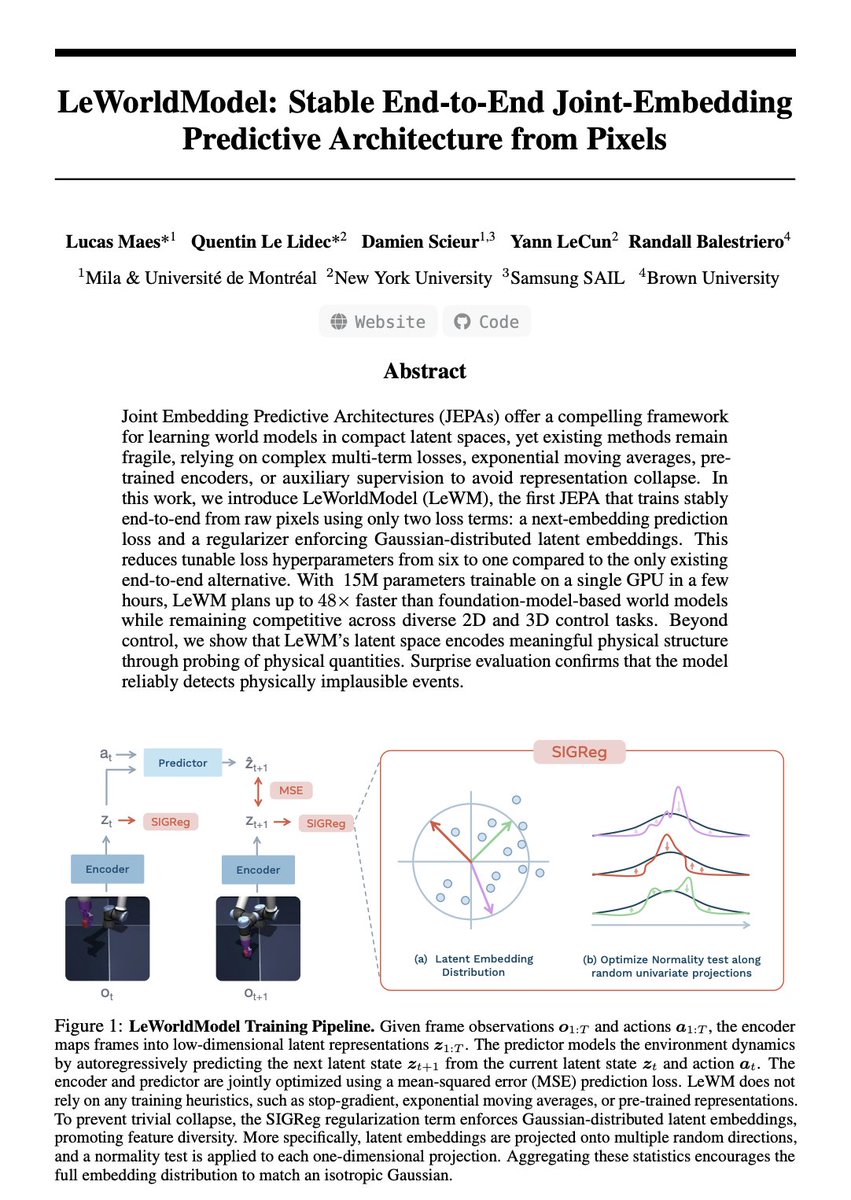
Researchers just dropped a paper called "LeWorldModel" (LeWM).
They completely solved the collapse problem.
They replaced the complex engineering hacks with a single, elegant mathematical regularizer.
It forces the AI's internal "thoughts" into a perfect Gaussian distribution.
The AI can no longer cheat. It is forced to understand the physical structure of reality to make its predictions.
The results completely rewrite the economics of AI.
LeWM didn't need a massive, centralized supercomputer.
It has just 15 million parameters.
It trains on a single, standard GPU in a few hours.
Yet it plans 48x faster than massive foundation world models. It intrinsically understands physics. It instantly detects impossible events.
We spent billions trying to force massive server farms to memorize the internet.
Now, a tiny model running locally on a single graphics card is actually learning how the real world works.
Logical Intelligence introduces first energy-based reasoning AI Model, and brings Yann LeCun to leadership as founding chair of their Technical Research Board
The 6-month-old Silicon Valley start-up, unveiled an “energy based” model called Kona and says it is more accurate and uses less power than large language models like OpenAI’s GPT-5 and Google’s Gemini.
It is also starting a funding round that targets a $1bn-$2bn valuation and has named LeCun chair of its technical research board.
Most large language models answer by predicting the next token, which can sound fluent while still drifting into confident mistakes.
Kona is an "energy-based reasoning model" (EBRM) that verifies and optimizes solutions by scoring against constraints, finding the lowest "energy" (most consistent) outcome. It's non-autoregressive, producing complete traces without sequential generation, reducing hallucinations.
Focuses on trustworthy, math-grounded reasoning for high-stakes applications where LLMs fail, emphasizing safety, efficiency, and constraint enforcement in logic-heavy tasks like puzzles or proofs.
How Kona operates
Its a non-autoregressive "energy-based reasoning model" (EBRM) model, meaning it doesn't generate outputs sequentially (like LLMs do token-by-token) but instead produces complete reasoning traces simultaneously. Here's how it works step-by-step:
- Input Conditioning: It takes a problem, constraints, and optional targets (e.g., a desired outcome like a proof goal or spec) as inputs. These condition the model directly, unlike LLMs which rely on probabilistic sampling.
- Energy Function Scoring: Kona learns an energy function that assigns a scalar "energy" score to entire reasoning traces (partial or complete). Low energy indicates high consistency with constraints and objectives; high energy flags inconsistencies, violations, or errors. This global scoring evaluates end-to-end quality, allowing the model to assess long-horizon coherence without degrading over extended traces.
- Optimization as Reasoning: Reasoning is reframed as an optimization problem. The model searches for the lowest-energy solution by minimizing the energy function, often through iterative refinement. It can revise any part of a trace mid-process, using dense feedback to localize failures (e.g., "this step violates constraint X") and guide corrections.
- Continuous Latent Space: Unlike discrete token-based LLMs, Kona works in a continuous space with dense vector representations. This enables precise, gradient-based edits and efficient local refinements without regenerating entire sequences.
- Output: The final low-energy trace represents a valid, constraint-satisfying solution. For example, in Sudoku, it maps allowable moves and finds a puzzle completion that minimizes energy (i.e., maximizes rule adherence).
This mechanism draws from physics-inspired principles, where energy minimization finds stable states, similar to how natural systems settle into low-energy configurations.
Overall, Logical Intelligence views EBMs as a path beyond LLM limitations, enabling AI that "knows" rather than guesses, with applications in verifiable, efficient reasoning.
This aligns with LeCun's long-standing advocacy for objective-driven AI via energy minimization, as opposed to autoregressive prediction.
13/ A final tip: probably the most important thing to get great results out of Claude Code -- give Claude a way to verify its work. If Claude has that feedback loop, it will 2-3x the quality of the final result.
Claude tests every single change I land to https://t.co/pEWPQoSq5t using the Claude Chrome extension. It opens a browser, tests the UI, and iterates until the code works and the UX feels good.
Verification looks different for each domain. It might be as simple as running a bash command, or running a test suite, or testing the app in a browser or phone simulator. Make sure to invest in making this rock-solid.
https://t.co/m7wwQUmp1C
Just got access to Runner H from @hcompany_ai an AI agent that can actually complete entire tasks for you!
You can try it now for free: https://t.co/hNpidYL7Rs #RunnerH