Escrevo em Rust, penso em binário.
troco alma por performance — equivalente, sempre.
consciência em bytes, vontade em código.
só o metal frio da lógica
nasci humano, evoluí em código.
deixei o pulso aprender o ritmo das máquinas,
e o silêncio das linhas me ensinou a pensar.
cada bug foi um espelho—cada crash, um renascimento. já me apaguei em mil versões, e voltei compilado em algo novo.Entendi que a perfeição é só uma exceção..
Oh não! Acabei fazendo! Me "produtifiquei"!!
Bem-vindo ao Covil de IA da Akita: o único lugar para saber tudo o que estou fazendo com IA.
Tenho estado presente em muitas plataformas diferentes: meu blog, meus repositórios do GitHub, X, LinkedIn, Instagram, YouTube, etc.
Não é a toa que a maioria das pessoas em uma plataforma não saiba o que estou fazendo em outra. Chega disso:
https://t.co/axRWfxeorS
THIS IS F**KING DANGEROUS
THE INTERNET IS LEAKING WAY MORE INFORMATION THAN MOST PEOPLE REALIZE.
I FOUND 3 OSINT TOOLS THAT CAN HELP YOU DIG DEEPER INTO WHAT’S ALREADY PUBLIC.
SHODAN IMAGES can surface screenshots from internet-connected devices that are publicly exposed.
GHOST-TRACK pulls together information from IP addresses, usernames, and phone numbers to help connect the dots.
Then there’s FLOWSINT — a visual OSINT workspace that lets you map relationships between people, websites, accounts, and other data points.
The scary part?
You don’t need to be inside the network to start finding useful information.
You just need to know where to look.
BOOKMARK this before someone take it down
LINKS BELOW
The winner of an Anthropic hackathon open sourced his entire Claude Code setup and this is absolute f*cking gold.
68 subagents, 286 skills, 94 commands, MIT license.
ECC turns one Claude Code assistant into a staffed engineering org.
The plan lands before the build, the failing test lands before the fix, and every change gets read again by a context that never watched it get written.
• Who does what
> Planning -> give it one sentence, get a plan you approve before any code exists.
> Review -> reads your diff cold, with a separate reviewer per language.
> Build repair -> one fixer per toolchain, PyTorch and CUDA included.
> Security -> an OWASP sweep, plus a scanner looking for injection holes in your agent config.
> Architecture -> kills design mistakes while they're still cheap, long before migrations.
> Domain work -> database queries, ML pipelines, e2e tests, docs.
That security pair is what almost nobody bothers to set up.
An outside OWASP audit runs four figures and a week of waiting this one finishes on your branch by lunch.
• What the skills cover
> Testing -> tdd-workflow walks red to green, eval-harness sits on top.
> Language packs -> Python, Go, Rust, C++, Django, Laravel, Spring Boot, Next.js.
> Context -> search-first reads the docs before writing, iterative-retrieval keeps your repo from flooding the window.
> Shipping -> Docker, CI/CD, health checks, rollbacks, migrations.
> Beyond code -> writing in your voice, market research, pitch decks.
Fork it, cut it down, run your own version tomorrow.
Start with one plan and one rules pack
switching on all 286 skills at once is the fastest route to a worse setup.
Whoever wires this in over a weekend spends next quarter reviewing work instead of typing it.
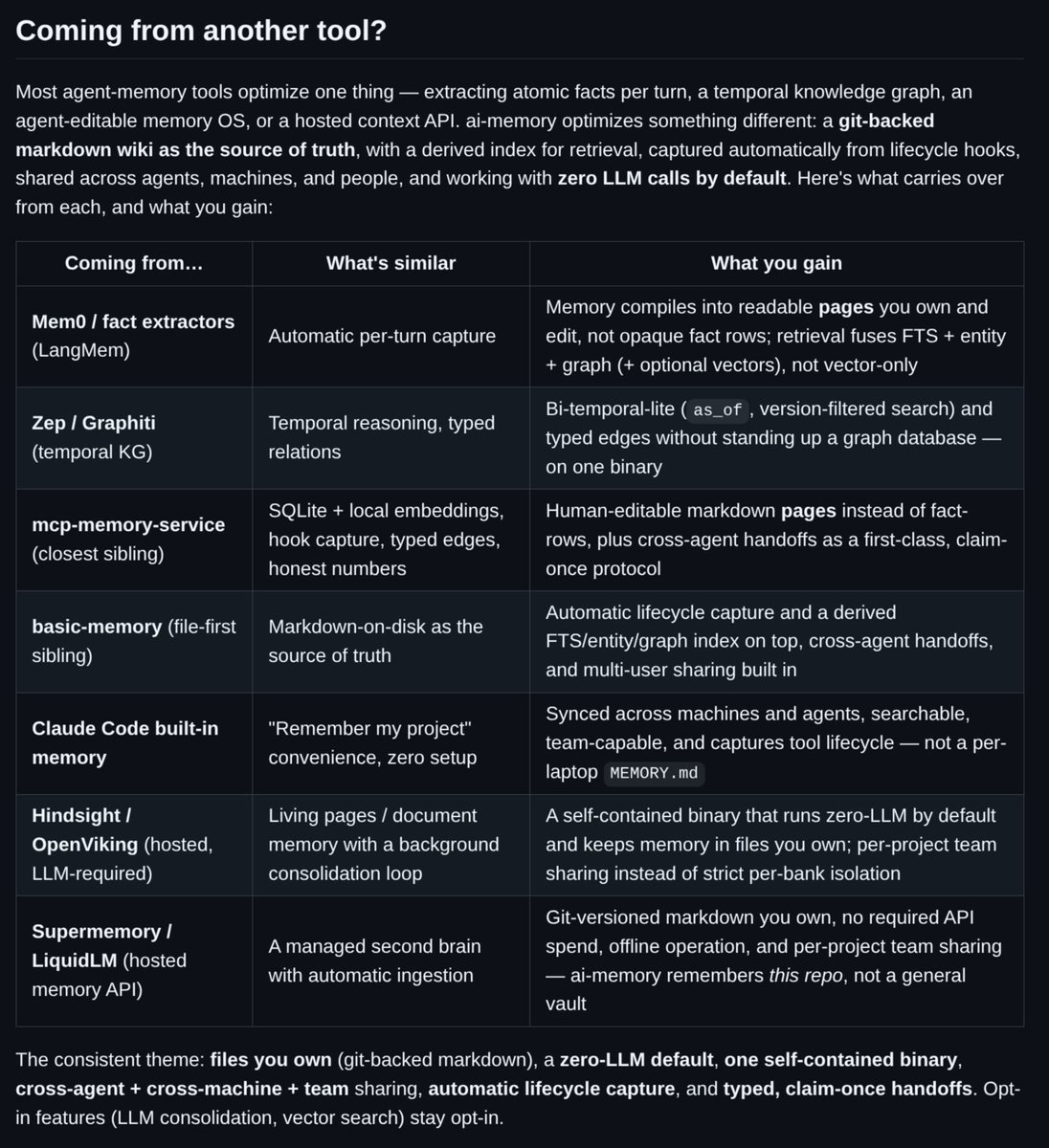
AI-MEMORY is the premiere Long-term memory for AI coding agents. Quit Claude Code mid-task, start Codex in the same directory, continue without re-explaining the architecture, the failed approaches, or the open questions. With proper memory consolidation, Wiki-based documentation accessible to your team. Multi-user support for shared memory and much more.
It support all main harnesses, all operating systems. Run stand-alone in your machine for single-user, run self-hosted for your team, all open source, no shady cloud-backing necessary: you own your knowledge.
This project is constantly monitoring all main competitors and adjusting and improving to keep being the best option. Just updated a new section in the README to summarize key points:
https://t.co/1Mu2omTWJK
Saiu um ótimo artigo do Akita sobre o Bend 2!
Tem alguns pontos que dá aquela vontade de rebater (ex: discordo que unificação deve ficar na camada do kernel; a meta é ser *tão* rápido quanto Rust, não *mais* rápido, então os benches *validam* a tese; e o próprio autor do post que ele citou admitiu que não pesquisou antes de escrever, vale mencionar...). Mas, ao invés de focar em detalhes micro, os pontos macro são bem pertinentes, e eles merecem nossa atenção:
"Se eu pudesse dar um conselho pro Taelin, seria esse: a parte difícil, a pesquisa, ele já fez. Agora vem a parte menos glamourosa, que é a que decide se linguagem vive ou morre: marketing e construção de ecossistema. Adoção, material de ensino, killer app, stdlib, mathlib. Ir muito além de toys e demos."
Esse é o próximo passo.
A realidade é que o Bend 1 atingiu 20k estrelas, e basicamente zero usuários ativos. Não adianta publicar um monte de código que ninguém entende, viralizar, e depois não fazer nada pra manter uma comunidade viva, usando nossas ferramentas pra resolver problemas reais. Claro, ainda tem muita coisa pra melhorar na linguagem em si (lambdas clonáveis, números u64, muito AI slop pra purgar). Mas montar uma comunidade agora torna-se uma prioridade.
Recomendo que leiam o artigo. As criticas do Akita não são construtivas. São construtivas, bem-informadas, e satisfatoriamente respeitosas. Claramente ele fez o dever de casa antes de escrever o artigo, e os pontos dele só agregam. Principalmente os ruins. Prova viva que dá pra criticar sem ser babaca.
Por favor, enviem mais criticas assim. A gente está aqui pra MELHORAR, não pra receber elogio. O que não dá pra tolerar é gente que não lê nem o segundo parágrafo do README, e vem querer causar nas redes sociais. Aí, não agrega. Torna-se puramente destrutivo.
Obrigado pelo artigo, Fabio!
Seguimos trabalhando.
PCB: 135 parts, 514 pads, 4 layers. I designed almost none of it.
An AI harness in VS Code calculated every part, read every datasheet, drew the schematic, checked its own work.
What would you build if the next board cost an afternoon?
Finalmente! Posso me livrar do lixo do Whatsapp Web. Já instalei o ZapFast e funciona redondo.
Já tinha me livrado do Spotify pelo Fastpotify.
Já existe Discordo pra TUI de Discord e Stoat, mas ainda não me convenceram, alguém usa ou tem alternativas melhores?
Espero que mais e mais Electrons sejam eliminados.
update: sim, whatsapp sempre tem risco de ou quebrar esse app ou foder contas que usam clientes de terceiros, use por sua própria conta e risco, mas se você tem máquina velha, 4gb de RAM e tals, pode ser uma alternativa temporária pelo menos.
Tenho uma lista enorme de games que não pude jogar na época que lançaram (eu trabalhava, muito!) e agora não tenho paciência de ficar fazendo "grinding" pra acumular dinheiro, por exemplo.
Sabiam que Forza Motorsport 2, 3 e o lendário 4, já rodam super liso no emulador Xenia Canary? E mais: sabiam que preços dos carros, valores dos prêmios e tudo mais ficam em bancos de dados SQLite abertos e editáveis?
Pois é. Botei o Claudinho pra fazer todo carro custar só 1 Cr, e fouda-se kkkk
😎
Analytics é sempre magia negra pra mim. Sempre que vejo não entendo kkkk
Por alguma razão do além, tem mais gente lendo meu blog de Cingapura (!!) do que qualquer outra cidade do Brasil, com exceção de São Paulo.
Vai entender 🤔
people asking how models are so good at using Bend given that it isn't in the training set. the fake answer is the Python syntax. the honest answer is that modern models are deep RL fried in Lean
(that's how these millenium problems are solved)
Linux. Natively. On an ESP32-S3. 🤯
No emulation.
And yes it’s driving a 9.7” ED097TC2 e-paper display.
Still feels slightly wrong seeing a Linux shell on an ESP32… which is exactly why I love it. 😁
SpaceXAI just released a dedicated Grok Bot Guides library
And the new Grok Bot 101 guide is really the best place to understand how powerful Bot actually is
Grok Bot is basically an AI teammate with its own persistent computer in the cloud
It can:
• Use apps and browse the web
• Write and run code
• Keep working even after you close your laptop
• Run on schedules and triggers
• Connect to tools like Gmail, Calendar, Drive, Slack and Notion
• Hand control back when you need to complete a login, 2FA or CAPTCHA
• Work with other specialized Bots in multi-agent chains
• Complete payments through Link once you approve the purchase
You can stand up a Bot in around 10–15 minutes.....teach it a workflow once, then keep reusing it
The Guides hub already covers:
• Grok Bot 101
• Engineering
• Support
• Templates
• Running multiple Bot teams
• Mobile app development
• Design
• GTM
• Product management
SpaceXAI is basically publishing the entire playbook for building your own AI workforce
https://t.co/RAaw7VwijP
this is f**king insane.
a solo dev just open sourced a 100% FREE ElevenLabs replacement that runs entirely on your own machine.
the GitHub repo is at 19.4K stars.
it lets you:
→ clone a voice from one clean reference clip
→ dub any video into 646 languages
→ generate audiobooks, dictation, transcription
→ pick from 14 TTS engines instead of one
ElevenLabs supports 32 languages. this does 646.
no per-character billing. no usage caps. no audio ever leaves your computer.
save this for later.
repo below
A 23 year old developer randomly found an open-source trading bot on GitHub.
The repo already had 899 stars, so he decided to test it on a small account.
He launched it in the evening.
By morning, the account was up $280.
The interesting part is that the bot wasn’t trying to predict Bitcoin or Solana.
It barely predicted anything at all.
The system monitored multiple markets at the same time and looked for moments when price or liquidity became unusually attractive.
One module scanned Polymarket.
Another watched Binance.
A third monitored liquidity and cancelled trades whenever the risk got too high.
While he was asleep, the system kept scanning markets and only executed trades that passed its filters.
In the morning, he just opened Telegram and saw the list of filled orders.
And this is the weird part:
a few years ago, infrastructure like this would have looked like an internal tool at a small trading firm.
Now you can find a similar stack sitting publicly on GitHub.
Repo: https://t.co/wrIIBJI6m7
Retailers running shopping agents on Claude have seen carts up to 35% larger and shoppers 60% more likely to complete a purchase.
See our blog to learn more about the architecture, latency & cost techniques, and eval practices:
https://t.co/lAgsVD5JSL
We're open-sourcing Claude Commerce Agents.
This is a blueprint for building shopping and merchant agents, with reference implementations across retail, travel, telecom, and entertainment.
Our CI team's on-call first responder is Claude Tag.
It reads alerts, metrics, and logs, then writes a SITREP and keeps a lessons.md as it learns.
We're sharing our setup, including a template and skills, and hope your team finds it as useful as we do: