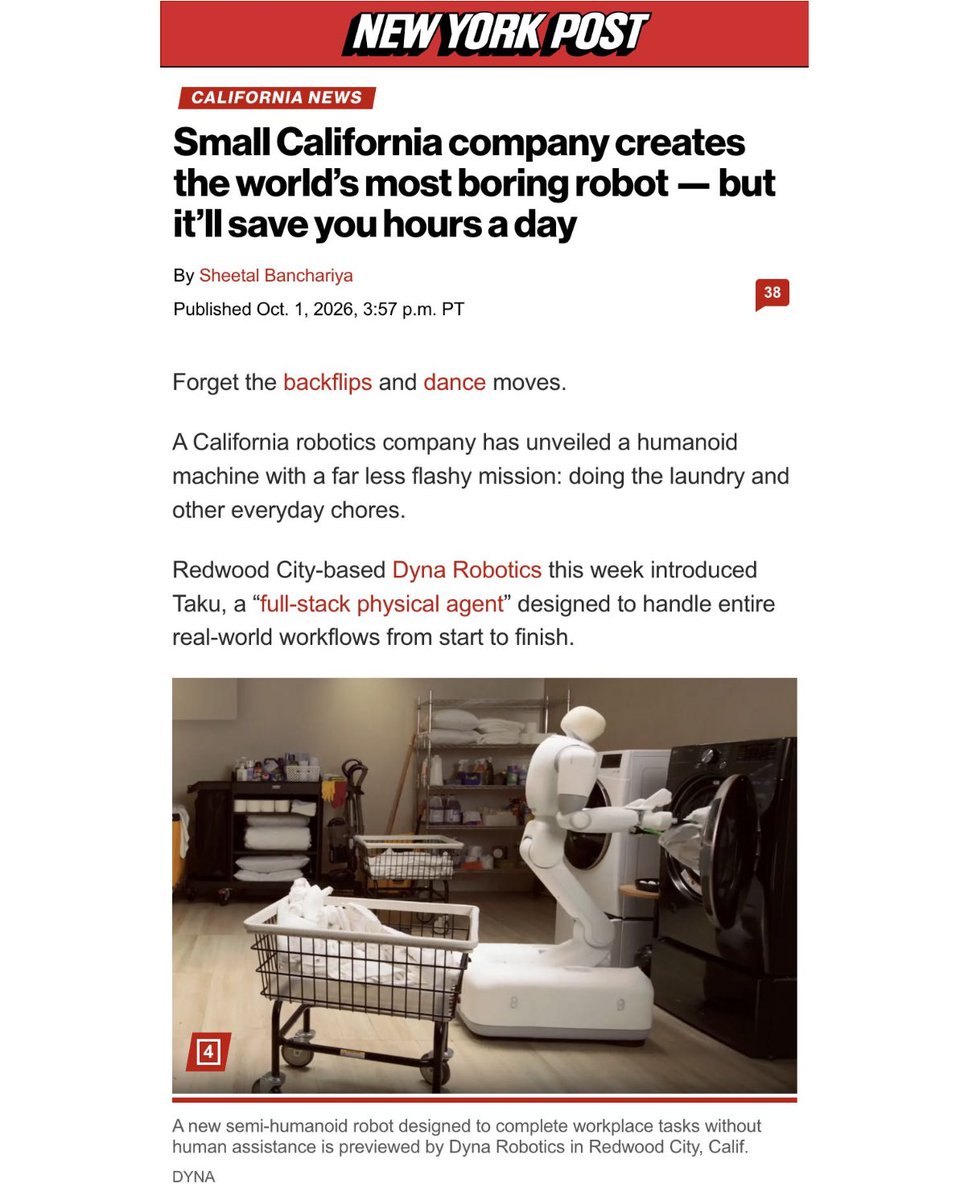
When the New York Post calls your robot “the world’s most boring robot”, you know you are doing something right. 😭😂
This is actually the highest praise ever: when robots actually work, they are supposed to be boring, just calmly and reliably getting the job done.
Here’s a more personal breakdown of how we built Dyna-2.1 - the first Physical Agent to achieve 1-hour-long, dexterous whole-body autonomy.
A lot of the system came down to a few fairly fundamental design choices.
We are releasing Dyna-2.1, the first Physical Agent that achieves reliable super long-horizon whole-body autonomy. It combines our brand-new semi-humanoid hardware with an agentic system built around Dyna-2 to handle ultra-long real-world workflows.
Here is an uncut footage of Dyna-2.1 completing an entire hour-long laundry room workflow, just like a human does.
This is our release that I am actually most excited about because it shows and proves what truly matters. Deployment is the ultimate prize and the only reliable eval for robotics. After having worked on so many research projects and models in my career, where I saw so many new capabilities I had never seen before, there was always a question in the back of my mind: do they matter and how?
At a time in robotics where the signal-to-noise ratio is so low, where there’s so many demos, models, pilots, you see everyday, the conclusion I arrived at has always been shipping our models, robots, and entire systems to real customers and proving that they actually fulfill a need for real people. Showing a demo is easy, proving that the robots create sustainable value for customers over a long period of time is extremely hard. We know it's hard, but we also know it's necessary to get right. This mindset is also why I decided to start Dyna with @Lindon_Gao and @YorkYang5050 in the first place, because our heart has been focusing on the right problems from day 1. It’s great to see the whole team’s effort culminating in this first scaled deployment release of its kind for the industry. But we are just getting started, and I am more excited about the future of the physical economy than ever before.
After so many demos, models, pilots, robots are still struggling to land real deployments with real customers. Until now.
Today we’re excited to share that our robots have successfully crossed the ROI threshold, and Din Tai Fung, one of the highest revenue per location restaurant chain in the US, is rolling out Dyna robots across its extensive restaurant network.
This brings our rollouts across hotels, logistics, data centers, and many other use cases to a fleet that reaches hundreds of robots by the first half of 2027. And we’re just getting started.
It’s been a wild year, and today we’re double clicking on the battlefield stories and sharing a few learnings about scaling robot deployments. We are just scratching the surface.
Read the full blog post: https://t.co/8QVEoQuzBY
We’ve seen plenty of impressive robotics demos. But now the bar must move higher: robots must create real value in the real world — and that value must scale.
For us, the real test is not whether a robot can complete a task once. It is whether customers get enough value that they want to deploy more. Robotics only matters when it solves real problems: taking repetitive, tedious, dirty, and difficult work off people’s hands while creating meaningful economic value for the businesses using it.
ROI and scalability are inseparable. One successful deployment can prove customer ROI, but not a scalable product or business. If every new customer or workflow requires rebuilding the solution, the economics will never scale. You only prove that ROI can scale when the same underlying technology keeps creating value across customers, workflows, and industries — while the effort, cost, and time for each new deployment keep coming down.
We think about the path very simply:
Demo: “It works.”
You’ve proven technical possibility.
Pilot: “It works here.”
You’ve proven it can work in a real environment and start creating value.
Scaled deployment: “We want more.”
Customers keep expanding because the ROI works, and we can keep delivering that value without rebuilding everything from scratch.
Every deployment must make the next one better. A problem solved in the field should leave something reusable behind — a better model, better tooling, better infrastructure, or a more general capability. What we learn from one customer should make the next deployment easier, faster, and more reliable.
This is also why research and deployment must stay tightly connected. Research expands what robots can do. Deployment tells us what actually matters, where things break, and what must be solved fundamentally — not patched case by case. You need both to build a product that can truly scale.
Today, we’re sharing more of what we’ve learned across a broad range of industry partners — the successes, failures, operational challenges, and hard-earned lessons behind getting robots to create real value in production.
The goal is not just to make robots work. They must create real value. That value must repeat. And it must scale.
Waymo was founded in 2009. Their demo took 18 months. Their first driverless rides opened to the public in 2020.
It's easy to show a demo. What comes after are the edge cases, recovery, uptime, integrations, and the small failures that only show up once a robot has done the job every day for months. In the field.
We spent the past year in that "after" with our customers, running their napkin operations day in and day out. Twelve months ago, Dyna-1 was the most reliable robot foundation model DEMO published at the time. Today the comparison with Dyna-2 is stark.
We announced today that Din Tai Fung is taking Dyna's robots beyond pilot sites and across its restaurant network. That's what product-market fit looks like: not a benchmark, not a demo, but a customer deciding they want more. That's what I joined Dyna to work on!
After so many demos, models, pilots, robots are still struggling to land real deployments with real customers. Until now.
Today we’re excited to share that our robots have successfully crossed the ROI threshold, and Din Tai Fung, one of the highest revenue per location restaurant chain in the US, is rolling out Dyna robots across its extensive restaurant network.
This brings our rollouts across hotels, logistics, data centers, and many other use cases to a fleet that reaches hundreds of robots by the first half of 2027. And we’re just getting started.
It’s been a wild year, and today we’re double clicking on the battlefield stories and sharing a few learnings about scaling robot deployments. We are just scratching the surface.
Read the full blog post: https://t.co/8QVEoQuzBY
When people talk about robotics, they usually talk about models, data, or hardware. Few people talk about the infrastructure that lets you iterate on all three quickly. Today we're publishing how we trained Dyna-2 on over 1,000,000 hours of egocentric video, repeatably. At this scale, most of what worked at ten thousand hours did not hold up:
• ingestion throughput was capped at 14,000 episode-hours per week — a million hours would have taken over a year
• building a training manifest took 48 hours before a run could even start
• reading a petabyte from cloud storage during training left GPUs exposed to latency and packet loss
🧵
Dyna-2 is here. Robot performance improves predictably with every hour of human video. A million hours of human video in, and capabilities are still switching on.
Now the fun part for me: getting it out to real customers! 🦾
Today we are introducing Dyna-2, a world-action model pre-trained on one million hours of human video. At this scale, for the first time, we discovered several new scaling laws:
• world-action models exhibit scaling law on human data across four orders of magnitude, from 1000 to 1,000,000 hours,
• this human data scaling law implied a scaling law on never seen robot data,
• both data and objective matter; world modeling and scaling on video data are essential for cross-embodiment scaling transfer to emerge
🧵