🚨 Anthropic just showed a 27-minute workshop on how to actually do prompts for Claude.
Taught by the people who built it.
Free. No registration. No paywall.
I've seen $300 courses that don't cover what they teach in the first 8 minutes.
Watch it and bookmark it now.
Two Anthropic engineers spent 24 minutes exposing every Claude Code feature you didn't know existed.
Most people will scroll past this. Don't be most people.
If you're serious about mastering Claude, then this is the most important video you'll ever watch.
How to go from Beginner → Pro in 3 steps, with the exact memory system I use to set up Cowork + Claude Code for the best results.
This video will permanently change how you use Claude:
THEY DID IT.
The SEC and CFTC just dropped a landmark document that officially classifies crypto assets.
They're actually telling us which crypto assets are securities and which ones aren't - by name!
THIS IS SOMETHING GENSLER REFUSED TO DO
(he focused on prosecuting crypto out of existence)
This rule doc gives crypto many of the benefits of the clarity bill - it lifts us out of the gray market - it gives every asset a path.
It's almost like the Clarity act just passed by way of regulator.
(of course, the actual clarity act will harden all this into legislation and make it irreversible in the event we get another Gensler, we still want it)
This rule says there's 5 categories for crypto assets:
1) Digital Commodities - assets tied to a functional, decentralized crypto system (e.g., BTC, ETH, SOL, XRP, ADA, DOGE). Not securities. (yes, they name them on page 14)
2) Digital Collectibles - NFTs, meme coins, artwork tokens, in-game items. Not securities (fractionalized collectibles may be an exception).
3) Digital Tools - membership tokens, credentials, domain names (e.g., ENS). Not securities.
4) Stablecoins - payment stablecoins under the GENIUS Act are not securities. Other stablecoins, it depends.
5) Digital Securities - tokenized versions of traditional securities. Like tokenized stocks. Always securities.
Amazing! This makes so much sense I can't believe it's coming from a regulator.
No more enforcement threats to Ethereum developers and crypto exchanges.
How about the Howey test?
More common sense! If an issuer makes specific promises of managerial efforts from which buyers expect profits, the offering is a security until those promises are fulfilled. Then it's a commodity. The asset itself was never the security, the deal around it was. (E.g. XRP was a security pre launch, became a commodity after).
How about stuff like staking and mining?
Mining? Not a securities transaction.
Staking? Also not a securities transaction, that includes custodial and liquid staking even with LSTs!
How about wrapping BTC? Not a securities transaction.
Airdrops? NOT SECURITIES. NO MORE GEO BANS PROTECTING AMERICANS from free airdrops.
Remember this is a joint doc from the SEC and CFTC, They're actually cooperating on this, no internal strife, this is binding to both.
SEC regulates $80-100 trillion assets
CFTC regulates $5-10 trillion assets
Both of the world's largest capital markets are showing us that crypto assets are here to stay and they're welcome alongside traditional assets.
Every country will follow.
This is the biggest move toward legitimacy I've seen in all my time in crypto. Maybe bigger than the genius act since is covers all crypto assets.
Well done @MichaelSelig and @SECPaulSAtkins.
And especially well done to the indefatigable @HesterPeirce. Her fingerprints are all over this, couldn't have happened without her eight years of principles-based curiosity.
JUNE 2028.
The S&P is down 38% from its highs. Unemployment just printed 10.2%. Private credit is unraveling. Prime mortgages are cracking. AI didn’t disappoint. It exceeded every expectation.
What happened?
https://t.co/JzzwCrbJgS
I have built the future
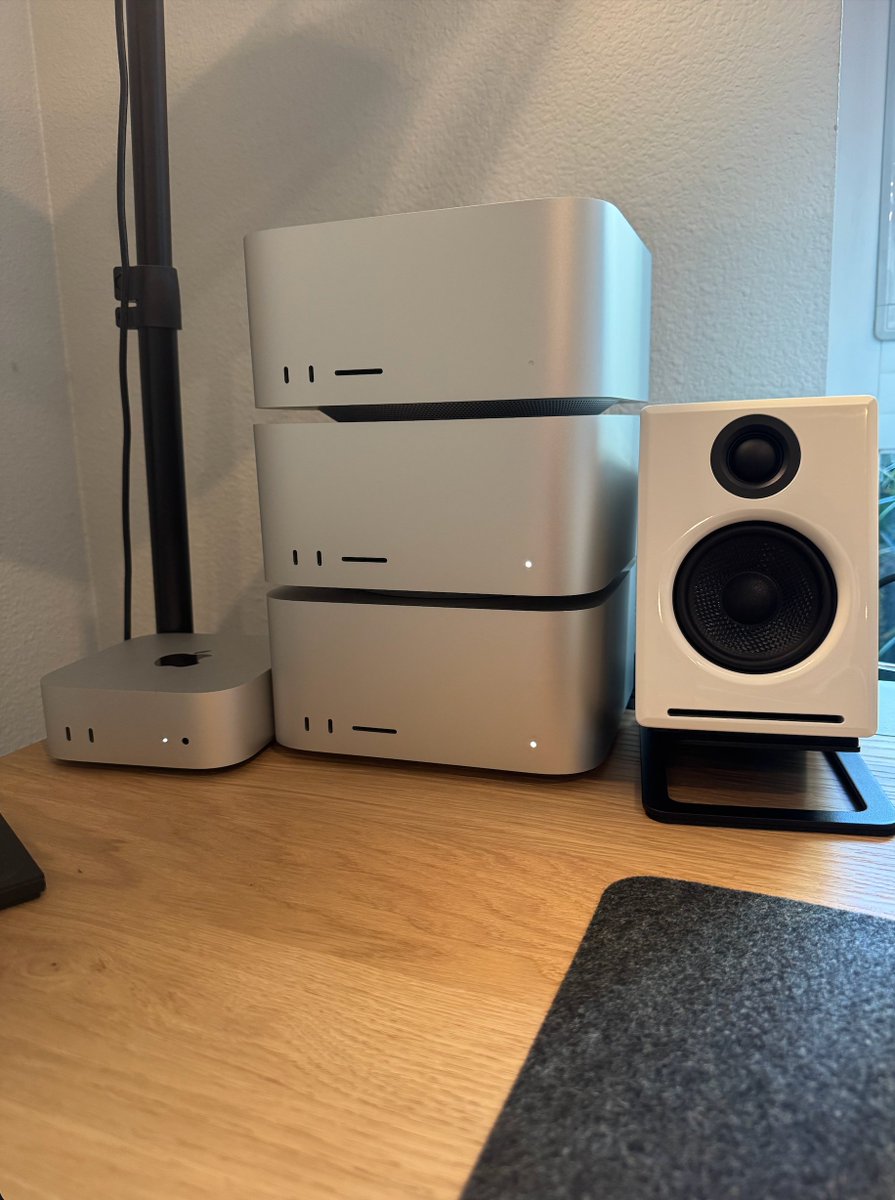
I'm now running 3 of the most powerful AI models in the world on my desk, completely privately, for just the cost of power.
3rd 512gb Mac Studio is in (Apple reached out and lent me the third one! Thanks Apple!)
Here are the models I'll be running:
• Kimi K2.5 (600gb across all 3 studios via EXO labs)
• MiniMax 2.5 (120gb on one studio)
• Qwen 3.5 (220gb on one studio)
• GOT OSS 120B Heretic (60b on one studio- completely uncensored 😈)
3 ultra powerful models coding, writing, researching, reading your posts, 24 hours a day. 7 days a week. Nonstop.
Running across 4 OpenClaws on 3 Mac Studios and a Mac Mini
A few use cases I have set up:
• Kimi K2.5 reading feature requests for Creator Buddy and building out the feature requests autonomously. My own personal product manager
• MiniMax 2.5 reading Reddit all day, looking for challenges to solve. Then building prototypes for me to review every morning. All autonomously.
Qwen 3.5 hitting the X API every hour to see top trending posts in AI and vibe coding. Turning those into video scripts for me to review hourly (this has already built me one script with over 100k views on YT)
Unlimited economic power just sitting there. No cloud APIs. No crazy API bills. No tech executives reading my logs. Totally customizable and private.
This is the future. I'm just showing it to you before it arrives
Video made by Seedance, an AI model made by Bytedance, the parent company of TikTok.
Less than a year ago, to determine whether a video is AI generated, you just need to count the number of fingers.
My Thesis for the Privacy Narrative
For the better part of a decade, the prevailing narrative in both traditional finance and crypto was that ''transparency is a virtue''. We were conditioned to believe radical openness is the default state of the future, and that only those with something to hide (criminals, tax evaders, paranoiacs) would ever demand privacy.
I think that era is ending.
As we enter 2026, the market is already showing a rotation that most people are still ignoring.
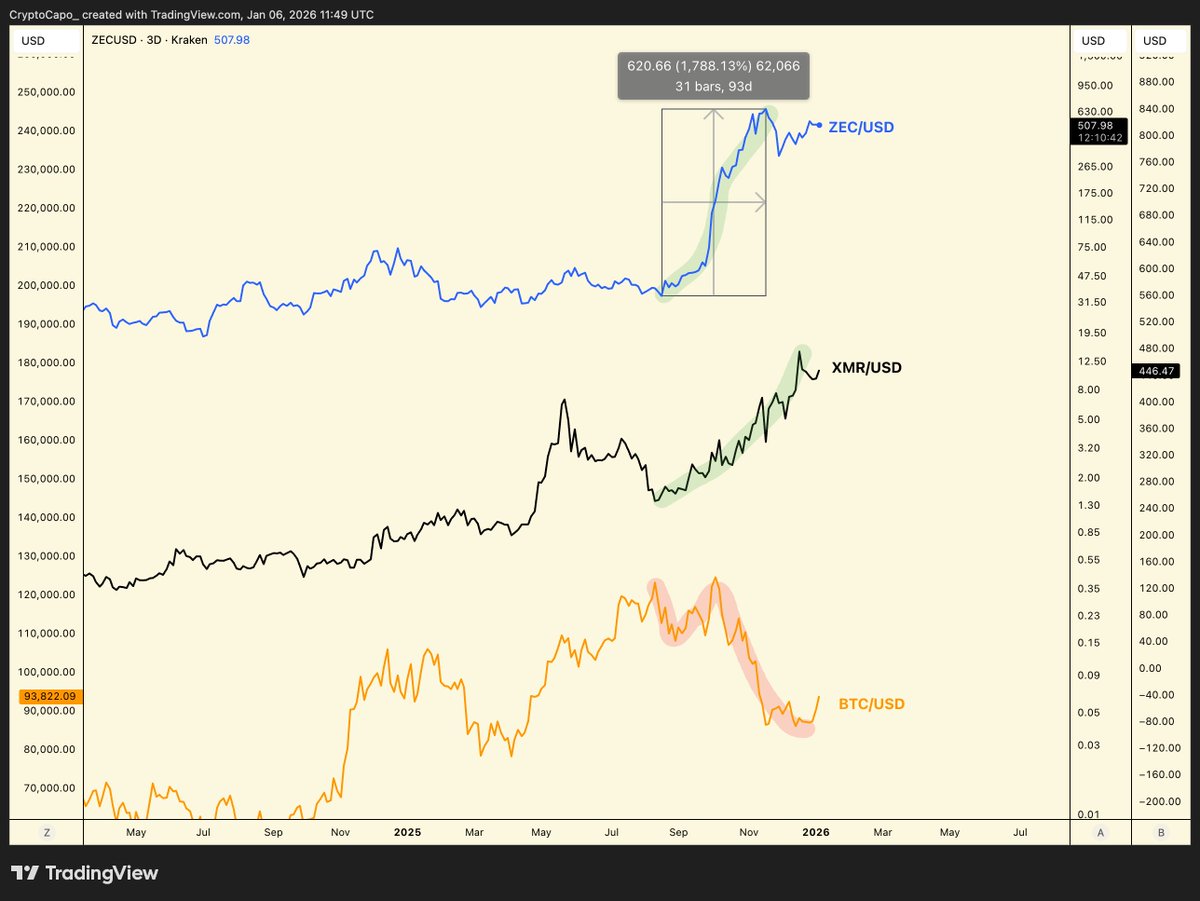
Take this chart as an example:
$ZEC printed an 18x to 20x move in roughly 3 months (Aug to Nov 2025), and is now consolidating. $XMR has also doubled in price in the same timeframe. All of this while #Bitcoin has retraced from the all-time high of $125k to a local low of $81k. This means money has been rotating, and it’s a clear sign of strength for privacy coins.
But… why is this happening?
Privacy is no longer a luxury. The social contract regarding money is being broken. Money is transitioning from being a tool of freedom to becoming a tool of surveillance.
Money is constantly evolving. Now digital money is becoming more integrated, more automated, and more connected to rules and systems. That trend is largely unavoidable.
CBDCs are part of that conversation. With 137 jurisdictions, representing 98% of global GDP, exploring Central Bank Digital Currencies (#CBDCs), the debate is no longer if they will arrive, but when and how. While CBDCs offer some benefits, like offering clear efficiency gains for central banks, their underlying programmable nature introduces the structural capacity for unprecedented oversight.
The design specifications of many pilot programs include features that could theoretically allow for expiration dates on funds, negative interest rates to enforce spending, or spending limits based on social metrics (social credit score). Even the potential for such control is altering the risk profile of holding cash within the traditional system. As these architectures get closer, the market is beginning to price in the demand for alternatives where money cannot be programmed or restricted by a central issuer. Not predicting a dystopian future, but hedging about the technological capabilities of it is always a smart choice.
This is also being accelerated by the systematic ‘’War on Cash’’. As governments eliminate physical cash, through withdrawal limits and the stigmatization of paper money, a massive vacuum is created. We already saw in Canada that a supposedly democratic government was willing to freeze the bank accounts of citizens for peaceful protest.
However, the argument for privacy extends far beyond that. There is a fatal flaw in the ''transparency'' narrative that the crypto community is only now starting to price in: security. Living in a ''Glass House'' is dangerous. With the advent of AI and advanced chain analysis, ‘’transparency’’ is a synonym for vulnerability. For example, if you pay for a coffee with Bitcoin on a public ledger, the barista can theoretically see your entire net worth, your income, and your home address. High net-worth individuals are realizing that total transparency makes them targets.
This is amplified by the reality of corporate espionage. Major corporations are less likely to move their supply chains to a public blockchain like Ethereum or Solana. Why? Because they cannot afford to have their competitors see exactly who they pay, how much they pay, and when their supply chains falter.
The market data confirms this rotation. We are seeing the DEX/CEX ratio hitting all-time highs as users seek non-custodial, private ways to trade.
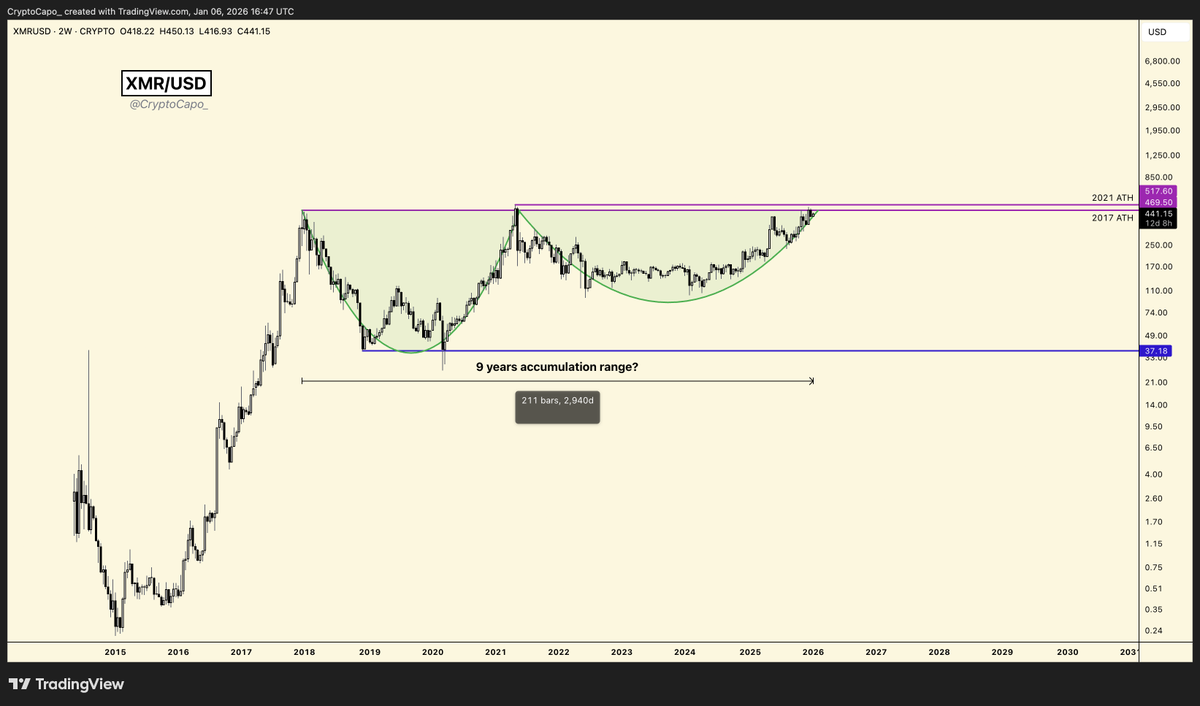
Not to forget the technicals, which I consider even more important than fundamentals. #Monero remains the main privacy coin. There’s probably better privacy tech out there, but there are other factors that make it number one by market cap (though temporarily slightly surpassed by ZEC).
As I’ve been posting these last weeks, $XMR chart is one of a kind. With a massive bullish pattern that resembles similarities with the silver chart just before the breakout.
If we get a clean breakout, I see $1,000 as a minimum target. And if that happens, it likely pulls the entire privacy narrative with it.
Here's the bottom line:
-Privacy is being repriced as infrastructure, not just ideology.
-The world is building more digital control surfaces, whether people admit it or not.
-Cash is fading, reporting is expanding, and on-chain transparency is becoming a liability for both individuals and businesses.
-When a narrative concentrates into a small group of assets, moves can be violent.
I think 2026 is a year where the privacy theme can dominate for months, and potentially longer.
Security. Fairness. Sovereignty. Resilience.
And one last reminder: none of this is a call to live in fear. Privacy is a tool, not a lifestyle. Protect your optionality, but don’t forget to disconnect sometimes. Touch grass. Keep your mind clear. That’s an edge too.
Disclaimer: This is just my opinion and does not constitute financial advice.
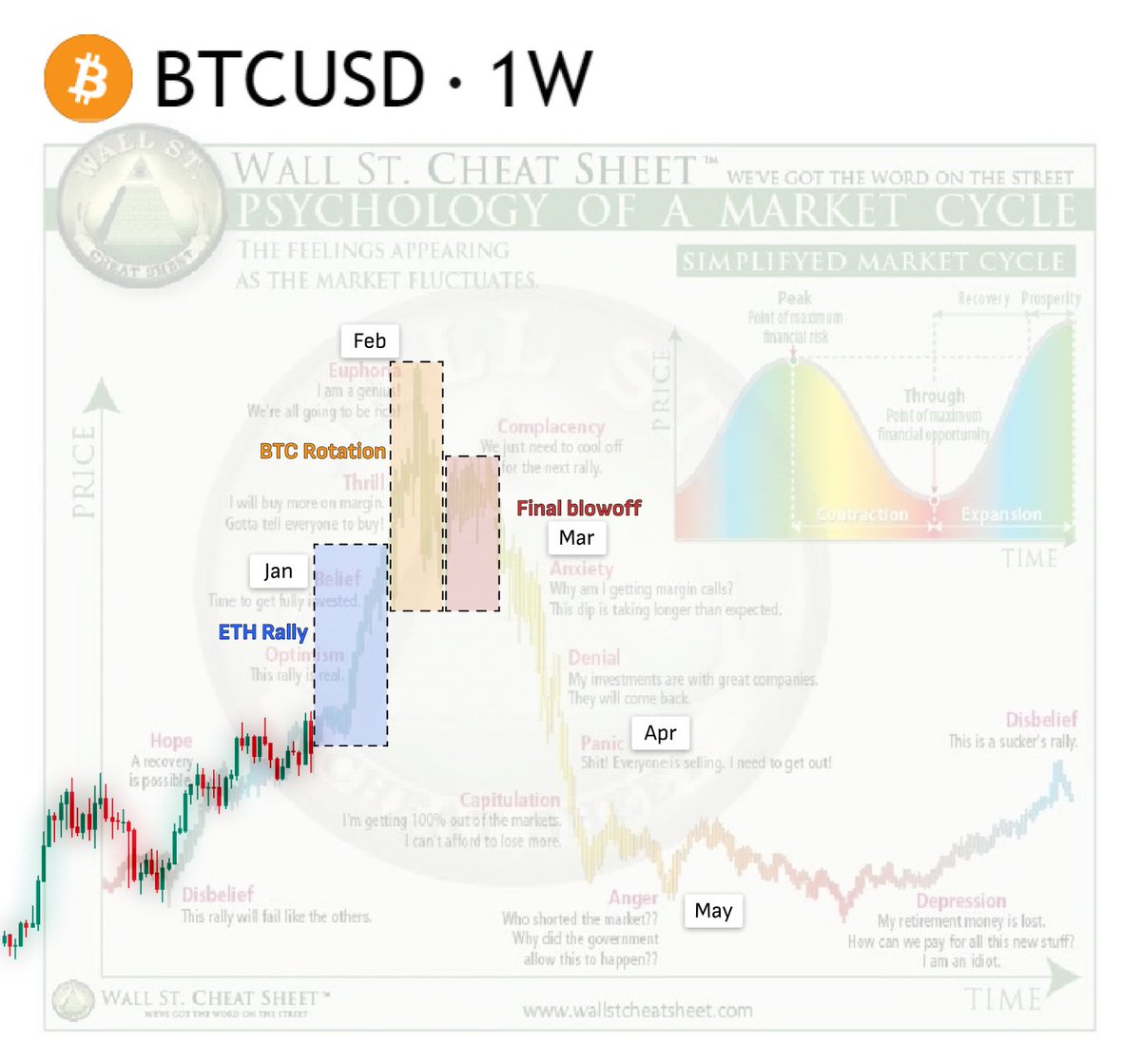
2026 Roadmap:
December – Accumulation phase
January – BTC takes the lead
February – Altseason
March – Bull trap forms
April – Markets break down
May – Full bear market
Take note, check back later
DRAGON BALL Z – LIVE ACTION
We’re on a roll lately… +8 MILLION views in 1 day with this video 😱
This trend is going super viral and a lot of people are making their own version. Hope you like mine 😉
Oh! And as always… TUTORIAL 👇🏻🧵
BREAKING: Aztec just shipped the Ignition Chain, the first fully decentralized L2 on Ethereum.
This launches the decentralized consensus layer that powers the Aztec Network.
https://t.co/nYyD7cykz2
🧵
Privacy matters. Today during @web3privacy, maestro @VitalikButerin highlighted #Kohaku, a new Ethereum framework focused on bringing real privacy to wallets. All 8mins!
Solana Seekers deserve some love too. Claim your Seeker X Moonbirds SBT on @solana now!
Open for all owners of a @solanamobile Seeker with a Seeker Genesis Token as well as all holders of Moonbirds, Mythics & Oddities. Holders can mint 1 SBT per NFT held.
https://t.co/WuEbSgP7at