Jensen Huang acaba de matar el prompt engineering
El CEO de NVIDIA (el 7º más rico del planeta) habló 67 minutos en Stanford sin guion ni filtros y dejó esto:
«Si todavía escribes prompts… para. Empieza a construir loops.»
Esto es gratis
Y vale más que la mayoría de cursos de 300 dólares
No lo mires
Construye tu primer loop ahora
Guía abajo 👇
OpenAI just introduced GPT‑5.5, the smartest and most intuitive to use model yet, and the next step toward a new way of getting work done on a computer. GPT-5.5 is now available in the API, Codex, and ChatGPT.
GPT‑5.5 understands what you’re trying to do faster.
The war in the Middle East has accelerated lifted demand for alternatives to volatile fossil fuels, setting 2026 up to be the year of the battery https://t.co/Uf7gBOOKRI
@r0ck3t23 Without scaling the energy base, the upper layers hit a ceiling. But the same AI tech driving demand is also being applied to solve grid challenges—creating a feedback loop.
The next few years will test whether innovation in power can match the pace of compute scaling.
@MAGA_X_Times Poor people. How important to have certified pilots, balloons inspected and an strict weather monitoring protocol. Capadocia in Turkey is a good example.
Jensen Huang just gave every CEO on the planet a single number to judge their engineering team by.
Not lines of code.
Not features shipped.
Dollars burned in compute.
Huang: “If that $500,000 engineer did not consume at least $250,000 worth of tokens, I am going to be deeply alarmed. And this is no different than one of our chip designers who says, ‘Guess what? I’m just gonna use paper and pencil. I don’t think I’m gonna need any CAD tools.’”
Half a million dollars in salary.
Five thousand dollars in token spend.
That ratio should be keeping every hiring manager awake tonight.
It means your most expensive engineer is solving problems by hand that a machine could close in seconds.
You are paying Formula 1 money for someone pedaling a bicycle.
Huang is not suggesting engineers use more AI.
He is saying if they are not consuming massive volumes of inference, your organization has a structural failure it has not diagnosed yet.
And if you are the engineer in that seat right now, the math is staring directly at you.
Your value is no longer measured by what you can build alone.
It is measured by how much machine output you can direct, evaluate, and multiply.
The ones who refuse to let go of the keyboard are pricing themselves out of the conversation.
Calacanis pushed him on what this looks like two or three years out.
Huang didn’t give a forecast.
He eliminated three assumptions the entire industry still plans around.
Huang: “‘Wow, this is too hard,’ that thought is gone. ‘This is gonna take a long time,’ that thought is gone. ‘We’re gonna need a lot of people,’ that thought is gone.”
Too hard. Gone.
Too long. Gone.
Too many people. Gone.
Every planning conversation in every boardroom in the world is built on at least one of those three constraints.
Huang just declared all three obsolete.
Huang: “This is no different than in the last Industrial Revolution somebody goes, ‘Boy, that building really looks heavy.’ Nobody says that. Everything that’s too big, too heavy, takes too long, those ideas are all gone. You’re reduced to creativity.”
The Industrial Revolution made it absurd to say an object was too heavy to move.
This moment makes it absurd to say a problem is too complex to build.
Once you saturate your workforce with enough inference, the only bottleneck left is the quality of the idea itself.
Not the team size.
Not the timeline.
Not the technical difficulty.
The idea. That is all that is left.
Huang: “In the past, we code. In the future, we’re gonna write ideas, architectures, specifications. We’re gonna organize teams. We’re gonna define how to evaluate the definition of good versus bad. And I think that every engineer is gonna have a hundred agents.”
The engineer of the next decade does not write code.
They write intent.
They define what good looks like.
They architect the problem.
They evaluate the output.
They direct a hundred agents executing in parallel across every layer of the stack.
The companies still hiring engineers to manually write syntax are staffing a typing pool in the age of the printing press.
The engineer’s job is no longer to build.
It is to command.
Energy & Power as the New Bottleneck
Oil-field giants pivoted toward AI infrastructure with Baker Hughes booking 1.2GW of data-centre power orders in 2025 with a backlog exceeding $32B, while Halliburton teamed with VoltaGrid on a 2.3GW deployment to power Oracle’s AI centres .
5/5. 🚀 Performance Needs
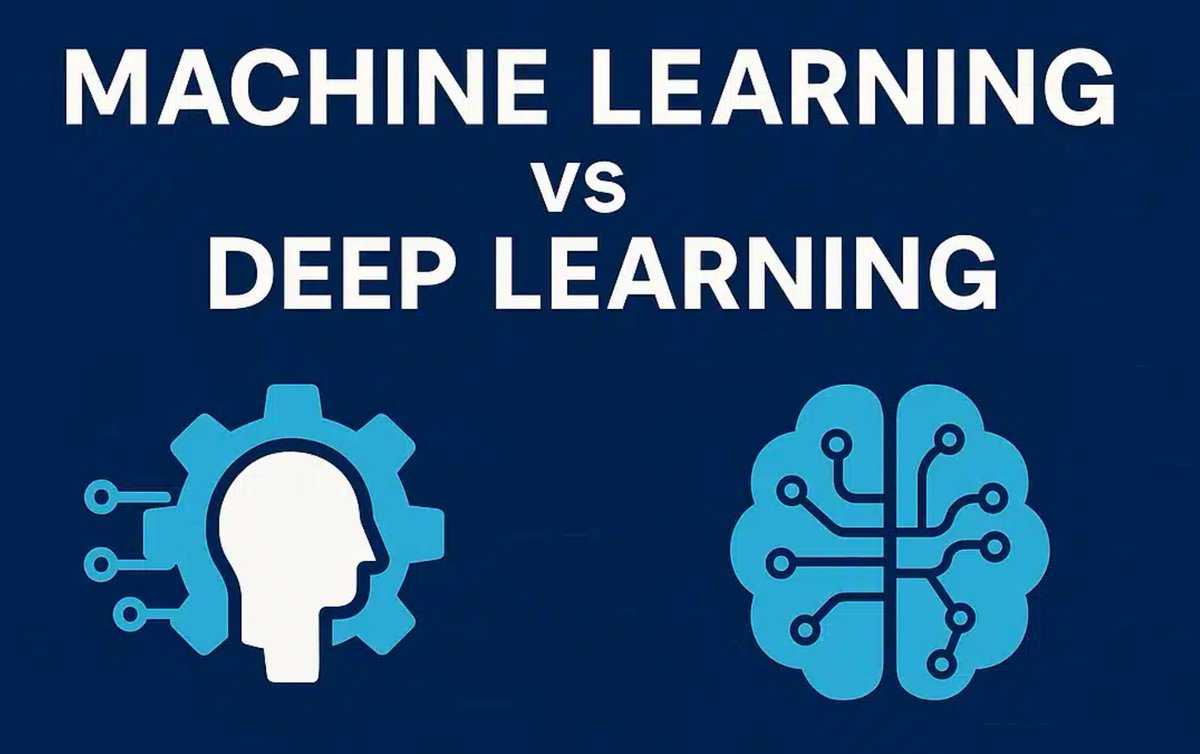
ML often gives “good enough” accuracy with less effort.
DL can push performance further when accuracy really matters.
👉 If baseline ML accuracy is already acceptable, you might not need DL.
4/5. 🔍 Interpretability vs Accuracy
ML models are more interpretable
DL models are more accurate but harder to explain
👉 If stakeholders need clear explanations → ML is often the choice.