Before a meaningful move, the market often tests the path.
After a possible bottom, price may press lower again. If volume, volatility, and downside progress shrink, there may not be much supply left.
After a possible top, price may press higher again. If buyers cannot create progress, demand may be exhausted.
So keep coming back to the same questions:
Who is making progress?
Who is spending more for less?
Who got trapped?
Did price accept or reject the break?
Which side can no longer create real damage?
Which of these waves actually matters on my timeframe?
Simple does not mean shallow. These are the questions that keep you from getting lost in the chart.
The goal is not to sound smart after the move.
It is to recognize the shift while risk is still definable.
8/8
Listen here, my fellow chart nerds. The easiest time to call a bottom is six months after it happened.
In real time, a bottom isn’t a call. It’s a percentage that keeps moving as price gives you more information.
Right now, I’d give Bitcoin roughly a 55–60% chance of being somewhere in an accumulation or bottoming process, versus 40–45% that this is redistribution before another leg lower. That’s a slight lean, not a victory lap.
What we have now looks like a legitimate spring attempt. Price pushed through support, failed to accelerate lower, recovered, and is trying to build away from the lows. But a spring is only a test. It still has to produce something.
And even if this is accumulation, that doesn’t guarantee the ultimate low is already in. Bottoms can be ugly and slanted. We could make another lower low months from now and still look back at this entire range as part of the bottoming process. The first stopping action can begin accumulation without ending the bear market that day.
So the percentages move with the chart. Close above 65–67k and hold it, and I’m probably around 68–70%. The spring would finally be producing actual upside progress instead of merely preventing another collapse. Reclaim 70–71k with real spread, then pull back and hold above roughly 67k, and I’m closer to 80%. That starts resembling genuine Phase D behavior… strength first, then buyers defending the ground they just reclaimed.
Acceptance above 74–76k gets me into the 88–90% range. Break 82k, hold it, then successfully back up into that old resistance without falling apart, and I’m around 98%.
Never 100%!
The downside works the same way. Lose 61–62k again and this is back near 50/50 at best. Close below 58–59k and then fail to reclaim it, and the current accumulation read falls toward 20–25%. Not zero, because a larger bottoming range could still include another lower low. But the spring we’re studying now would have failed, and that matters.
This is what professional trading is actually about. It isn’t screaming “bottom” for four months and then digging up the one screenshot where you finally got it right. Congratulations, you nailed 27 of the last three bottoms.
Trading is about making money while the answer is still uncertain. When the odds improve and price confirms, there are longs worth taking. When a key level fails and the reaction agrees with that failure, there are shorts worth taking. You don’t need a trophy for calling the exact low. You need the edge on your side when you put risk on.
Anyone can circle the bottom later. The work is knowing what would make it more likely now, what would prove you wrong, and how to trade either outcome while everyone else is still arguing about who gets credit.
My December macro newsletter is now available.
It discusses the debasement trade, changing macro conditions, and the large dislocation between the economy and markets.
https://t.co/jKRb3SH87p
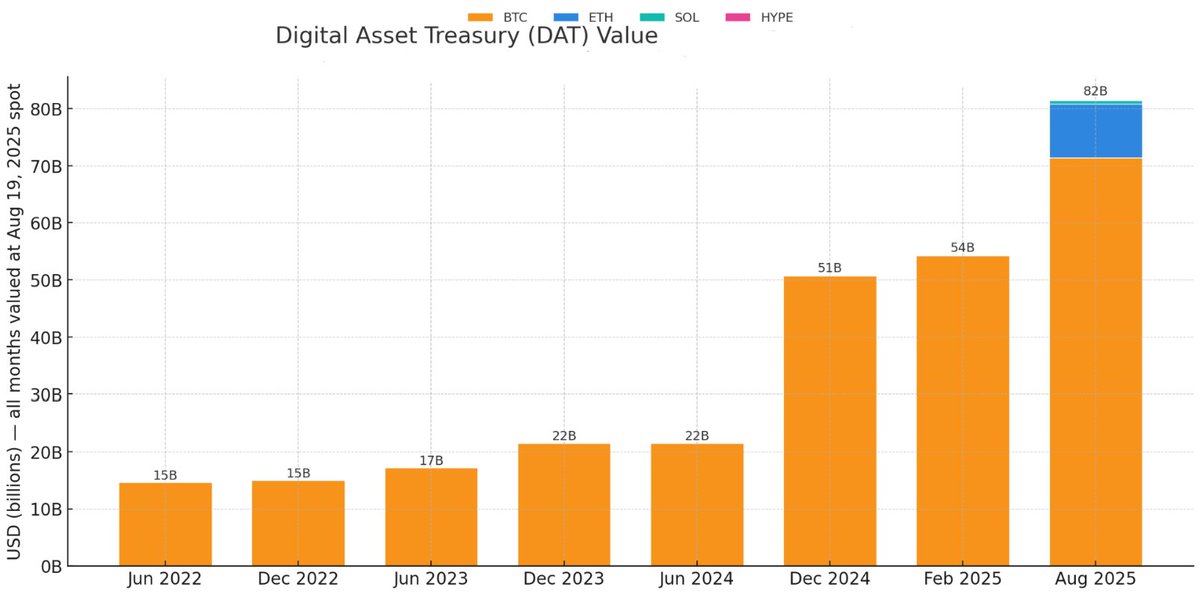
Why is everyone launching Digital Asset Treasury (DAT) companies?
Let’s explore the fundamentals of the DAT model and why it is a beautifully orchestrated arbitrage ponzi that has accumulated over 80b$ of crypto assets 👇
The arbitrage method
The core objective of a DAT is to increase the crypto holdings per share. For existing shareholders, this means you receive a “yield”. For example SharpLink Gaming increased their “ETH Concentration” per share by 94% in about 3 months. How did they do this?
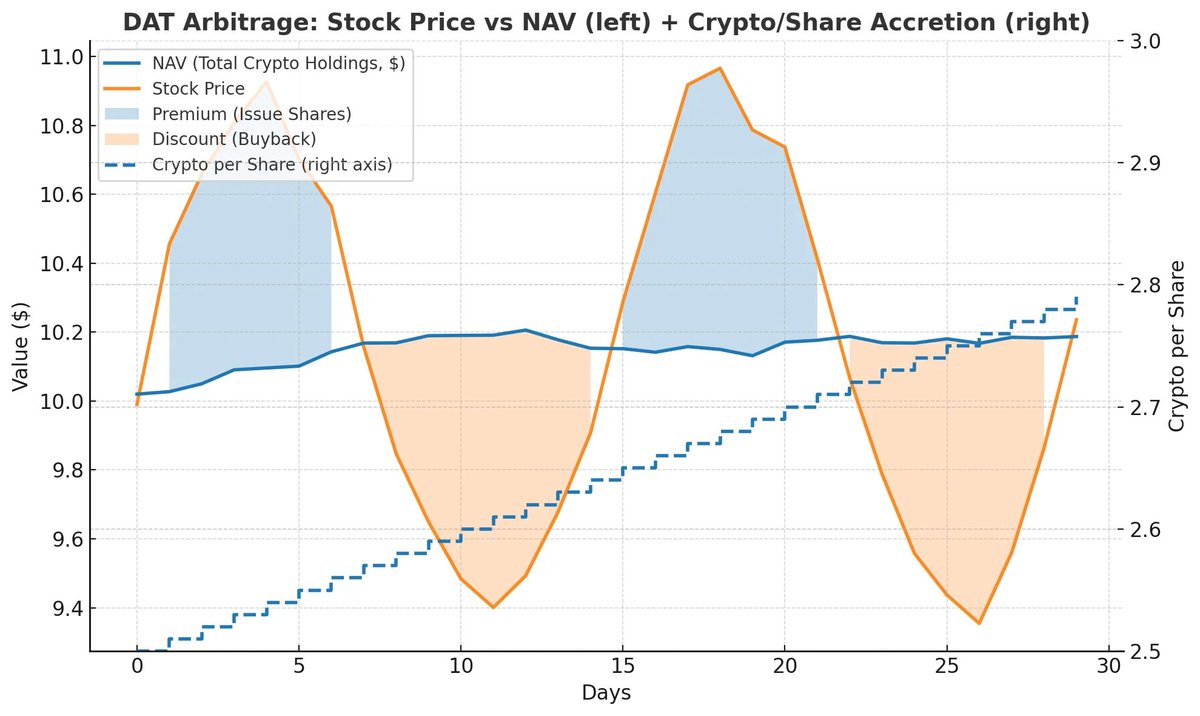
The way this yield is achieved is through arbitrage of the Net Asset Value (NAV) relative to market cap. If the $SBET NAV per share is 10$ but the stock price is 15$, the multiple of NAV, often referred to as “mNAV” is 1.5.
When the mNAV is above 1, there is an arbitrage opportunity the DAT can perform by issuing new shares and selling these At The Market (ATM) and buying crypto with the proceeds. This increases the crypto holding per share as long as mNAV is above 1.
When you buy a DAT share, you are thus betting that the stock will continue to trade at a premium, such that you may continue to benefit from the arbitrage. This is one reason why DATs are a form of sustainable “ponzi game”, because it is the expectation of future buyers continuing to keep the mNAV inflated, that makes the trade profitable to begin with. The earlier you enter the trade and the longer the stock trades at a premium, the larger the crypto yield.
Downside scenario
Now calling this a ponzi game makes it seem like the whole enterprise will collapse if the buyers stop flooding in, which is NOT the case with DATs. What happens when inflows are surpassed by outflows? If the stock is trading below the NAV, (mNAV below 1), stock buybacks that effectively do the inverse of stock issuance, are executed to further increase crypto per share. Buybacks can be funded by selling crypto holdings or leveraging cash on hand. This further produces yield for DAT shareholders, making the arbitrage accretive on both the upside and the downside.
DAT Permanence
A key idea of DATs is that they will be long term buyers and holders of crypto that will not sell in a downturn. I would contest that notion. As Charlie Munger famously said, “show me the incentives and I will show you the outcomes.” - DATs have a fiduciary duty to increase shareholder value and selling crypto to buyback shares when they are trading below mNAV of 1 is the optimal strategy to maximize crypto per share, which is the purpose of the vehicle. For example Tom Lee’s Bitmine Immersion has already authorized 1b$ of buybacks to be performed in response to BMNR trading below mNAV of 1.
Michael Saylor has stated Strategy will not sell their holdings even if there is a discount to NAV. Because of dilution, Saylor doesn’t have voting control of Strategy anymore, so I suspect shareholder incentives will decide the outcomes in the end, which would indicate dumping of BTC in a downturn to perform buybacks.
The blowup risk
The only real blowup risk in DATs stem from the use of leverage. None of the ETH DATs currently deploy any leverage. The use of leverage can further increase crypto per share without dilution, however, the cost basis begins to matter for purchases using leverage. If you borrow $ to buy ETH and the price of ETH drops, that’s a loss that all DAT shareholders will have to absorb. In the inverse scenario, profit accrues to shareholders. Only Saylor’s Strategy has meaningful leverage (5.2b$ non-converted debt, 3.95b$ preferred stock). As the market reaches the later stages of the bull market, my only worry is that DATs begin to lever up at the wrong time and go deeply under-water as a result. This could nuke crypto prices in a bear market, similar to the unwind of 3AC or FTX. However, we are yet to see this and several of the ETH DATs have expressed very conservative views on the use of leverage.
Future of DATs
I believe we will see the proliferation of DATs across many tokens and possibly other commodity markets (eg gold) with limited supplies. On some level, a DAT is a form of “token IPO”, which opens access to crypto exposure for new pockets of capital such as mutual funds, certain ETFs and wealth advisors. Whilst many blue chip tokens will likely launch ETFs in the future too, there is a broader set of tokens which will have DATs. Already today HYPE, ENA and SOL have major DATs, each with hundreds of millions in holdings.
From first principles, having broader market access is positive part of the trend of crypto and traditional finance rails merging. Whilst these vehicles push short term buying pressure, they likely are not long term fundamentally altering the value of the tokens held. Whilst a token being more widely held and liquid across more venues may add some premium, ultimately it is the underlying protocols and networks’ actual adoption which will determine the success of the tokens over time.
In the short term, the market is a voting machine, in the long term, it is a weighing machine. DATs bring many votes, but they don’t bring real weight. Heavy is the protocol with a strong product and network effect. Let us not forget why we are building the future of finance.
If you enjoyed this analysis, consider giving @robdogeth a follow :)
When the life insurers, who by law can pretty much only buy govt bonds, are getting smoked and need to pull back, the bond market is FUCKED. The BOJ is on notice. It’s only a matter of time before they slam even harder in the Brrr button.
Dec 2022, #BTC was at $16,000 and I made my "Wyckoff HTF Accumulation" video and stated we would run straight back to $69K
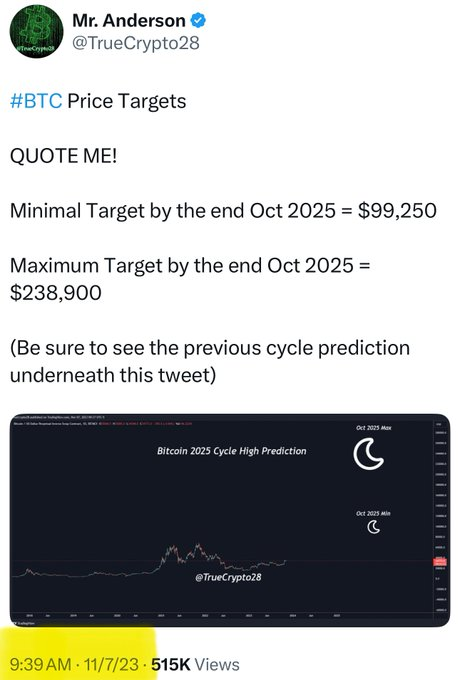
Then, on November 7th, 2023, in December 2022, #BTC was at $16,000 when I created my "Wyckoff HTF Accumulation" video and stated we would run straight back to $69K.
Then, on November 7th, 2023, #Bitcoin was at $34,000... I said, "Quote me!" again, The minimum target is $99,250, and the maximum target for this cycle is $238K.
On December 19th, 2024, I mentioned to look for a top of some kind on January 20th, which we then established as the recent top on the exact day. 🤷♂️
On April 2nd, I remarked that crises bring opportunities, so be ready.
On April 10th, I stated I believed the Bulls would look to hold the line that day, and they did.
On April 11th, I noted that this finally looks like it has a chance (order) to make a real run again.
April 25th gave us the daily "Go time signal," which indicates we are willing to buy dips that hold structure (and daily signals are expected to be late naturally).
Both April 29th and May 4th qualified.
Now, the Bulls want to hold 99.6K on this weekly close. Bulls eventually need a clean weekly scale on-close BoS (Break of Structure).
Once we achieve that, we can dream of a nice 3-6 week advance into the new Blue Sky Breakout (price discovery).
Once that occurs, and we see how far she is willing to go, we can use that data (along with the depth of the pullback that follows) to determine if she has the appetite for more!
Station-to-station, as always
Trump’s tariff formula is further evidence he is laser focused on reversing these imbalances. The problem for treasuries is that without $ exports foreigners can’t buy bonds. The Fed and banking system must step up to ensure a well functioning treasury mrkt, which means Brrrr.
You’re telling me money is just a ledger entry created on a government computer that then sends a message and changes the ledger entry on a bank’s computer?
Wow. I’m hearing this for the first time.
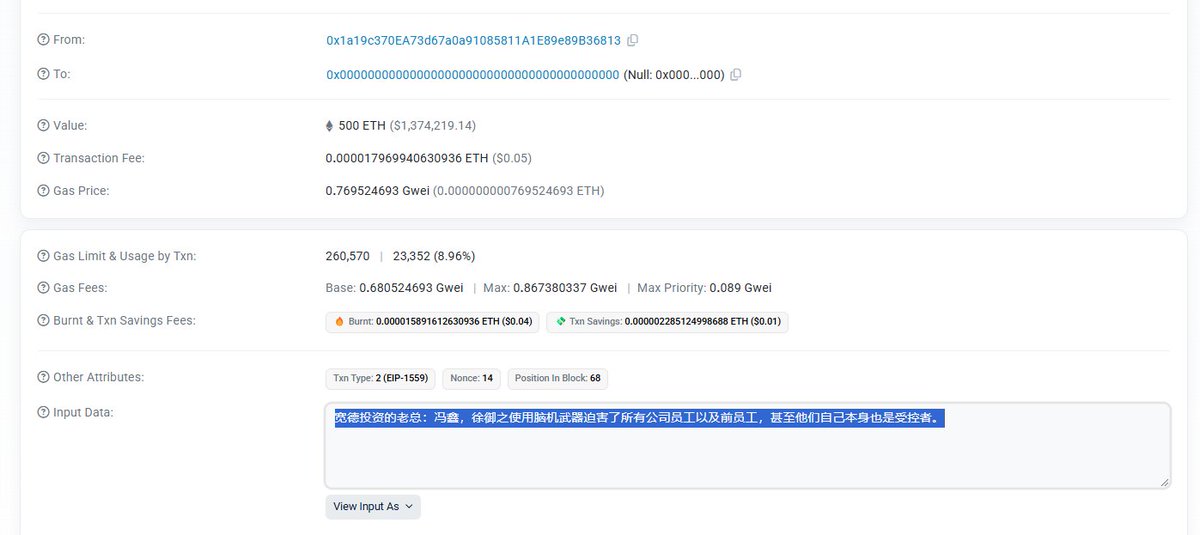
BREAKING: Someone just burnt 500 ETH (~$1,400,000) by sending it to 0x000... and wrote the following message 👇
"The bosses of Kuande Investment: Feng Xin and Xu Yuzhi used brain-computer weapons to persecute all company employees and former employees, and even they themselves were controlled."
(h/t @sassal0x)
1/ An investigation into how Greavys (Malone Iam), Wiz (Veer Chetal), and Box (Jeandiel Serrano) stole $243M from a single person last month in a highly sophisticated social engineering attack and my efforts which have helped lead to multiple arrests and millions frozen.
🔥🚨BREAKING: This doctor exposed how toxic chemotherapy is and he explained that you have to wear hazmat suits to even handle it safely.
Dr. Buttar compares chemo to napalm, obliterating everything in its path—healthy cells included. The result? Devastating collateral damage to the body, all in the name of treatment.
Watch The Full Expose’ Truth About Cancer’s “A Global Quest” in the comment below.
Introducing AINJ, the Injective Staking Exchange Traded Product (ETP), launched by 21Shares.
This innovative product offers exposure to $INJ via major traditional finance exchange venues and brokerages while also capturing staking rewards.
1/9🧵