A female-led and female-focused Initiative created to empower young out-of-school girls with globally relevant skills and accurate information for self-reliance
Everything everyone does in life is a step toward something. It's that constant sense of progress that gets them through the first 100 failed attempts.There are those who dream of great accomplishments, and there are those who wake up and work on them.
#MondayMotivation#DreamBig
We are reclaiming our voice as a survivor-led movement — established by women who have carried pain in their bodies, souls, and turned it into purpose.
This #16DaysOfActivism, we do not whisper.
We confront.
We educate.
We demand a world where women and girls live unapologetic.
Momentum is built months before your moment.
June events don’t grow in May — they grow from early planning, clarity, and consistency.
Start now.
Your event deserves strategy, not last-minute stress.
Contact Furst Events today!
#FurstSparkGroup#StorytellingBrand
Planning an event? Get uniquely thoughtful bulk gifts from @DurianNigeria — every order empowers rural families.
And for smooth delivery, creatives, coverage and marketing… talk to us.
What other items expose regular NGO attendees? Drop yours below 👇🏽
#FurstSparkGroup#NGO
From a spark to a constellation. ✨
Today we launch Furst Spark Group — 5 divisions, 1 mission: making brands unforgettable.
🟡 Spaces
🟠 Events
🟣 Stories
🔵 Tech
🟢 Design
Your vision. Our spark.
Let’s build the next century of stories.
#FurstSparkGroup#Rebrand
"Can you not at least put a sane woman among us?"
The words came from a terrified patient inside the Women's Lunatic Asylum on Blackwell's Island. She was begging the doctors, the nurses, anyone who would listen.
She was talking about the new patient. The one who seemed too calm. Too aware. Too sane.
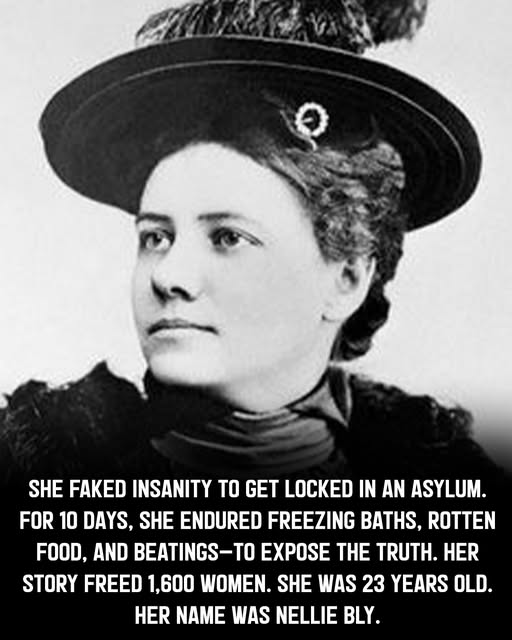
That patient was Nellie Bly. And she was exactly where she wanted to be.
In 1887, New York City's asylums were shrouded in mystery. Rumors swirled about horrific conditions, abuse, and women disappearing behind locked doors, never to be seen again.
But they were just rumors. No proof. No witnesses willing to speak. No way to know the truth.
Nellie Bly, a 23-year-old journalist for the New York World, decided to find out for herself.
Her editor, Joseph Pulitzer, supported her plan: get yourself committed to the asylum, document everything, and expose the truth.
It was dangerous. It was unprecedented. If something went wrong, Nellie could be trapped there indefinitely—declared insane with no way out.
She did it anyway.
Nellie checked into a women's boarding house and began acting erratically. She stayed up all night, spoke incoherently, stared at nothing, and claimed not to know who she was.
The landlady called the police. A judge declared her insane. And on September 25, 1887, Nellie Bly was committed to the Women's Lunatic Asylum on Blackwell's Island.
The moment she arrived, Nellie dropped the act. She behaved completely normally. She spoke clearly. She answered questions rationally.
It didn't matter.
Once you were inside, you were insane. No amount of sanity would set you free.
What Nellie discovered inside was worse than anyone imagined.
The asylum held over 1,600 women. Many of them weren't mentally ill at all.
They were poor. They were immigrants who didn't speak English. They were women whose husbands wanted to be rid of them. They were girls who'd been raped and were considered "damaged." They were inconvenient, unwanted, and discarded.
And once inside, they were tortured.
The "treatment" was barbaric. Patients were forced to sit in freezing cold baths for hours—punishment disguised as therapy. The food was rotten, inedible. Rats roamed freely. The halls were filthy.
Nurses beat patients with sticks. They tied women to chairs and left them for days. They mocked them, starved them, and ignored their pleas for help.
Nellie watched women scream for help and be silenced with violence. She saw patients beg for warm clothing and be denied. She witnessed daily cruelty designed not to heal, but to break.
And she wrote it all down. In her mind. Memorizing every detail.
For ten days, Nellie endured the same treatment as everyone else. She froze in the baths. She choked down spoiled food. She slept on a hard bench in a freezing room with no blankets.
She didn't complain. She didn't fight back. She documented.
On October 4, 1887, after ten days inside, an attorney hired by her newspaper secured her release.
She walked out of Blackwell's Island and immediately began writing.
On October 9, 1887, the New York World published "Ten Days in a Mad-House"—Nellie Bly's firsthand account of life inside the asylum.
The article was explosive.
Nellie described everything in vivid, horrifying detail. The cold baths. The rotten food. The rats. The beatings. The women who didn't belong there.
She wrote about a woman who spoke only German and was declared insane because doctors couldn't understand her. She wrote about girls as young as sixteen locked away for being "difficult." She wrote about women who begged to be released and were told they'd never leave.
The public was horrified. Outraged. Demanding answers.
A grand jury was convened to investigate. They toured Blackwell's Island. They interviewed patients and staff.
They confirmed everything Nellie had written.
The city of New York immediately allocated an additional $1 million to the Department of Public Charities and Corrections to reform asylum conditions. Staff were retrained. Oversight increased. Patients gained new rights and protections.
Some of the women Nellie had met were released. Others received proper care for the first time.
"Ten Days in a Mad-House" became a sensation. It was published as a book. It was read across the country. It sparked a national conversation about mental health, women's rights, and institutional abuse.
Nellie Bly became famous overnight.
But she didn't stop.
In 1889, at 25 years old, Nellie set out to break the fictional record set in Jules Verne's Around the World in Eighty Days. She traveled around the globe in 72 days, 6 hours, and 11 minutes—by steamship, train, and sheer determination.
She became an international celebrity.
But it was "Ten Days in a Mad-House" that cemented her legacy as the mother of investigative journalism.
Nellie Bly proved that journalism wasn't just about reporting what happened. It was about uncovering what was hidden. It was about giving voice to the voiceless. It was about risking everything to tell the truth.
Before Nellie, undercover journalism didn't exist. She invented it.
After Nellie, investigative reporters followed her lead—going undercover in factories, prisons, sweatshops, and more to expose injustice.
Nellie Bly died in 1922 at the age of 57. By then, she had revolutionized journalism, traveled the world, and advocated for women's rights and workers' protections.
But her asylum exposé remains her most enduring achievement.
Because of Nellie, over 1,600 women were seen. Their suffering was acknowledged. The system that imprisoned them was forced to change.
Because of Nellie, mental health reform began in America.
Because of Nellie, journalists learned that sometimes the most important stories require more than a notebook—they require courage.
Nellie Bly didn't just write about injustice. She lived it. She endured it. And then she made damn sure the world knew.
She was 23 years old.
She faked insanity to get locked in an asylum.
For 10 days, she endured freezing baths, rotten food, and beatings.
She did it to expose the truth about 1,600 women who'd been abandoned by society.
Her story changed mental health care in America.
Her courage invented investigative journalism.
Her name was Nellie Bly.
And she proved that one person, willing to risk everything, can change the world.
Healing isn’t always loud. Sometimes it’s the quiet strength of showing up for yourself again and again.
This #WMHD, we’re gathering reflections from survivors and allies on what healing truly means. Your words could be someone’s light.
💌 Share yours → https://t.co/EAZTCyM05A
@SarahsHeart_FDN The younger generation can make older generations see the dangers of #FGM and #GBV from their immediately community to ensure they understand @TheGlobalSarah
At the 2025 Sustaining Impact Summit, African leaders and social innovators explored how to build lasting impact through systems thinking, design, and local resourcefulness. Read the article here: https://t.co/8PNfQ9gIO7
Due to technical issues, our Space couldn’t hold yesterday.
We’re back and better.
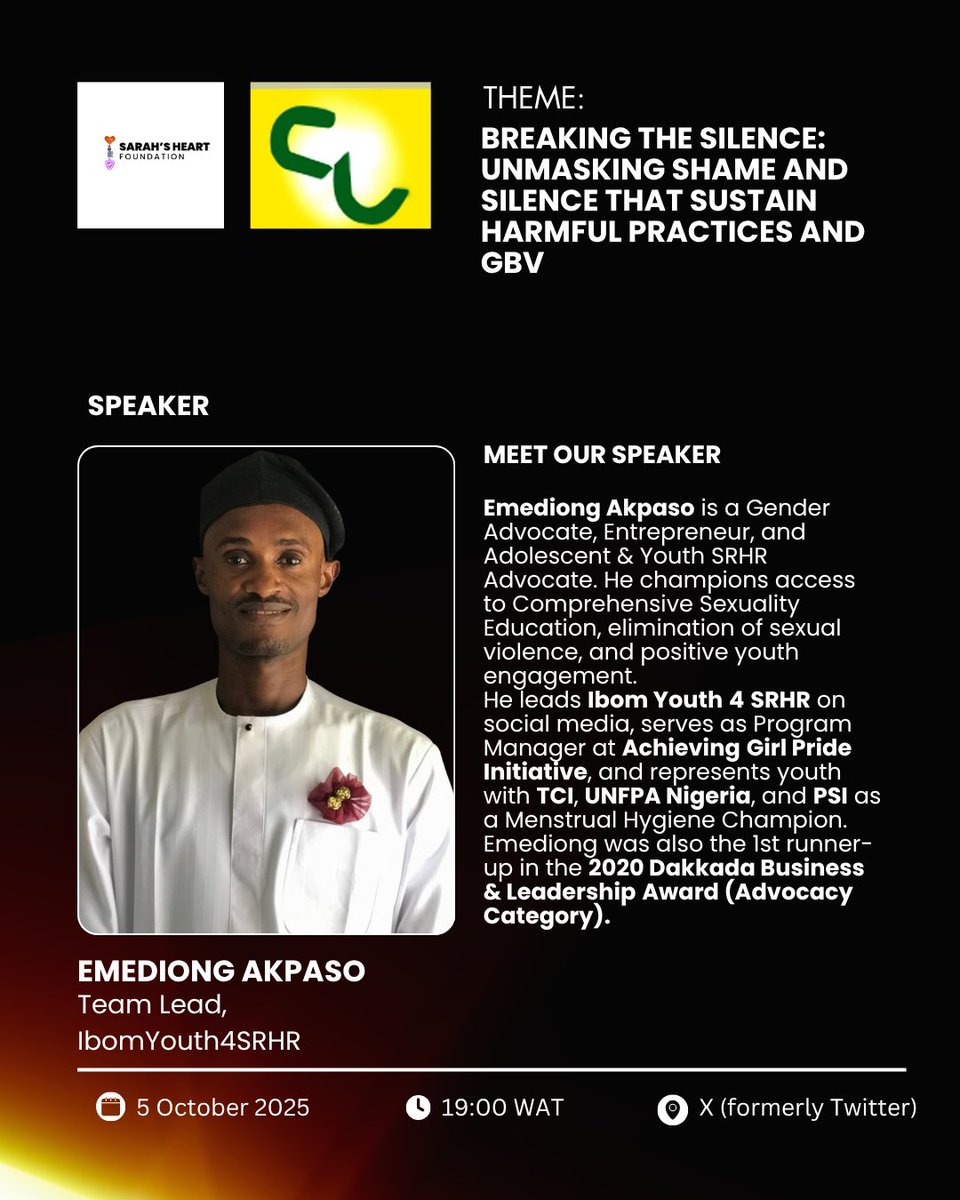
Join us 🗓️ October 8, 2025
16:00 WAT
#SHF#RSCF#BreakingTheSilence#EndGBV
Set a reminder for my upcoming Space! https://t.co/uOevF9XBE6
In 2015, Christian Mwijage made a decision that many would have called risky. He left the comfort of a tech career to take on one of Africa’s toughest challenges: plastic waste.
Today, as a strong force behind EcoAct Tanzania, he has helped turn what others throw away into something communities can build on - cleaner streets, safer spaces, and livelihoods for families.
Christian’s story isn’t just about waste management. It’s about vision, courage, and the belief that one idea, acted upon with persistence, can reshape the future.
#SustainingImpactPrize #ASEW #SIS2025
It's finally the D-day and we can't wait to host you all. Join us today as it promises to be insightful and impactful.
Set a reminder: https://t.co/kdNG0Cj4kn
#EndGBV@thegirdlengr@GPtoEndFGM@DOHScares@africanngos
@Omoyemioladiran of @El_vocational secured the first place position at our annual Sustaining Impact Prize competition. Among numerous applications submitted from all over the continent, her entry stood out with the compelling story of impacting thousands of women in underserved communities in Nigeria. We are thankful to our partners who made this happen and we look forward to celebrating more strides by Omoyemi in the course of the next 12 months.
#SustainingImpactPrize #ASEW #SIS2025
From Ibadan to the continent, @OguguamobiO, founder of Mobi Design, has turned her passion for fashion into a force for cultural pride and community empowerment. This vision earned her the 1st Runner-up Prize at our 2025 Sustaining Impact Prize competition.
Her story reminds us that impact doesn’t always come from the loudest voices, but from those who stay rooted in purpose and creativity. We look forward to supporting and celebrating Oguguamobi’s continued contributions in the year ahead.
#SustainingImpactPrize #ASEW #SIS2025
D’Ibadan au continent, @OguguamobiO, fondatrice de Mobi Design, a transformé sa passion pour la mode en une force de fierté culturelle et d’autonomisation communautaire. Cette vision lui a valu le prix de 1ère Dauphine lors de notre compétition Sustaining Impact Prize 2025.
Son histoire nous rappelle que l’impact ne vient pas toujours des voix les plus fortes, mais de celles qui restent ancrées dans le but et la créativité. Nous avons hâte d’accompagner et de célébrer les contributions continues d’Oguguamobi dans l’année à venir.
#SustainingImpactPrize #ASEW #SIS2025
Every strong enterprise begins with clarity.
Debbi Brock shares why knowing your What, Why, How, Where, and When is non-negotiable when starting a social enterprise.
It’s not just about starting — it’s about lasting.
Your clarity becomes your compass when challenges come.
#SIS7 #ASEW #Entrepreneurship #SocialImpact #PurposeDriven
Chaque entreprise solide commence par la clarté.
Debbi Brock explique pourquoi définir clairement son Quoi, Pourquoi, Comment, Où et Quand est incontournable lorsqu’on lance une entreprise sociale.
Il ne s’agit pas seulement de démarrer — il s’agit de durer.
Votre clarté devient votre boussole lorsque les défis se présentent.
#SIS7 #ASEW #Entrepreneuriat #ImpactSocial #Mission
"Relying on external funding alone is not sustainable."
Dr. Adeyemi Adelekan @AdeyemiAA2014 reminds us that true impact comes when social enterprises leverage local resources, resilience, and innovation — not just donor support.
The question is: are we building systems that can survive when the aid boxes stop coming?
#SIS7 #ASEW #SustainableImpact #SocialEnterprise #InnovationInAfrica
«Compter uniquement sur le financement extérieur n’est pas durable.»
Dr. Adeyemi Adelekan nous rappelle que le véritable impact naît lorsque les entreprises sociales s’appuient sur les ressources locales, la résilience et l’innovation — et pas seulement sur le soutien des bailleurs.
La question est la suivante: construisons-nous des systèmes capables de survivre lorsque les boîtes d’aide cessent d’arriver?
#SIS7 #ASEW #ImpactDurable #EntrepriseSociale #InnovationEnAfrique
Hello Twitter,
We need your voice! 🚨
Help us strengthen the Lagos State’s Sexual Harassment Guidelines by taking this quick survey.
It won’t take more than 2 minutes, but your feedback is crucial to shaping a safer and more accountable Lagos.
👉 Click here:
https://t.co/dal8lwxxuU