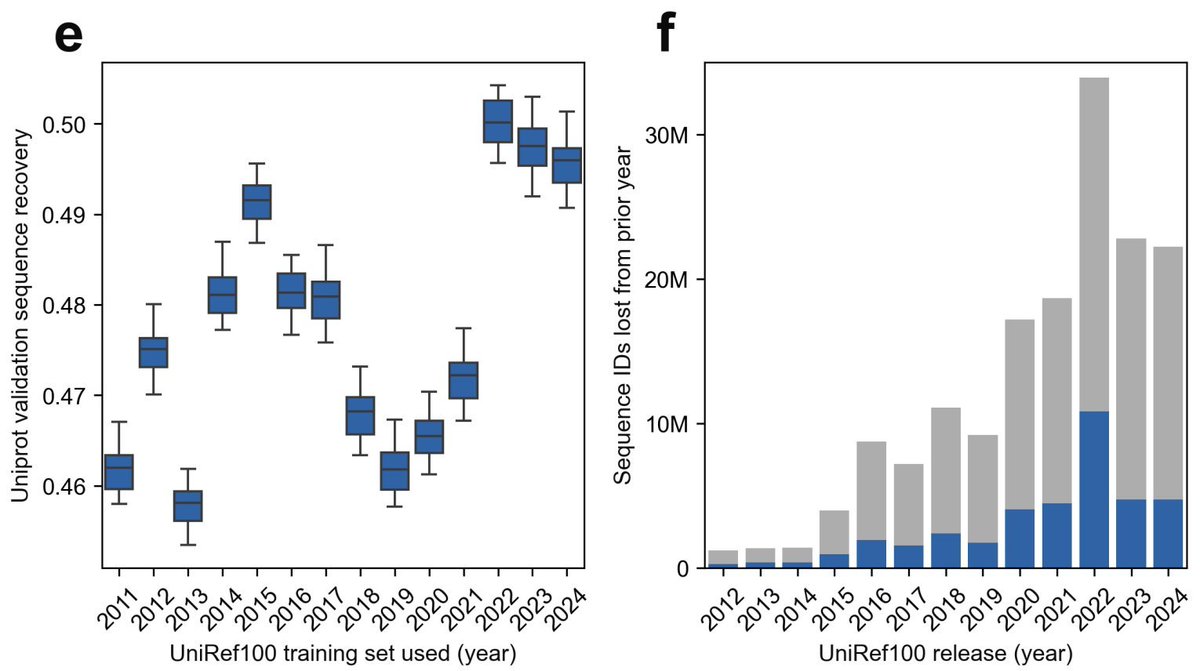
Retraining PLMs with newly deposited sequences doesn't guarantee better performance. Authors trained PLMs on each copy of UniRef100 from 2011 to 2024; the largest performance boost (2021->2022) coincided with the removal of unusually large number of invalid sequences from UniRef
Let me tell you a story. It'll end up at the current tech-bio and protein design scene.
But the story starts about 25 years earlier.
Did you know that, commercially, the human genome project precipitated the end and not the start of a genomics boom? 1/
1/5 Today, I’m sharing 7yrs of work. I believe we discovered a comprehensive mapping from protein structure to glycan structure, a genetic encoding for specific glycans, and a new paradigm in extracellular biology.
https://t.co/eba5yTub5x
#Glycotime
Editors rant: how many more GNN or message-passing architectures do we *really* need to score/predict protein-ligand interactions? A new one appears every day!!! 🤯#compchem
Working on ML for Drug Discovery I have been frustrated with the size and/or quality of publicly available datasets to train and benchmark models with, so when my co-founder and I started our company we swore we would open-source some data as quickly as possible.
https://t.co/eNCCULTHFj We wrote a review on recent developments in integrative modeling and frontiers in the field for a Springer Mol Bio Handbook. Comments are appreciated! Deep work by co-first authors @s_arvindekar@KartikMajila
The sad reality is that most people don't have what it takes to work in tech:
Up at 4am.
Post a pic of my new Eight Sleep in the group chat for sweet, sweet engagement.
Hit the gym.
Crush 8 jumping jacks.
35 minute cold plunge.
Rip a My First Million episode at 2x speed.
Drink a bottle of Bryan Johnson olive oil.
Eat 4 bags of Athletic Greens powder.
Feel sick.
Power through.
Open laptop.
Knock out 7-8 emoji reactions to threads on Slack.
Grab lunch. (A 2nd bottle of olive oil)
Open Jira.
Comment "any updates?" on 3 tickets.
Wind down for the day.
Open Substack and resume writing Part 4 of "Problems with European Work Ethic: a San Francisco perspective" - a banger that got 8 likes on Substack and two thumbs up in the group chat.
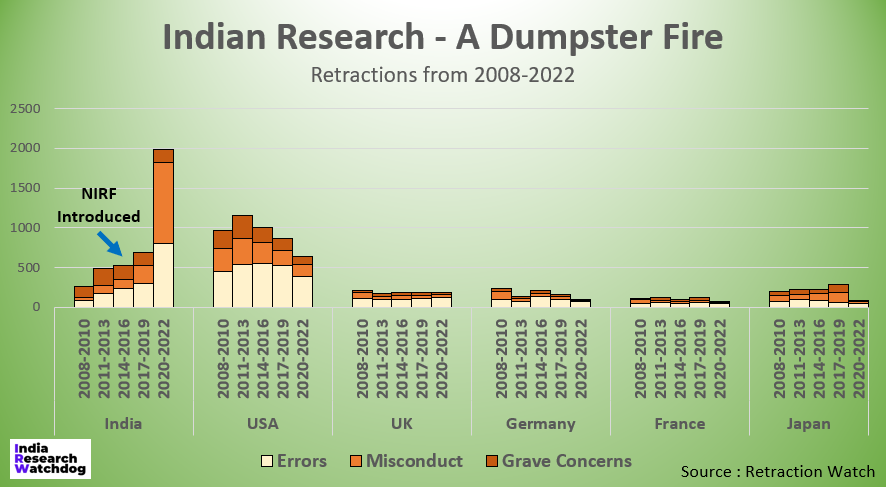
𝐈𝐧𝐝𝐢𝐚𝐧 𝐑𝐞𝐬𝐞𝐚𝐫𝐜𝐡 𝐂𝐫𝐢𝐬𝐢𝐬 - 𝐍𝐨𝐭 𝐣𝐮𝐬𝐭 𝐚 𝐒𝐦𝐨𝐤𝐢𝐧𝐠 𝐆𝐮𝐧 𝐛𝐮𝐭 𝐚 𝐃𝐮𝐦𝐩𝐬𝐭𝐞𝐫 𝐅𝐢𝐫𝐞
If you had any doubts about Indian Research being in a deep crisis, this graph should definitively lay them to rest. (1/N) 🧵
#IndiaResearchCrisis
Chandrayaan-3 Mission:
'India🇮🇳,
I reached my destination
and you too!'
: Chandrayaan-3
Chandrayaan-3 has successfully
soft-landed on the moon 🌖!.
Congratulations, India🇮🇳!
#Chandrayaan_3#Ch3
In 2008 October, I was back from college for a weekend visit to my parents, when the Chandrayaan-1 mission happened. 15 years later life comes full circle: my parents are visiting me on their vacation when Chandrayaan-3 soft-lands an unmanned rover on the moon!
Excited to have nearly the entire integrative structural modeling community in one place: tremendous effort by @shruthiLab! Also, I am teaching a brief workshop on writing Python-based custom restraints within the Integrative Modeling Platform (IMP), please attend if interested.
Register by this week for conference on Macromolecular assemblies @IISERPune and workshop on integrative modeling with @salilab_ucsf https://t.co/junGSMG38Y
1/8 Excited to introduce CombFold - an algorithm for predicting large multi-protein complexes using the combinatorial and hierarchical assembly of #AlphaFold models. @DinaSchneidman
https://t.co/sW5gMgf8Ky
Some perspective for scientists who may be asked to review computational methods: Computational methods are indeed innovated by taking existing mathematical and algorithmic atoms and putting them together in a novel way. Second, small changes in the steps can have a large effect on the outcome! Examples below:
The classic ISOMAP method could be considered a combination of shortest paths on graphs + MDS. Neither of these was novel but ISOMAP was one of the first breakthrough manifold learning algorithms.
Spectral clustering is just using graph Laplacian eigenvectors and K-means, again the combo is what makes this able to detect arbitrarily shaped clusters.
The difference between SNE and t-SNE was just the "t" (student t-distribution) but look at how much one is used over the other :).
The difference between a GAN and a conditional GAN is just a conditioning input signal.
Please do comment on anyone's paper that because the atoms they used are not novel, or the change doesn't seem vast, that the entire method is not novel. This is completely unfair and ignores how computational innovation proceeds...
Really excited to present new work by @ritagonmar: we visualized the entire PubMed library, 21 million biomedical and life science papers, and learned a lot about --
THE LANDSCAPE OF BIOMEDICAL RESEARCH
https://t.co/OhEx7iSjlU
Joint work with @CellTypist and @benmschmidt. 1/n
We wrapped up the first LLM hackathon for applications in materials and chemistry last week. The results to me were astounding. We are at the point now where some tasks that took years can now be completed in days. Here is a list of the fantastic submissions!
I'm serious. STEM without the Arts, Social Sciences, and Humanities will produce more "innovative" tech bros who giddily reinvent rent, roommates, taxes, and now...roller skates. With complete, straight-faced, sincerity.
This is a problem. And I have a list (So, thread 🧵)