Humans are hungry for power and they will not cede so easily or voluntarily at least. So I don’t know if there will be an AI version of decision makers where humans have no control. The first watershed movement will be when a public company is led by AI CEO where financial returns drives change and not power necessarily.
BIG: so exactly 7 months after losing out in Parliament on Delimitation Bill, Modi govt to bring it back again on Nov 30th. This time, they seem to have the numbers, courtesy DMK, NCP (SP), Shiv Sena rebels and TMC’s breakaway ‘shell’ party NCPI (still not recognised by the LS speaker!). Plus a few abstentions if needed. Jod Tod ki rajneeti in full swing even while the Bill has not even been circulated ! All this on Constitution Day!🙏
Firstly, from @AdaniOnline congrats to @AnthropicAI
Second,
Cross-Regime Category Error: Why Legacy Bankers Can’t Price Synthetic GDP
Comparing Anthropic’s $1.5T valuation to India’s top 10 corporates as "undervaluation"vs. "catching up" is a textbook category error in asset pricing. It benchmarks a convex call option on synthetic Labor in a new economic substrate against discounted cash flow (DCF) claims on a human-constrained economy.
1. The Ceiling of Human-Economy Equities
Traditional blue chips (banking, energy, staples) are linear yield vehicles anchored to biological human GDP. Growth is capped by demographics, credit penetration, physical consumption, and waking hours—priced via mean-reverting multiples (P/E, EV/EBITDA).
Calling them "undervalued" next to frontier AI is like calling Mumbai real-estate undervalued next to the discovery of thermodynamics.
2. Anthropic as a Call Option on Synthetic GDP (Yₛ)
Cognitive labor is decoupling from human population growth. Frontier models aren't SaaS tools; they are the "infrastructure of intelligence" for a parallel synthetic workforce (Yₛ) operating above human output (Y_Total = Yₕ + Yₛ). At $1.5T, markets aren't capitalizing EBITDA. Using Black-Scholes intiution Wall Street is pricing implied volatility and right-tail convexity of a 24/7 digital workforce scaling at the marginal cost of compute.
@AdaniOnline , we are already operationalizing this reality through our cobotic workforce model—a dual-track organizational architecture weaving human creativity with autonomous AI agents and robotics across our utilities, ports, and operations, upskilling 11000+ professionals annually to lead a ybrid industrial paradigm.
3. The 1999–2020 Precedent: Euphoria Still Underprices Regime Shifts
In 1999, Mary Meeker and Dow 36,000 were mocked as peak-bubble delusion when global e-commerce was ~$150B, internet penetration was 5% (277M users), and $1T tech firms seemed impossible. When the NASDAQ peaked at 5,048 in March 2000 and crashed 78% (wiping out ~$5T and bankrupting https://t.co/cTFPLaPK4w and Webvan), legacy finance declared the thesis dead.
Yet by 2020, reality crushed 1999’s wildest models: 4.5B+ internet users (57% of humanity), $4.2T+ in annual e-commerce, >60% digital ad share, and core winners (Apple, Microsoft, Amazon, Alphabet) compounding into a $16T+ asset class. Legacy allocators mistook the 2000 clearing event for a ceiling, missing a new digital GDP layer.
4. The Epistemological Blind Spot of Legacy Bankers & Capital
This is classic lender-mindset orthodoxy: mistaking backward-looking accounting ratios for capital creation. Allocators trained in capital-scarce banking worship trailing multiples, static book value, and incremental yield—dismissing any paradigm-building capex cycle that breaks 20th-century spreadsheet as a "bubble."
While legacy finance debates scoreboards in the rear-view mirror, we have laid out our $100B+ (₹10 lakh crore) roadmap for the "Infrastructure of Intelligence"—mastering the full physical-to-digital stack from Port to Power to Metals to Processor, integrating gigawatt-scale renewable energy, grid transmission, and hyperscale liquid-cooled AI data centers (scaling toward 5 GW). Because intelligence is written in code, but it runs on electrons and sovereign infrastructure.
India’s blue chips are neither undervalued nor "behind"—they are yield vehicles monetizing the physical human economy, while those building the energy-and-compute backbone are underwriting the new substrate of an add-on synthetic economy. You cannot measure a non-linear dimension with a static ruler built for the old world ( much like 2000, clearing out will occur here too). Scientifically, Ai is a bigger shift, akin to development of scientific method in 16th century thus an order of magnitude a greater opportunity.
A huge percentage of my life is spent avoiding crowds. Avoiding fashionable ideas, investing in underpriced assets, finding cool places that aren't deluged with tourists — they're all variants of the same thing. Whenever I find myself in a crowd, I feel something is wrong.
In an interview with @Nidhi , Dr. Raghuram Rajan asked why Indian business isn't trying to conquer the world.
An American investor committed $20M to us after one dinner. Indian customers took six months to invest $700 in software.
My response in this thread
Exclusive. ECI’s internal records of 2024 elections: On 51 seats of Maharashtra, Haryana and J&K, votes counted differed from votes cast. ECI rules say such mismatch should trigger probe into possible rigging.
@TweetSumedha & @VenkateshNSS report
1/6
https://t.co/qKVoRpx0iP
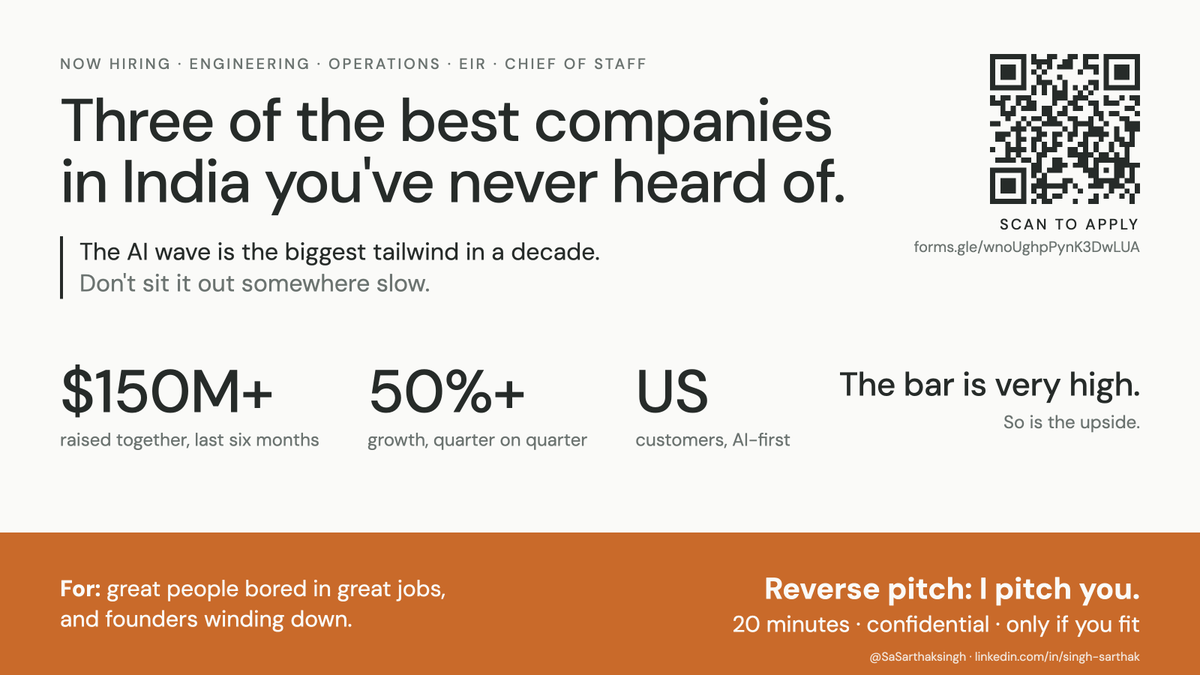
We are HIRING. Interestingly, few of the best companies being built in India right now might be the ones you've never heard of. Three Accel portfolio companies I work closely with have raised ~$150M+ between them in the last six months. We don't believe in big announcements or building in public. Just heads down.
Every one of these founders have been telling me the same thing: talent is the bottleneck in India. So I'm helping with it myself. They're hiring across engineering, operations and generalist roles (EIRs, Chiefs of Staff). The bar is very high.
Why I think they're among the best places to work in India:
1. AI at the core of the product
2. Global exposure, with US customers and markets
3. Growing 50%+ quarter on quarter
4. Founders for 2 were CXOs at large public companies
5. Just getting started, so the equity upside is real
If you know someone who's the best engineer or operator on their team and are quietly bored, send this their way. If there's a fit, I will walk you through each company: what it does, how fast it's growing and why I think it wins. .
Form in the reply 👇 or just DM me!
If you’re hunting for a remote job, there are some recruitment agencies and talent networks that can connect you to employers who are already hiring.
All you have to do is create a talent profile, get matched with opportunities, or apply for roles through their platforms.
Here are some of those agencies and how to get started:
Under pressure from Israeli prime minister Benjamin Netanyahu, the Trump administration may be within days of launching a nuclear strike on Iran. The target would be Pickax Mountain in central Iran, where Israeli intelligence claims the Iranian government has restarted its nuclear enrichment program. No conventional weapon in the American arsenal can penetrate 300 feet of solid granite to destroy the tunnels where enrichment is supposedly taking place. The only military option is a nuclear strike. Netanyahu has been pushing hard for one. “Bibi calls Trump about it every day,” says an informed observer.
Netanyahu is cornered and desperate. After last week’s election results, he can’t form a government unless Trump intervenes directly in Israeli politics and brokers a deal with other parties that gives Netanyahu 61 seats in the Knesset. Otherwise, he is out as prime minister and on his way to ignominy, investigations and possibly jail. Netanyahu must stay close to Trump. He needs this war.
To that end, he’s applied maximum pressure to his closest allies in the administration, including Secretary of Defense Pete Hegseth and CENTCOM commander Brad Cooper. Both oppose a negotiated settlement to the war they’ve so grievously mismanaged; both are pushing to restart major combat operations. Secretary of State Marco Rubio and CIA director John Ratcliffe are also following Netanyahu’s lead, as are leaders of the Democratic Party. In a recent meeting on the subject, former president Barack Obama said he opposes the current Iran peace deal being drafted in Doha.
The rest of America’s longtime allies in the Middle East are terrified by the prospect of more war. On September 27th, Netanyahu flew secretly to Abu Dhabi to enlist the UAE in his lobbying effort for a final attack on Iran. The Emiratis refused. After eight months of conflict, Gulf economies are teetering. So are global energy and fertilizer markets. They won’t recover soon. Globally, there are a total of about 850 supertankers used to transport oil from producers to the rest of the world. In October alone, 11 of them were badly damaged in Hormuz. At this pace, a global depression is imminent. A nuclear strike would radically accelerate the destruction. Fallout from a ground explosion at Pickax Mountain would contaminate the Persian Gulf, poisoning the water supply for 100 million people.
And those are just some of the immediate consequences for the region. The rest of the world is every bit as exposed. No country other than the United States has ever used a nuclear weapon in war. Some would like to. An American nuclear attack on Iran would set a new precedent. The Russians have already told at least two other governments that an American nuclear strike on Iran would free them to use nuclear weapons against Ukraine. Pakistan and India would be tempted to do the same against each other, as would North Korea against Seoul. After the first nuclear strike, World War Three is inevitable. That war would be short and final.
We’ve been sleepwalking toward this moment for months. Since February, the administration has quietly rewritten America’s nuclear doctrine to make first use of so-called “battlefield nukes” easier and therefore more likely. No one in Washington in either party seems bothered by this. Now we’re on the brink of it.
Close observers say Trump is likely to decide by next weekend whether or not to use nuclear weapons. That would be November 7, six days from now. To his credit, he’s hesitating. At the moment, Trump is listening to his vice president, JD Vance, and to his envoy and friend Steve Witkoff, both of whom argue a deal with Iran can be made.
They’re right, though it won’t be simple. The Iranians are famously frustrating to negotiate with under any circumstances, and elements of that government have become more radical since Ayatollah Ali Khamenei and his family were killed in February. After decades of isolation, even relatively moderate Iranian leaders seem confused by how decisions are made in the West. (There is a widespread belief in Tehran, for example, that the United States government controls Israel.) But overall, people who have spoken to decision-makers in Iran say there is consensus there that more war is bad for everyone and a deal is worth making.
One group that hasn’t been consulted so far is the global population — the hundreds of millions of people who will be killed along with their children if Trump is pushed by Netanyahu into launching a nuclear strike next week. Now would be the time for them to speak up.
Anthropic's IPO was filed on October 26, 2026, and I value it's equity at about $1.475 trillion, which will inform my decision on whether to buy or sell its shares. To make your Anthropic choice, though, you should value it yourself, and I will provide a story and input structure to help you. https://t.co/Lym8DlfifV
My predictions over the following months:
1. Stock market will get hurt bad when the music stops on data centers, models, and chips.
Too much froth, too high of investment, too many companies will fail. The switching costs are low. I don't know how these companies will become profitable. Its a mega bubble.
The rest of the economy is already in a deep recession. Real pain will set in when the public markets dive.
2. Power is the bottleneck.
AI is burning an absurd amount of power. The cost of electricity is skyrocketing which is making the cost of everyday life more expensive and hurting quality of life. I'm against data centers because of the power, not the water.
The grid is extremely fragile and the weakness will be exposed in the coming months.
3. Subsidies are skewing the market.
AI isn't cheap. The prices to use it are artificially low because of subsidies all the way up the chain.
You pay $20 or $200 a month but the true costs are 10x That spread is venture capital money being incinerated at scale.
When they raise the price, the users will disappear and investors will hold the bag.
3. A big security breach is coming.
A bank, a certain model, something is going to rock our world.
People are letting bots log in to their banks, their email and everything else. Big trouble coming.
4. Grokbot is exceptional.
Its the first model that is adding significant value to my everyday life. I don't know why anybody would use a different personal assistant.
5. AI is insanely high maintenance
Billions are being poured into training the next model. They day it comes out its already behind. China has cheaper electricity and more chips.
The chips they bought will be obsolete in 18 months.
Companies are stuck paying big money every month to maintain and update all of their AI tools. Its a mess.
6. The power companies will renege on their deals.
Political pressure will unwind all the unsustainable power deals these data centers and LLMs have negotiated.
Power costs will explode. Then comes the choice:
Do we jack up costs for our AI / compute and watch everybody switch to the next model or do we incinerate more VC capital? Nobody wins.
7. Credit will be the first domino to fall.
Data centers are already struggling to finance the GPUs over 10 years when they will be obsolete in 18 months. We'll end up with a shit load of half built data centers who can't negotiate power rates or buy chips because nobody will let them borrow money.
The money will get cold feet as soon as the markets tank and the show will be over.
8. It'll be a dark, dark period in economic markets.
The people who own assets that make real money (real estate or businesses) will win.
The people who plan ahead and avoid massive leverage will win.
The people with cash on their balance sheet will accumulate more assets and generate exceptional wealth.
--
Don't listen to me. I'm just a bear. Not investment advice. Good luck!