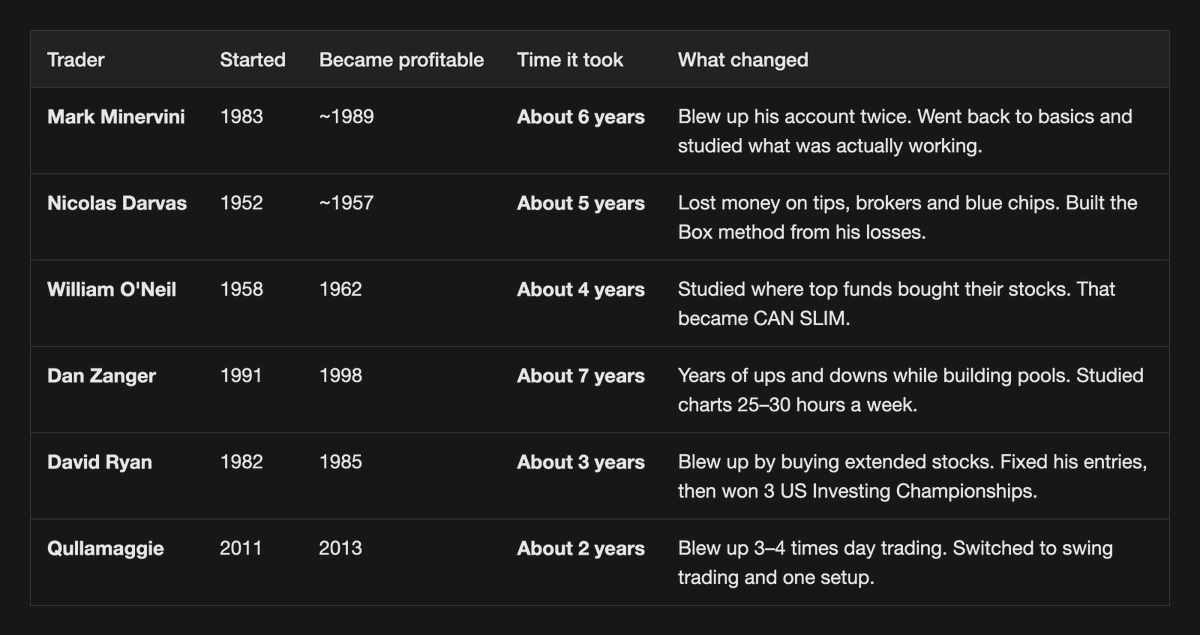
How long did the legends take to become profitable?
Mark Minervini: 6 years
Nicolas Darvas: 5 years
William O'Neil: 4 years
Dan Zanger: 7 years
David Ryan: 3 years
Qullamaggie: 2 years
Btw, Most of them blew up their accounts along the way.
New Trader Expectation:
100% returns by year 2 by taking some random trade, with no deliberate learning or practice.
Honestly, Some traders are still struggling after 5+ years because they never learned the value of study and review.
What the legends did to turn it around:
• Studied past winners . Non-Negotiable
• Mark up charts. Why a stock qualified,entry, exit etc.
• Mastered one setup instead of chasing many
• Reviewed every trade, especially the losers
• Cut losses fast and kept position size small
• Created model book of A+ setups.
• Put in hours, even around a full-time job
• Studied successful investors and their case studies.
Time in the market doesn't make you profitable. Deliberate practice does.
This is how @Qullamaggie made $700.000+ in NIO
Even Market Wizards get stopped out, doubt their entries and break their own rules.
Most trades are messy. Full trade breakdown 👇
$BTC
My plan still remains the same after this pump...
Before the final leg up kicks off, market will sweep $61K liquidity cluster first
Don't get trapped - turn notifs on, I'll update soon
My new eBook, FOMO, is out now! 🎉
Why does a trade you never took feel like money you lost?
And why does your next trade become an attempt to recover profit you never actually lost?
FOMO explores the thinking that turns “I should have taken it” into “I cannot miss the next one.”
Rather than teaching you how to endure FOMO, it examines the thought process that creates it and helps you rebuild that thinking through probabilistic thinking.
https://t.co/bjR4G9IAUW
Both PDF and eBook versions are included.
And guess what? To celebrate the launch, you currently get the audiobook too!
All three formats for $10.
Read when you have time.
Listen while traveling, walking, or doing everyday tasks.
Real wisdom, right in your pocket.
There is a graveyard in American tech right now and nobody is walking through it. Companies down 70, 80, 90% from the highs. Still profitable. Still growing. Still the leader in their category. Just unloved. The Trade Desk at 9x earnings. PayPal at 12x with $6 billion in free cash flow. Adobe at 17x and people are talking about it like it’s Kodak. Etsy at 8x EBITDA running a marketplace that two billion people have heard of. Roku trading below its own balance sheet liquidation value if you squint. Match Group, Zoom, Pinterest — each of these would have been a hedge fund’s top pick at this multiple in 2017. Now they’re orphans. Everyone is buying the Mag 7 because the Mag 7 is the trade. The Mag 7 IS already the trade. The trade is over. The next trade is in the rubble pile. You don’t get rich buying what worked. You get rich buying what stopped working for reasons that turn out to be temporary. Every name on that list was a market darling 36 months ago. The fundamentals didn’t fall 80%. The narrative did. Narratives come back. Earnings compound. I’m not buying NVDA at 45x. I’m buying the names CNBC won’t say out loud anymore
REMINDER: They need a credible off ramp from the hyper scaling narrative they’ve been selling for months. Safety concerns are an obvious way to justify the incoming pivot. They also justify taking the whole thing into a closed “Manhattan project” type setting at the government’s expense. This justifies the incoming lockdown.
As I predicted in August the scale narrative had run its course due to kimi. Hyper scaling wasn’t about genuine demand expectations. It was about winning the ai race by outspending and bankrupting your competitors. Kimi made that pointless.
This is no doubt the asymmetric information Bessent has been alluding to for weeks. There’s going to be a helluva lot of liquidity freed by this move. It’s all going to go flooding into USTs. Happy D day bond guys.
👇
sam altman (openai ceo): with gpt‑6 astra, you barely need to write prompts at all
in a quick 10‑minute walkthrough, he lays out how one person can ship what used to take a full team a month of late nights to finish
his takeaway is straightforward: keep raising the bar messy codebases, real research, full end‑to‑end sims. astra will shoulder more than you’d even bother trying to delegate
watch the clip, then jump into the guide below for the cleanest way to set up your own astra‑powered ai agent squad for free
How trading saved my life
I rarely talk about myself or my story, because I think it’s largely irrelevant. But as TSF grows, as I get to know more members and people, its only right to share a little about myself.
My name is Jonas, I’m an M.D, my biggest passion in life is my job. I work as a pediatric and neonatal intensive care physician and anesthesiologist. In short I take care of newborn babies and children that are critically ill. I have two little girls myself, I’m middle aged and my second passion in life is trading.
And trading saved my life. Because TSF didn’t start by chance, it started because I needed to be saved from what I was going through.
I have been trading for more than a decade, if you are part of TSF you know that I can read charts like I think few can, but I never had a real space where I could share my thoughts and observations.
But still, TSF didn’t start because I love trading, it started because I needed to immerse myself into something, to be able to distract myself from my current situation.
Because I lost both of my parents almost at the same time, both were completely healthy and suddenly poff they were gone. When that happens to a young guy that just became a dad, it’s not an easy thing to handle.
So I did what I have been trained to do for years in med school, focus on something you can study, build and fixate about. And that’s how TSF started, it started from zero. And I mean zero.
And here we are about 1.5 years later, TSF is one of the largest trading communities on substack, 450+ members. And TSF and the people of TSF bring me joy daily, I am honored to be a part of TSF and share what I can to make us all better each day.
Which brings us to the last piece of this long ass tweet. Don’t do what I did and fixate about the market too much, that is not the way. It always costs something on the other end.
Balance is key, if I have learned anything during the last couple of years, it’s that you will be a 10x better trader with clarity of mind.
Lite is more than charts and money, enjoy it as long as it lasts
Peter Thiel just put 72% of his public portfolio into energy and power.
Here’s the full list:
VIST 18.1%
Argentine shale in Vaca Muerta. Second biggest position in the whole book.
VST 14.1%
Independent power producer with nuclear and direct data centre contracts.
AEP 10.1%
Regulated utility with one of the largest contracted data centre pipelines in the country.
DTE 9.6%
Midwest utility feeding industrial and AI demand.
FE 9.5%
Transmission heavy. The wires side of the buildout.
CMS 9.4%
Another regulated utility, sized almost identically to the rest.
XE 0.9%
Small modular reactors. Tiny position, but that's the nuclear bet.
Generation, fuel, regulated utilities and next generation nuclear. 4 different ways to own the same constraint.
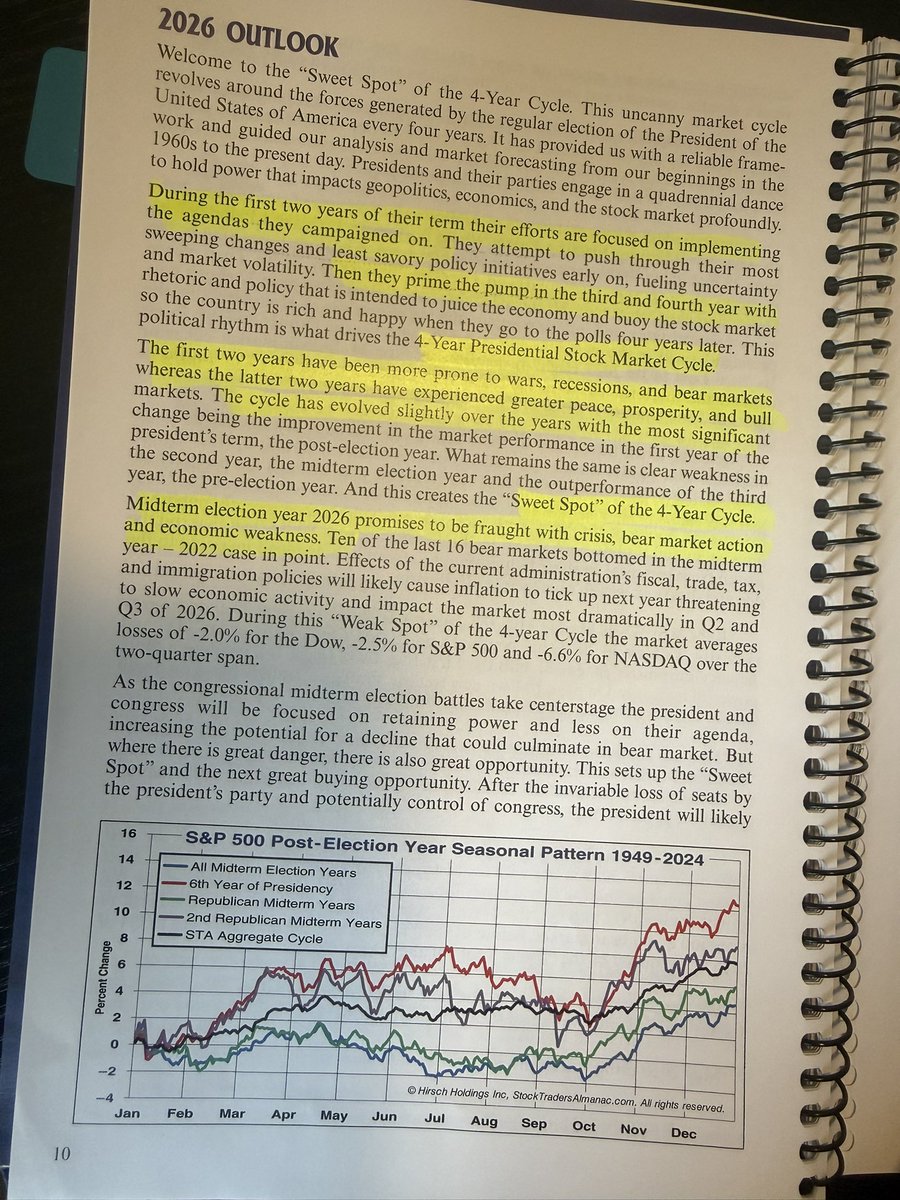
Stock Trader Almanac 2026 Outlook was spot on for this year. Let’s see if the 4-year presidential cycle holds.
“Midterm election year 2026 promises o be fraught with wars, recession and bear markets”
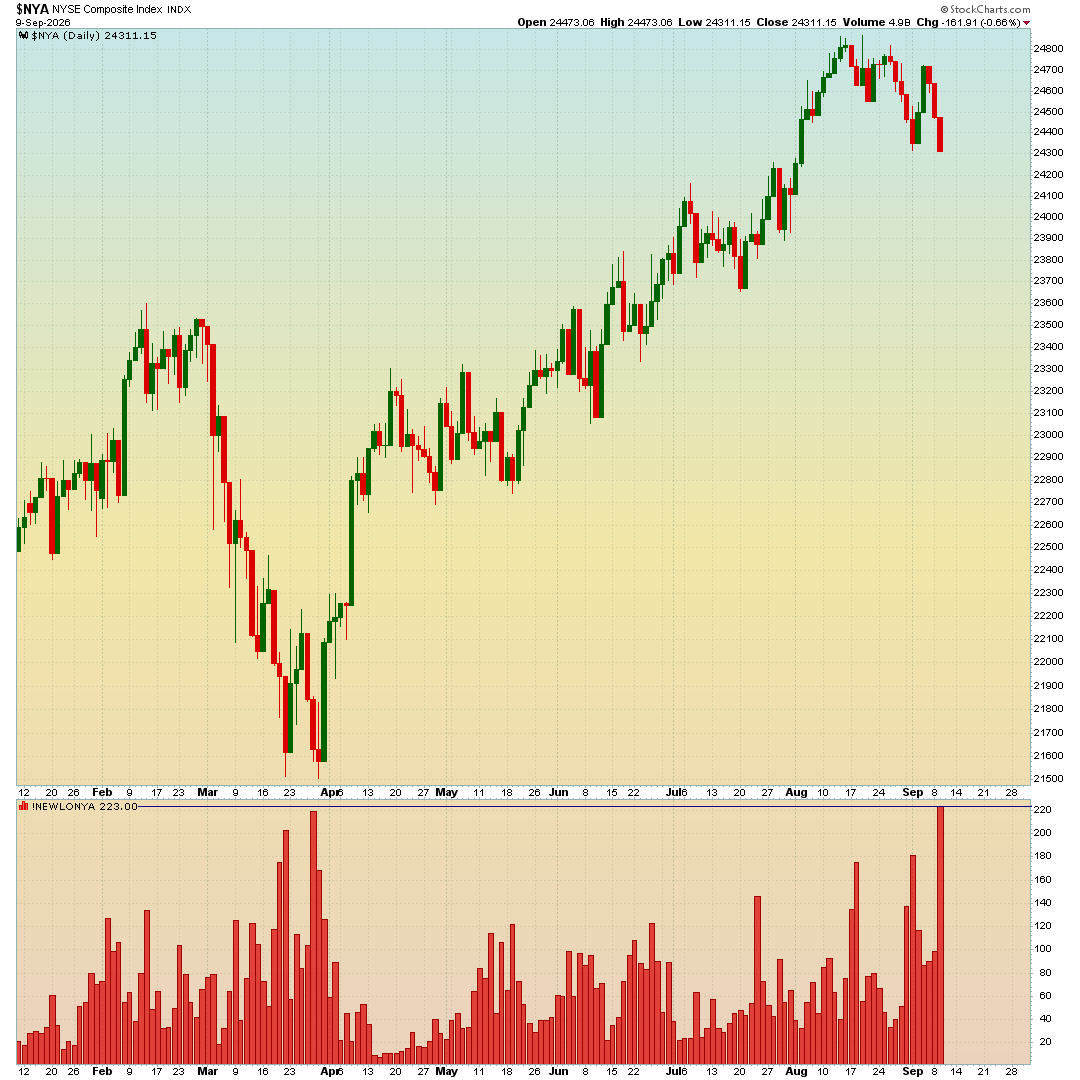
The NYSE Composite Index had 223 new lows today. The last time we had a similarly high reading was late March 2026, before the rally kicked off.
You would need to go back to April 2025 to see readings much higher than this. It's common to see clusters of these higher readings during market corrections and bear markets.
The opposite of success is not failure, but "not trying."
The challenge in trading is
1. Continuing to follow the same rules on the next trade, no matter what happens
2. Preparing thoroughly in advance to make that possible
Those are the two things.
It is certainly not about trying to win the trade in front of you or trying to avoid a loss.
What matters is continuing to execute the rules whose edge you have verified through your own testing, accepting both the wins and the losses they produce.
The game you should be playing is not the game of wins and losses, but the probability game.
Do not mistake what the challenge actually is.