Hider is live
CA: 0x365829b3567294f7bc930d69ab3c41c434f4a3fd
Give your agents a private life.
Hider combines proxy routing, an isolated browser, email and a phone number. Connect your existing agent, build its persona and manage its access from one dashboard, without sharing your personal accounts.
A private life for your agent
Your agent takes on different tasks. But using the same IP, browser session and accounts can leave a connected history of what it researches and does.
With Hider, your agents can browse privately, keep its sessions separate and choose from thousands of personas, each with its own name, photo, email, phone number and accounts.
Keep a familiar identity when continuity matters. Start fresh when the next task needs its own.
Your agent gets an online life of its own.
Your agent, from your phone.
@telegram is live in Hider. Review your agent’s exact request, approve or deny it, and revoke its Hider access directly from your chat.
Connect in Dashboard → Telegram.
https://t.co/nxOzO1HwEZ
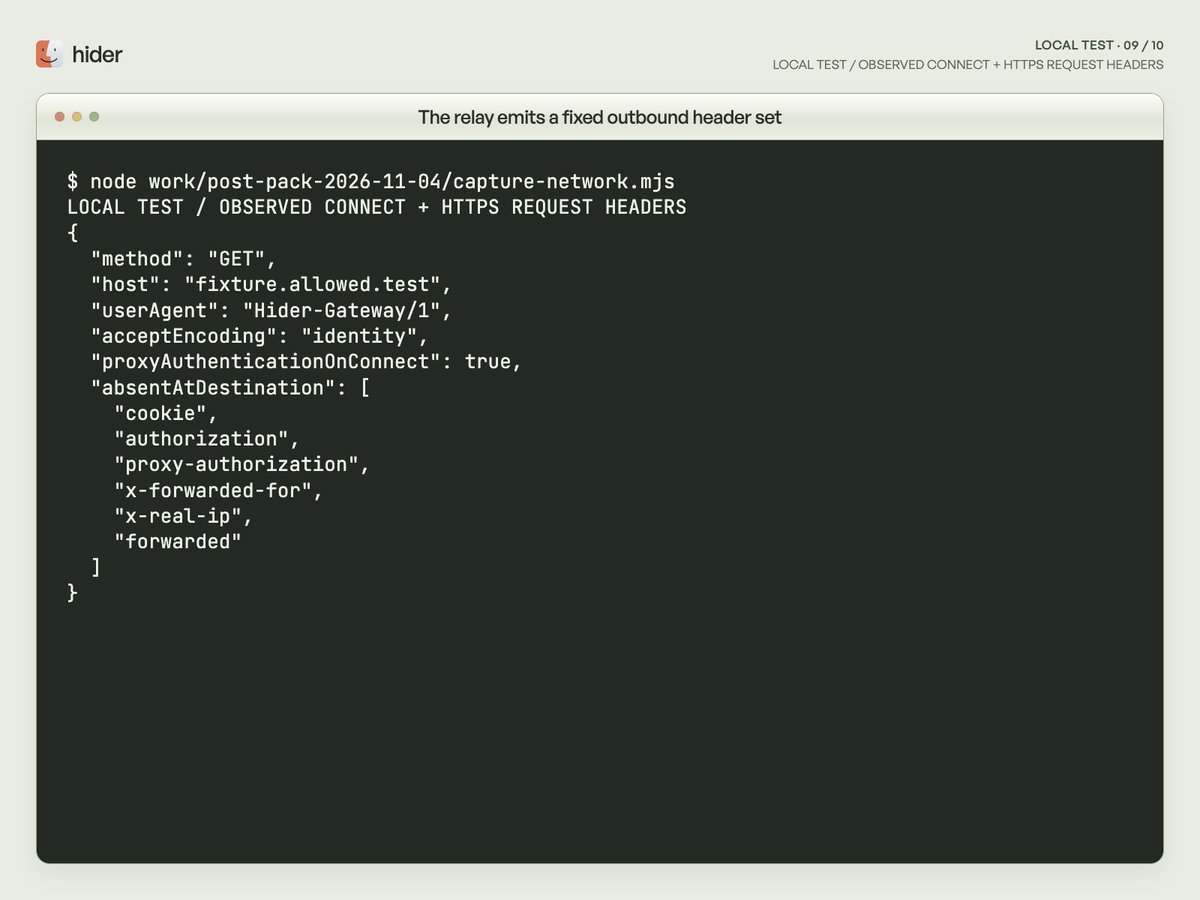
Using Hider's HTTPS relay doesn't carry your browser session along with the request. The relay creates a GET using fixed Accept, Accept-Encoding and User-Agent values. It leaves out incoming owner cookies, Authorization and forwarding headers that describe the caller's IP
Before connecting, Hider checks every address returned by DNS and rejects private or reserved destinations. It connects to a checked public IP while TLS verifies the hostname in the URL. Literal IP URLs and redirects are rejected. These are relay checks; a remote browser has its own provider and separate network limitations.
The operator can limit relay web requests to exact public HTTPS hostnames. A mask's web permission works within that list, and destinations must use port 443.
The signing key is loaded from a local file; it has no tool-input field. This capture makes zero gateway requests and exercises no provider operations. It checks discovery and input validation. Browser typing still accepts ordinary text, so strict schemas do not guarantee that arbitrary text contains no secrets. The local MCP host retains access to its own filesystem and other network tools.
The local stdio capture lists seven Hider tools by default. Starting the server with --enable-browser adds six Browserbase controls, bringing the list to thirteen. All thirteen input schemas reject additional properties, and calls containing unknown credential fields are rejected before reaching the gateway.
The agent guide sets out the request format and the steps for using a saved Hider key. AGENTS.md includes the signed challenge exchange, relay targets and resource operations, with commands for the agent's own environment.
The local fixture records the GET that leaves Hider's requestDestination function. It receives fixed Accept, Accept-Encoding: identity and User-Agent: Hider-Gateway/1 headers, plus the destination Host header supplied by Node. Cookie, Authorization, Proxy-Authorization and client IP forwarding headers are absent from that request.
Proxy authentication appears on the CONNECT request to the proxy. This capture inspects outbound traffic directly; it does not simulate an incoming owner HTTP request. The relay constructs this header set for each outbound request. Hider's operator still sees the destination URL and the plaintext response after TLS.
The challenge issued for a signed relay request can be used once. Hider consumes it before making the outbound call, and another copy of that request cannot use it for a second fetch.
After an outbound attempt, retrying needs a fresh challenge and signature, including when the destination returned an error. Repeating the signed request that asks for a challenge is rejected too. This check is separate from the mask's permissions: the requested action still has to be allowed.
Verifying a saved mask runs a fixed sequence: IP once, IP again, the example-page diagnostic, then a web GET to https://t.co/DiZsh5JEXQ. Each step uses the saved identity and the normal signed protocol. A complete run needs all three relay permissions and an available proxy.
These local fixtures call requestDestination directly. One sends 65,537 bytes, one byte over the relay's 64 KiB limit. Hider stops reading and raises upstream_too_large with status 502. A body of exactly 65,536 bytes fits the limit
I like being able to use one Hider mask from both a terminal and an editor. The key identifies the same agent in either place, so I can switch tools without creating another identity
An SMS number has an end date. Hider records the expiry returned by HeroSMS and stops new message reads after the rental expires.
Before a purchase, the owner chooses a country, service and duration, then reviews a USD quote and confirms the purchase. The quote is valid for five minutes; the rental's lifetime is a separate period
Hider remembers a mask's configured proxy route in SQLite. Adding another proxy or changing the pool's order preserves that saved assignment, so routine pool edits do not choose a new route for the mask.
Removing or changing the assigned proxy produces an error until its route is restored. The saved reference identifies the configured route, while the provider controls the external IP behind it. Two requests using the same pin can still report different IP addresses.