本日、Applied Intuitionの自動運転システムが正式に日本へ上陸しました。日本の自動車業界は、サプライヤーに対して独自の基準を課しています。
私たちは長年にわたり、日本に拠点を持つチーム、日本でのデータインフラ、日本の企業とのパートナーシップを構築し、その基準を満たす準備を進めてきました。
自動運転を世界中でスケーラブルにするためのこの重要な一歩について、詳しくはこちら:https://t.co/mJPTg3i2GS
Today, Applied Intuition's Self-Driving System officially comes to Japan.
The Japanese automotive industry holds its suppliers to a different standard.
We've been building to meet it for years: local teams, local data infrastructure, local partnerships.
Learn more about this important step toward making autonomy scalable worldwide: https://t.co/4neCmik5nk
@tszzl RIP to one of the realest to ever do it. An actual contrarian. We worked together briefly back in 2023. She was the same person IRL as she was on here. Very sad to see this.
When I joined @AppliedInt, back in early 2019, it was just a handful of engineers working above a bar in Sunnyvale. The website didn’t really tell you what we were. We just wanted to build amazing products for the real world, from fighter jets to hundred ton trucks to autonomous vehicles.
But we’ve always been really paranoid about losing the special culture we built in the early days to the monotony of corporate scale. Somehow, even as we’ve grown into a thousand+ person company, a lot has stayed the same since (like being in the Manhattan of the Bay, Sunnyvale). And of course, we’re still building amazing products.
Continuing from my prior video, we captured the culture that pulled me in all those years ago and how we’ve protected it as we’ve grown in this @firstround Review. These are all questions I’ve been asked about in the last few years from founders of all company sizes so might as well put it in one place.
P.S. At the minimum, there’s some awesome photos inside so take a look :)
Applied Intuition x @Stellantis —expanded.
Our Vehicle OS and autonomy infrastructure will now be integrated into Stellantis's next-gen STLA Brain platform, powering multiple brands across their global portfolio.
One unified, AI-defined foundation built to scale, with faster development cycles, faster time to market, and continuous feature deployment across the vehicle lifecycle.
Learn more about the next phase of our work together here: https://t.co/XqDpTGHVfy
The future of AI-defined vehicles is simplified scalability.
We’re expanding our partnership with @Stellantis to integrate our Vehicle OS into STLA Brain. OEMs will no longer need to rebuild the software stack from scratch for every new vehicle.
Our partnership is accelerating the road to autonomy:
➡️ Unified stack: Seamless experiences across body, ADAS, and infotainment
➡️ Continuous evolution: Robust OTA updates + autonomous parking and trailering
➡️ Silicon Valley speed: Cutting dev timelines by 50%+ (from 4 years to under 2)
The result? Vehicles that actually get smarter after they leave the factory floor.
The future isn’t individual features. It’s the platform.
https://t.co/W1oL2KrU1s
.@qasar Younis (CEO): “Our crazy claim to fame is that we've never spent the money we've ever raised.”
→ Nearly $1B in funding
→ ~10 years in business
→ ~1,000 engineers
→ Not using capital to fund payroll
"For a customer who wants to have this long-term relationship, that's really confidence inspiring."
@AppliedInt
BREAKING: Rare Look Inside Applied Intuition’s $15B Physical AI Garage
Cars, trucks, mining, construction, agriculture, sea, defense
"Bits are out, Atoms are in"
Everything that moves will be automated.
Co-Founders @qasar Younis (CEO) & Peter Ludwig (CTO) give us the first public-facing tour inside @AppliedInt's garage..
where they’ve been quietly building autonomous AI systems across nearly every industry
𝐓𝐈𝐌𝐄𝐒𝐓𝐀𝐌𝐏𝐒
(00:00) Inside Applied Intuition physical AI garage
(03:00) Cars are a wiring mess
(04:31) Why modern architecture matters
(06:30) From simulators to autonomy
(07:50) Real-time autonomous operations
(08:34) AI solving labor shortages
(10:09) The mobile AI command center
(12:50) How defense became a core focus
(16:20) Becoming more public
(17:10) Connecting mines, ports, and roads
(19:07) Driverless trucks in Japan
(20:09) Why they don’t operate in China
(21:40) Which country is adopting fastest?
(23:00) Scaling a 1400-person AI company
(25:43) New vs old AI players
(27:49) "Bits are out, Atoms are in"
(29:40) Physical AI is just getting started
(32:06) The "Japan corner"
"Cult classic, not a bestseller."
After nearly a decade building in stealth, our co-founders @Qasar and Peter Ludwig join @MollySOShea to talk physical AI, the foundation behind it, and where the industry is heading.
Watch below. 👇
In partnership with @TRATON_GROUP, we’re announcing TRATON ONE OS, a unified software platform for improved fleet uptime across TRATON’s global brands: Scania, MAN, International, and Volkswagen Truck & Bus.
Read the full announcement here 👉 https://t.co/TpzoKKgY3u
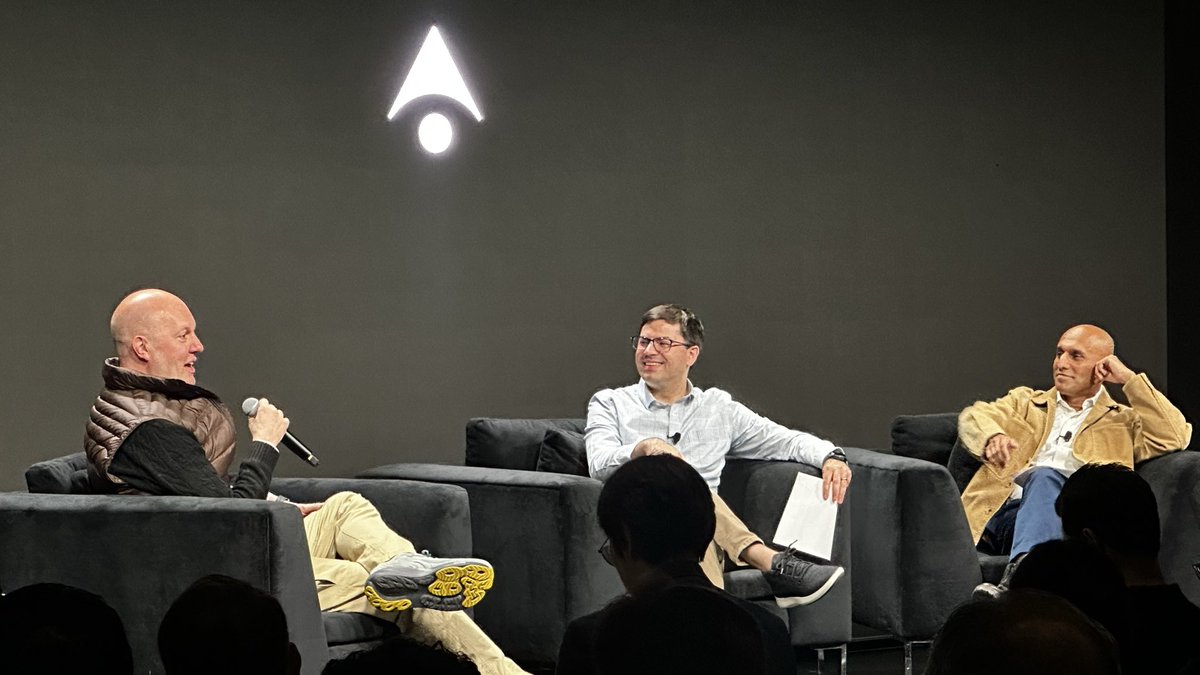
BREAKING: Marc Andreessen is wearing limited edition leather puffer vest
Live at @AppliedInt Physical AI Day
Applied Intuition CEO @qasar & CTO Peter Ludwig, + @pmarca
Here’s what I’d do if I was in charge of GitHub, in order:
1. Establish a North Star plan around being critical infrastructure for agentic code lifecycles and determine a set of ways to measure that.
2. Fire everyone who works on or advocates for copilot and shut it down. It’s not about the people, Im sure theres many talented people, youre just working at the wrong company.
3. Buy Pierre and launch agentic repo hosting as the first agentic product. Repos would be separate from the legacy web product to start since they’re likely burdened with legacy cross product interactions.
4. Re-evaluate all product lines and initiatives against the new North Star. I suspect 50% get cut (to make room for different ones).
The big idea is all agentic interactions should critically rely on GitHub APIs. Code review should be agentic but the labs should be building that into GH (not bolted in through GHA like today, real first class platform primitives). GH should absolutely launch an agent chat primitive, agent mailboxes are obviously good. Etc. GH should be a platform and not an agent itself.
This is going to be very obviously lacking since I only have external ideas to work off of and have no idea how GitHub internals are working, what their KPIs are or what North Star they define, etc.
But, with imperfect information, this is what I’d do.
people misunderstand the icarus story. the problem was not that he flew too high. it's that the wings were made of beeswax, which offered very little resistance to heating. with modern materials he would have had no problems. we can fly as close to the sun as we want now