One of my favorite uses of AI is watching a sketch turn into a shoe you can actually hold in your hands.
Vizcom takes you from sketch to rendered variations to exportable 3D model. We ran a design challenge with them and the shoes in this photo are the winning designs.
Barriers to entry are falling fast.
AI users are working longer because, for the first time, our tools can finally keep pace with our imagination.
But speed doesn't matter if you lack a destination.
When output is cheap, your greatest leverage isn't how much you build, but the taste to know what is worth building - and the rest required to see the difference.
Wrote an article about how React Server Components integrate with a bundler. It's a deep dive into how code splitting works, how RSCs eliminate network waterfalls, how environment directives like "use client" work, CSS loading, etc. Check it out! https://t.co/LzcdzszrG3
The most important skill for a software engineer IMO is debugging. Writing code is easy. Willingness and ability to debug through layers of abstraction, through code you didn't write, perhaps deep into other areas of the stack (libraries, frameworks, the server, the browser engine, etc.) can prevent you from ever being "blocked".
This is a skill I see lacking in a majority of developers these days. Too many people just stop as soon as they hit code they didn't write. They just report it to another team, file a GitHub issue, etc. And then complain when it isn't addressed for them immediately.
Your dependencies are your code. You are responsible for them. You can't rely on other people to fix problems you run into all the time. Understand your stack deeply. Learn to debug. It'll help you immensely.
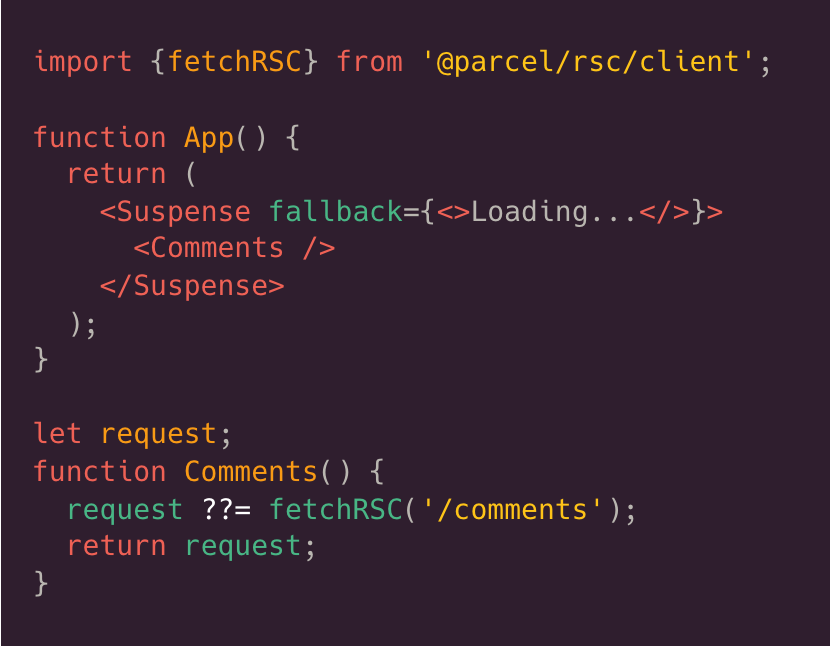
Don't need SSR or have an existing client-rendered app? You can just request RSCs from client components.
This lets you move heavy things like markdown parsing to the server, streaming the resulting components to the client.
Today, we’re deprecating Create React App for new apps, and encouraging existing apps to migrate to a framework.
We’re also providing docs for when a framework isn’t a good fit for your project, or you prefer to start by building a framework.
https://t.co/8REQYvcqHs
We may have a problem with package bloat and dependency hell in the JS ecosystem, but we could sure do with more of a focus on correctness/robustness/quality as well. Focusing on size alone often comes at the expense of many other important concerns unfortunately.
I've been cooking Triplex for VS Code and it's looking AMAZING, video attached.
What's Triplex? It's the React Three Fiber visual editor, and when integrated into your favorite IDE it's never been easier to get started.
Want to get your hands on it? See the next tweet! 👇
Announcing uv: an extremely fast Python package installer and resolver, written in Rust.
uv is designed as a drop-in replacement for pip, pip-tools, and virtualenv.
https://t.co/9cRaTBfkEU
Made some progress on supporting React Server Components in Parcel over the weekend. Will be very different from other implementations:
• Not a framework. No router, server, networking layer, cache, etc. — just the raw bundling primitives.
• Use with any server/router (eg express). Instead of an HTML file, your server JS file is the entry point. In each route, dynamic import a server component and render it to HTML or RSC payload. Client components and styles used by that server component are optimally bundled and loaded automatically.
• You can fetch a server component whenever you want, with any networking layer. Doesn’t need to be on a route boundary (eg infinite scroll), can be sent via a web socket if you want, etc.
My hope is that by exposing the raw primitives, it’ll be easier to see how RSC works and enable more freedom to experiment. Parcel is particularly well suited for this because it already supports multi-target module graphs with a single entry point. Will share more soon!