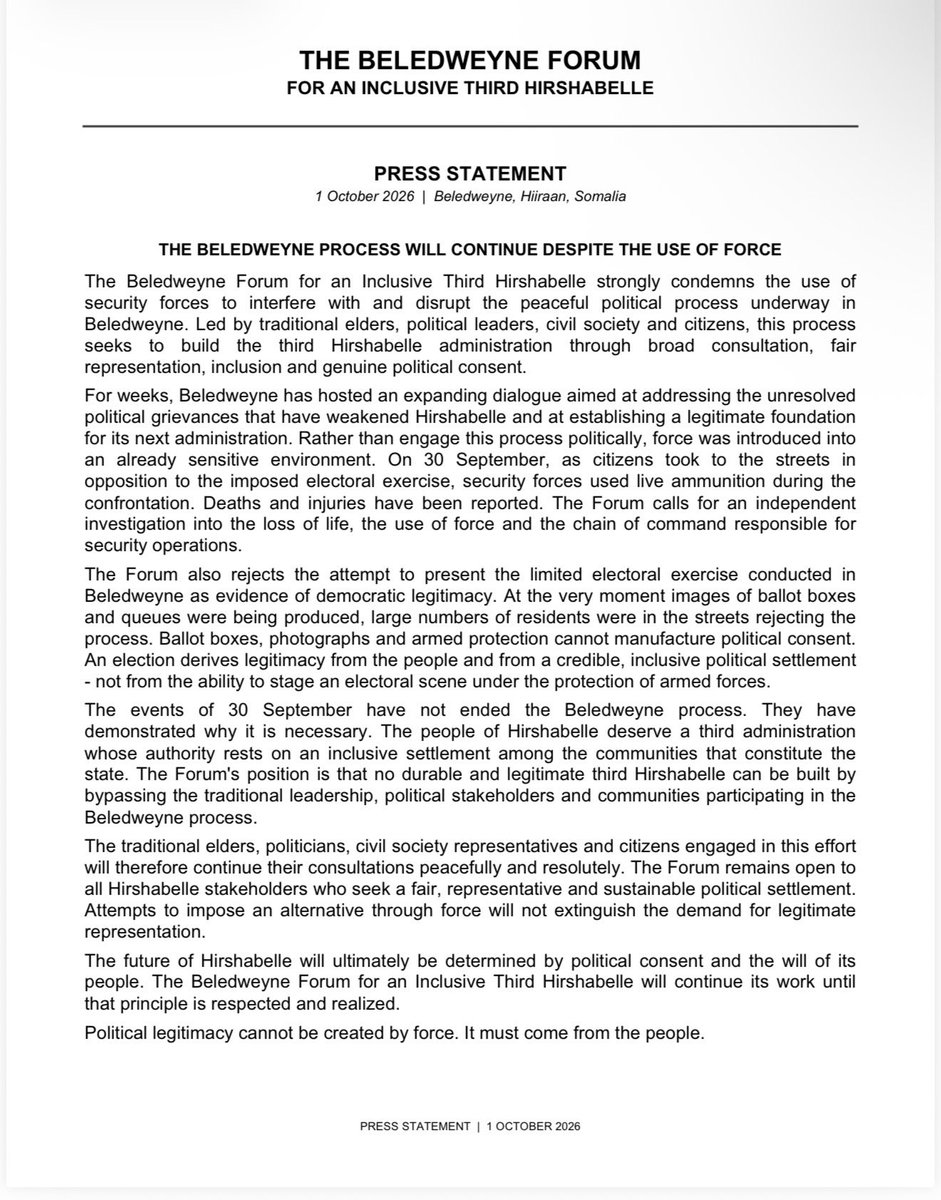
HAG is deeply concerned by reports that Djiboutian troops are facilitating the movement of forces from Mogadishu to undermine ongoing efforts in Beledweyne aimed at enabling the people of Hiiraan to shape their own political future.
Such interference risks deepening divisions and compromising peacekeeping neutrality.
Djibouti must respect the neutrality of its peacekeeping mandate and the legitimate aspirations of Hiiraan’s people under Ugaas Yusuf’s leadership.
@aussom_@_AfricanUnion@MAECIDJIBOUTI
HAG has formally written to the World Bank, African Development Bank, and international partners, raising serious concerns over the alleged misuse of public revenue to fuel conflict in Hiiraan.
Revenue Authority Director Faisal Mohamed Hashi has spent the past week in Beledweyne, allegedly financing activities that deepen divisions and fuel tensions.
We demand an independent investigation and accountability.
Public funds must serve the people, not fuel divisions.
We welcome the decision to hand over security in Beledweyne to the local Dulmidiid forces. Having received specialized training and been fully equipped and uniformed, these forces are capable of maintaining security throughout the district.
The immediate priority for all security agencies must be to hold accountable those sent from Mogadishu to destabilize the city and sow divisions within the community.
We urge all communities to stand united, preserve peace, and reject provocation.
BREAKING: Somalia's ex-President Sharif Sheikh Ahmed says Hassan Sheikh Mohamud wants to kill him, using the UAE as an excuse. “I live in the UAE,” he said.
Former President Sharif Sheikh Ahmed is generally known for having a stronger instinct than HSM for political accommodation across clans and regions. To this day, critics still point to what they describe as his “soft approach” toward Puntland and former President Abdirahman Farole, particularly around the Garowe I and Garowe II processes.
Yet Hirshabelle’s current political transition is one of the rare issues on which Sharif and HSM appear remarkably aligned.
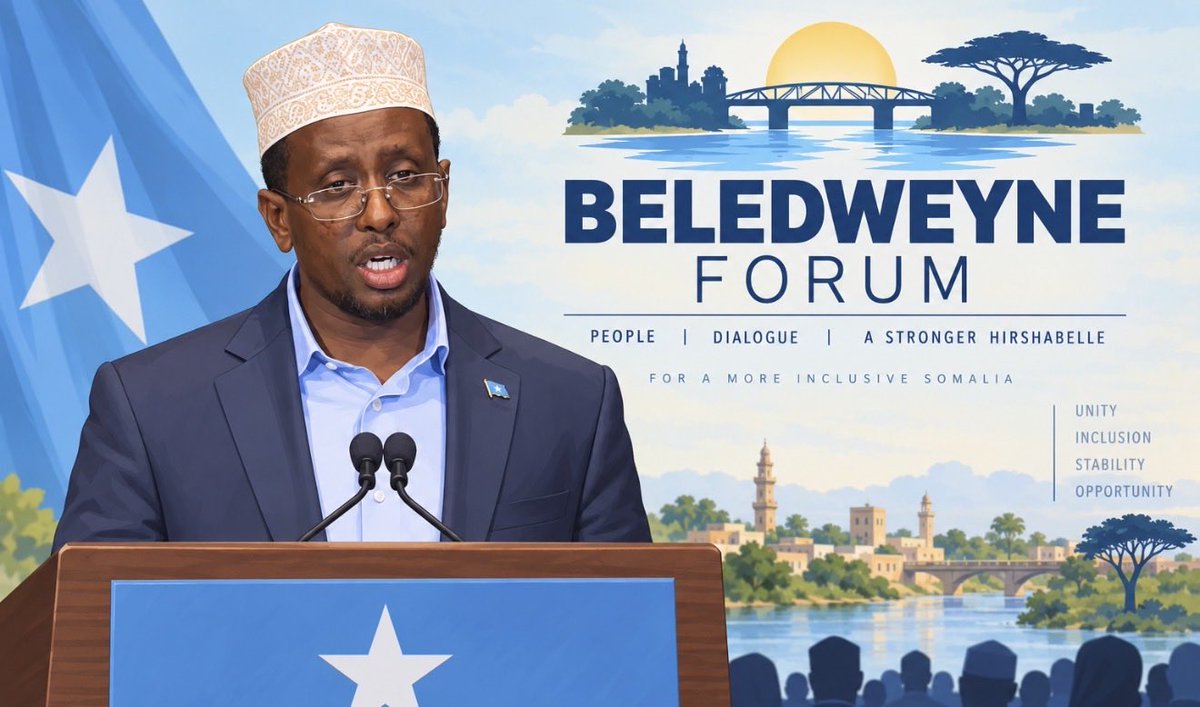
In Sharif’s case, the calculation appears to be driven less by anything else than by political arithmetic. Guudlaawe supported him with federal MPs and significant resources in the past, and Sharif may still regard him as a useful electoral asset. But the political landscape has shifted. The Beledweyne Forum is emerging as a new centre of political gravity in Hirshabelle.
Sharif therefore faces a stark political choice: continue placing his bet on Guudlaawe, expecting a return of the favours he received in 2022, or read the writing on the wall and invest in the process now taking shape in Beledweyne.
What is being challenged in Beledweyne is bigger than the future of Hirshabelle. It is the idea that whoever occupies Villa Somalia can bend federal institutions, dictate local political outcomes and treat the consent of communities as irrelevant.
The Beledweyne process is therefore not only about rescuing Hirshabelle; it is about defending the federal compact itself. If that principle can be successfully asserted in Hirshabelle, its significance will reach far beyond it: Somalia is a negotiated federal republic, not the political property of whoever happens to occupy Villa Somalia.
A story written in sacrifice deserves to be preserved in history.
Thank you @MoallimHarare. We are pleased to learn the announcement of your book and hope it will document Macawisley in its entirety—its origins, victories, setbacks, sacrifices, mistakes and the forces that shaped its course.
Macawisley is more than a chapter in Somalia’s war against Al-Shabaab. It is an experience from which Somalia still has much to learn.
Following many suggestions from friends, traditional elders, security officers and members of the communities who participated in the struggle that became known across Somalia as Macawisley, I have decided to begin researching and writing a book on the movement—its history, its experience, and what the future may hold for it.
The work will involve extensive research, interviews, gathering testimony and piecing together evidence scattered across the history of the struggle. I will examine the dynamics and circumstances that gave rise to Macawisley, the factors that enabled its remarkable battlefield successes, and the local conditions that made communities capable of challenging Al-Shabaab in areas where conventional approaches had struggled.
I will also investigate what went wrong: the political, institutional and operational factors that weakened or obstructed the movement, the opportunities that were lost, and the lessons that can be drawn from them.
Most importantly, the book will look beyond the battlefield. It will examine Macawisley’s longer-term impact on Somalia’s security and political landscape—particularly how the uprising changed the calculations, perceptions and strategic thinking of both the communities that confronted Al-Shabaab and Al-Shabaab itself.
The research for Macawisley has begun. There is a story here larger than battles won and lost: the story of what happens when ordinary communities decide that their own survival is ultimately their own responsibility.
The delegation of traditional elders and politicians that arrived in Beledweyne yesterday has agreed to establish and organize a 15,000-strong Macawisley force to safeguard the security and stability of Hiiraan.
Macawisley welcomes this historic decision. Hiiraan’s security cannot continue to depend on temporary arrangements made when crisis strikes and forgotten when the immediate danger passes.
Organizing Macawisley is about securing the future of Hiiraan with a force rooted in the communities that have defended it, understand its terrain and have already demonstrated their commitment to its security.
Macawisley welcomes the new political initiative taking shape in #Beledweyne, led by traditional leaders and grassroots voices determined to rebuild Hirshabelle on legitimacy, inclusion and genuine local consent.
Our struggle against Al-Shabaab paid a heavy price when it was undermined by the @GudlaweHussein administration in alliance with @HassanSMohamud. We therefore know firsthand what happens when #Hirshabelle is reduced to an instrument for the political interests of incumbents in @TheVillaSomalia .
A new and better Hirshabelle—built by its people, accountable to its people, and serving its people—is a cause Macawisley wholeheartedly welcomes.
A warm welcome awaits Omar Artan, one of Africa’s finest referees and a proud son of Somalia.
Your success has inspired a nation and earned respect across the continent.
Welcome home, Omar Artan! 🇸🇴
This moment calls for deeper reflection. What is at stake is not merely a political outcome, but the trust, cohesion, and shared purpose on which lasting progress depends.
At a time when defeating Al-Shabaab requires sustained alignment, the current handling of the federal government in regional electoral processes—particularly in Hirshabelle—does not appear to strengthen the collective effort needed.
Somali leaders at all levels have a responsibility to ensure that political processes do not come at the expense of national cohesion and hard-earned security progress.
A few years ago, Somali people have learned what is possible when local populations, authorities, and national efforts move in alignment against Al-Shabaab.
We have also learnt that where that alignment weakens, gaps begin to emerge, which is often where setbacks begin.
Reclaiming lost gains will depend on whether Somali stakeholders can act with a shared sense of purpose, or allow those divisions to quietly return. The current electoral cycle is one whose handling will matter far beyond politics
Groups like Al-Shabaab have long relied less on strength, and more on fragmentation—between federal and state actors, between institutions and communities, and sometimes within communities themselves.