Bundle of Hair Extensions
These hair extensions would have been placed in a tomb for use in the afterlife. In this world Egyptians used extensions to make their wigs or natural hair thicker and more attractive, just as people do today.
Old Kingdom to early New Kingdom, late 6th Dynasty to early 18th Dynasty, ca. 2114-1502 BC.
Now in the Brooklyn Museum. 37.2042.25Ea-c
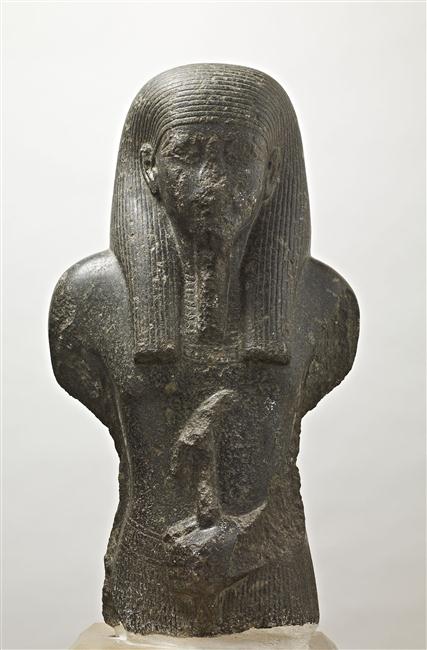
Bust of a male deity holding Was-sceptre
New Kingdom, 18th Dynasty, reign of Amenhotep III, ca. 1391-1353 BC.
Musée d’Archéologie Méditerranéenne, Marseille. n.207
To the Egyptians, Hippopotami were associated with the protective goddess Tawaret who was associated with childbirth, pregnancy, and motherhood.
The Egyptians saw hippos as a fearsome creature who protected their young from predators, with the ferociousness of the hippo encapsulating protective love. Therefore, the nature of the hippo became a symbol of guardianship during pregnancies, childhood and motherhood in general, as well as inspiring folklore in the region.
The legendary tale Manetho documented of Egyptian king Menes being killed by a hippo during a hunting spree seemed to be a popular story told during Manethos' lifetime. For now, it is believed to be just a myth, but it showcases how the hippo, among other predatory animals the Egyptians knew of, inspired the imagination. Despite the hippos known dangerousness, their violence was recognized by the Egyptians as a protective act, giving the mother goddess, protector of children, Tawaret, a hippos' likeness.
What's more is, the funerary figures of hippos, would be placed in many tombs, such as the famous faïence hippo at the Met Museum. And as Egyptians truly believed in the spirit realm, these figures would often have their legs broken off before being placed in the tomb, in fear of the hippo's spiritual reanimation leaning into it's ferocious predator role in the Afterlife and harming the deceased.
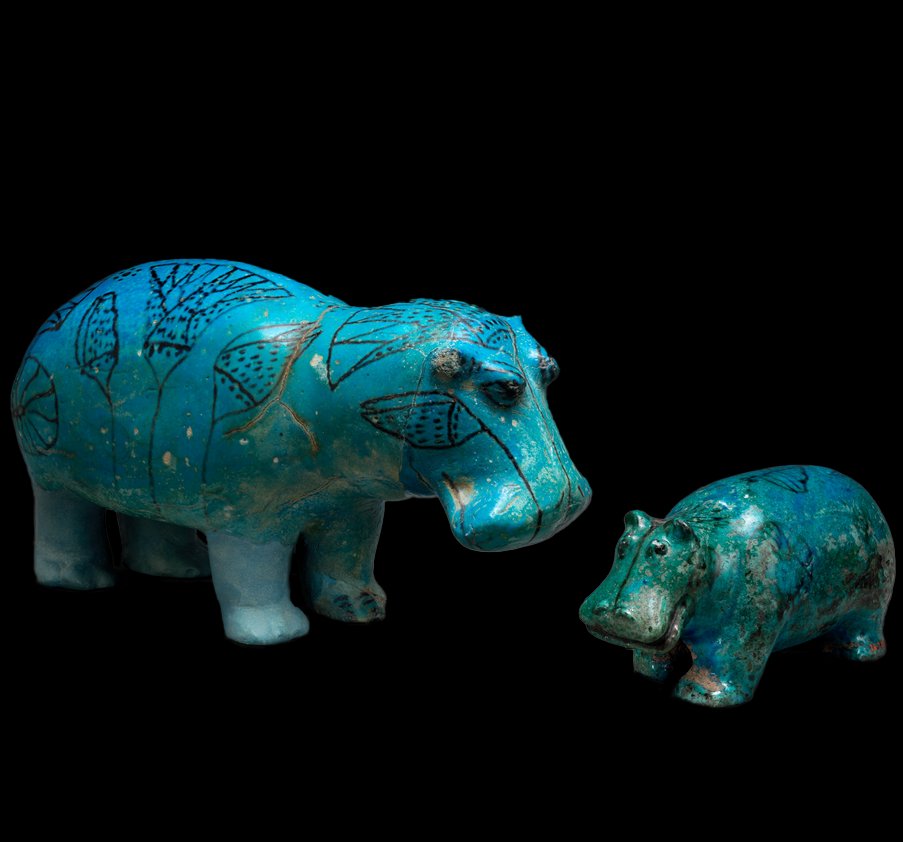
In the picture below we see the faïence hippo known today as "William", and if you look closely, you will notice the legs are a modern addition.
William the Hippo, c. 1961–1878 B.C.
Met Museum. 17.9.1
First studio photograph of the bust of Nefertiti, taken on 23rd December 1912, by the photographer Paul Hollander in the excavation house.
https://t.co/ZlQtsu8OPX
"The most comprehensive publication of the lists of the festivities of the Egyptian Religious Tradition (dated for the year 2025). A practical application of the Egyptian Religious Calendar for the current age.
In this edition you will find, for the first time, the list of the daily Hathor-Goddesses from the architraves of the First Hypostyle Hall, also known as the Outer Hypostyle Hall, of the Temple of Horus at Edfu.
Moreover, I have completely revised the notes, adding in particular geographical information on all places mentioned, and on their Egyptian pronunciation preserved in Coptic: while in the previous edition there were just over forty notes, now they are more than three hundred."
— Egyptian Religious Calendar 2025: 425th-426th year of the Great Year of Ra, by Luigi Tripani
https://t.co/BFmdn6zUAd
Red granite seated statue of Ramesses II between two deities at Tel el-Maskhuta
Photograph by Ermé Désiré, 1867.
Tel el-Maskhuta, located in the eastern Nile Delta, has been associated with various archaeological finds, including statues, from different periods of Egyptian history. The statues and artefacts from Tell el-Maskhuta illustrate the site's rich history, spanning from the Hyksos period through to the Late Period and into Hellenistic times, reflecting both indigenous Egyptian practices and foreign influences.
Excavations have uncovered findings, like this statue, which were associated with the Ramesside era and such discoveries became central to early 19th-century scholars like Édouard Naville and Flinders Petrie, who identified the site with the biblical city of Pithom due to inscriptions mentioning "pr-itm" (House of Atum).
The identification of Tel el-Maskhuta with Pithom has been controversial, with some modern scholars questioning this link based on archaeological evidence and the dating of the finds. It is actually now believed this statue was not originally from Tel el-Muskhuta but usurped from elsewhere, something Ramesses II is quite known for among scholars.
The statue is now at the Ismailia Museum
Seated limestone statue of the royal official Meri-ptah "Royal Scribe of the Table of the Lord of the Two Lands", seated between his mother Kafi and brother Sa-aset
New Kingdom, 19th Dynasty, reign of Ramesses II, c. 1304–1237 B.C.
From the tomb of Meri-ptah (TT387), Sheikh Abd el-Qurna
Now at the Kunsthistorisches Museum, Vienna, Austria. Ägyptische Sammlung, INV 48
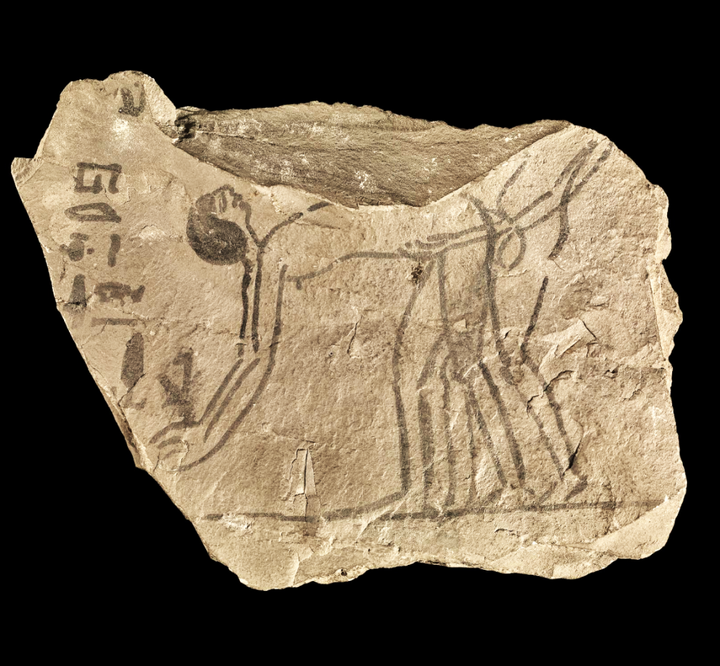
An ostracon showing a pair copulating, dating between the 19th-20th Dynasties, from Deir el-Medina (workman's artisan village).
British Museum. EA50714
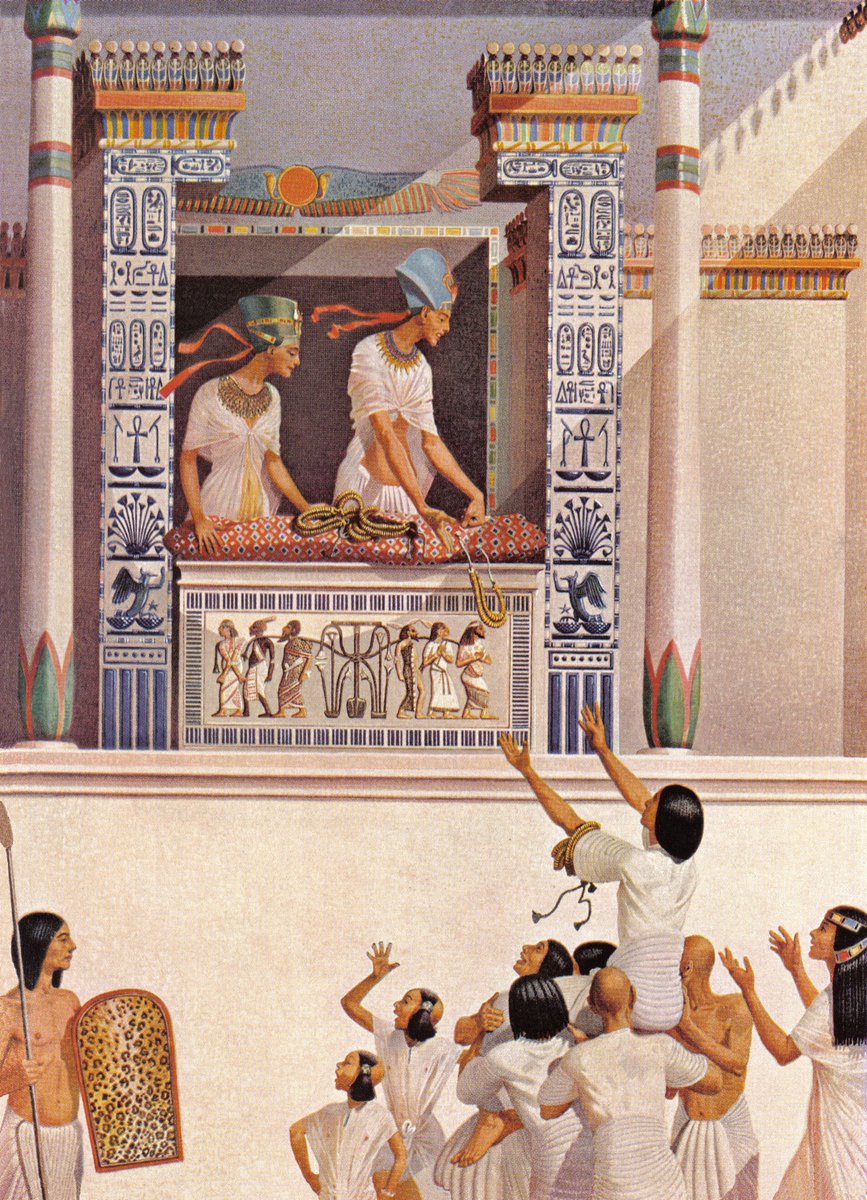
King Akhenaten and Nefertiti bestow honours at the Window of Appearances.
Artwork by Herbert M. Herget (1885-1950), for the National Geographic; "Life, Culture, and History of the Ancient Egyptians", 1941.
Tutankhamun as a sphinx trampling traditional Egyptian foes
From the Tomb of Tutankhamun (KV62), Valley of the Kings, West Thebes
Now in the Egyptian Museum, Cairo. JE 61467
https://t.co/L1yUjWtIsl
Statue of Queen Nofret
Two identical images of #Nofret were discovered at Tanis. They had been taken there after the end of the New Kingdom, more than a millennium after they were made.
Middle Kingdom, 12th Dynasty, reign of Senusret II, ca. 1897-1878 BC. Mission of Emmanuel de Rougé during the winter of 1863-1864. Photograph: Aymard de Banville (1837-1917). Now in the Egyptian Museum, Cairo. CG 382
Read more: https://t.co/TOsg0feFr6
The "mysterious" Osireion
Architecturally, the Osireion is unique due to its subterranean design, constructed at a much lower level than the surrounding Seti I’s temple, suggesting it was either built into an existing depression or the ground level has significantly changed over time. The structure features massive blocks of red granite, some weighing up to 100 tons, which were sourced from quarries as far as Aswan, about 500 miles away. This indicates a significant logistical effort in its construction.
The central hall of the Osireion is surrounded by what appears to be a moat or channel of water, making it resemble an island. This water might symbolize the primeval waters of creation in Egyptian mythology. The hall is supported by large granite pillars and features a stone-paved ‘island’ in the centre. The structure’s design, with its lack of prolific inscriptions and stark, megalithic style, contrasts with the ornate temples of the New Kingdom period, leading to much speculation about its purpose and age.
The Osireion’s mysterious water channel and its depth, which connects to an underground water source, have been subjects of interest. Recent studies have involved monitoring the water’s quality and source, indicating it has unique characteristics compared to other local wells, suggesting a distinct origin. The presence of water in the Osireion, forming what looks like a moat around a central ‘island’, suggests it might have been a sacred water shrine. Water in Egyptian mythology often symbolizes creation, rebirth, and purification. This could have been a place for rituals related to these themes, possibly connected to the annual flooding of the Nile or the resurrection of Osiris.
Traditionally, Egyptologists attribute the Osireion to Seti I, viewing it as a cenotaph or symbolic tomb for the king or for Osiris himself. However, the absence of inscriptions and its architectural style have led to debates about its true age and purpose. Some theories suggest that the Osireion might predate the New Kingdom, possibly from an earlier period due to its construction techniques and alignment with true north, which could imply astronomical significance.
The structure’s age is therefore deemed controversial by some; as theorists claim it could be much older than the reign of Seti I, potentially from pre-dynastic times, with even claims that suggest the geological signs like rain erosion on the stones, would place its construction around 12,000 to 10,000 B.C. Some also speculate, with less archaeological backing, that the Osireion might have been used by a secret society or mystery cult dedicated to Osiris or other deities, where initiates would undergo rituals symbolizing death and rebirth. In short, the Osireion has captured the imagination of many.
Egyptologists and Archaeologists typically date it to Seti I’s era, with some suggesting renovations or additions by later pharaohs like Merenptah, generally agreeing that the Osireion served as a cenotaph, a symbolic tomb for either the god Osiris or king Seti I. This would align with the religious significance of Abydos, considered the burial place of Osiris. The cenotaph symbolizing the place where Osiris was said to be buried, linking the living world with the afterlife.
Osiris’s association with water is multifaceted, encompassing life, death, rebirth, fertility, purification, and the very essence of creation in Egyptian cosmology. This connection is reflected in art, mythology, and the architectural features of places like the Osireion, where water might symbolize both Osiris’s domain over the afterlife and his connection to the life-giving properties of the Nile.
https://t.co/pqftoN9sZy