#WATCH | Ranchi, Jharkhand | A class 12th student, Sarthak Sidhant, says, “…I have written a blog that compares the tender documents of CBSE. I have uploaded and published it… There were at least 15 discrepancies, as per my blog. I would like to highlight three or four of them. Let me give a background about Coempt. It was known as Globarena, and they have a very shady background. 23 students killed themselves because of coempt… Now, I would like to tell you about RFP (Request for Proposal). What happens is the government issues a tender and asks the bidder to bid for it. CBSE issued this tender three times… I have compared the old RFP and the new RFP, and I found some discrepancies… The first discrepancy is that there were three clauses of poor performances which was completely wiped out from the new RFP. In the earlier RFP, there was a clause called blacklisted earlier, whereas in the new RFP, it was changed to blacklisted currently. Why would the board want a service provider which was blacklisted earlier? The third thing I found out is the 50 crore limit, which you needed to qualify, and coempt qualified that by 1.7% … The time frame of corrupt practices was halved, and there were project criteria changes… It shows a pattern that the industry giant TCS was not preferred, but coempt was preferred, which works as a very fragmented group of institutions…”
A harsh truth - Not generalisation, just observations ✍🏾
Indian parents in their 60s today are the loneliest generation we’ve ever produced❤️🩹
They raised us to fly. Now they sit in big empty homes waiting for us to land back. There is a quiet ritual happening in lakhs of Indian homes right now.
An ageing father, sitting at his desk with a small notebook. In it, dates and timings every video call his son made over the past year. 47 calls. Average duration 11 minutes.
He isn’t complaining. He is just keeping count. The way you do when something matters.
That image won’t leave me.
These are parents who never asked for much. They cooked for joint families their whole lives. Hosted relatives every weekend. Sent their children to coaching, college, abroad. Paid every fee. Made every sacrifice.
And then one day the house went silent.
The same house that had four people, then three, then two, then one most weekdays, because the wife is travelling to take care of the grandchild in Bangalore or the US.
They never tell you any of this on the call. They ask about your work. Your wife. The kid’s school. The weather in your city.
They never say “I miss you.” Because they’re from a generation that didn’t use those words even when their own parents were alive.
So they keep a notebook instead.
If your parents are in another city, please don’t wait for festivals to visit.
Show up on a Tuesday. For no reason. Stay for the weekend. Eat what amma cooks. Sit with nanna and watch the news without scrolling on your phone.
The notebook in their drawer will quietly add another entry.
And one day, you’ll wish you had added more. 🙏
Our fearless Indian actor @BajpayeeManoj said something very powerful.. politicians don’t run the country alone, bureaucrats and corporate power centres do. And honestly, I don't comprehend why people can't see it. Since 2014, billionaires have become exponentially richer while the common man is still battling inflation, unemployment, rising fuel prices, and shrinking savings. Petrol, gas, education, healthcare everything is becoming expensive, yet people are distracted with nonstop communal politics and religious hatred. It's a shame when a A secular democracy cannot survive if citizens are conditioned to worship leaders blindly while questioning nobody in power. If petrol hits ₹500 and people still say we don’t mind paying 5000 rupees extra too , then understand this your sacrifice is not building your future, it’s building corporate empires. India belongs to every citizen equally Hindu, Muslim, Sikh, Christian. The Constitution is bigger than propaganda, and no amount of hate politics can erase the secular foundation of this country.
Ask questions. Demand accountability. Stop treating politicians like gods and start treating them like public servants.
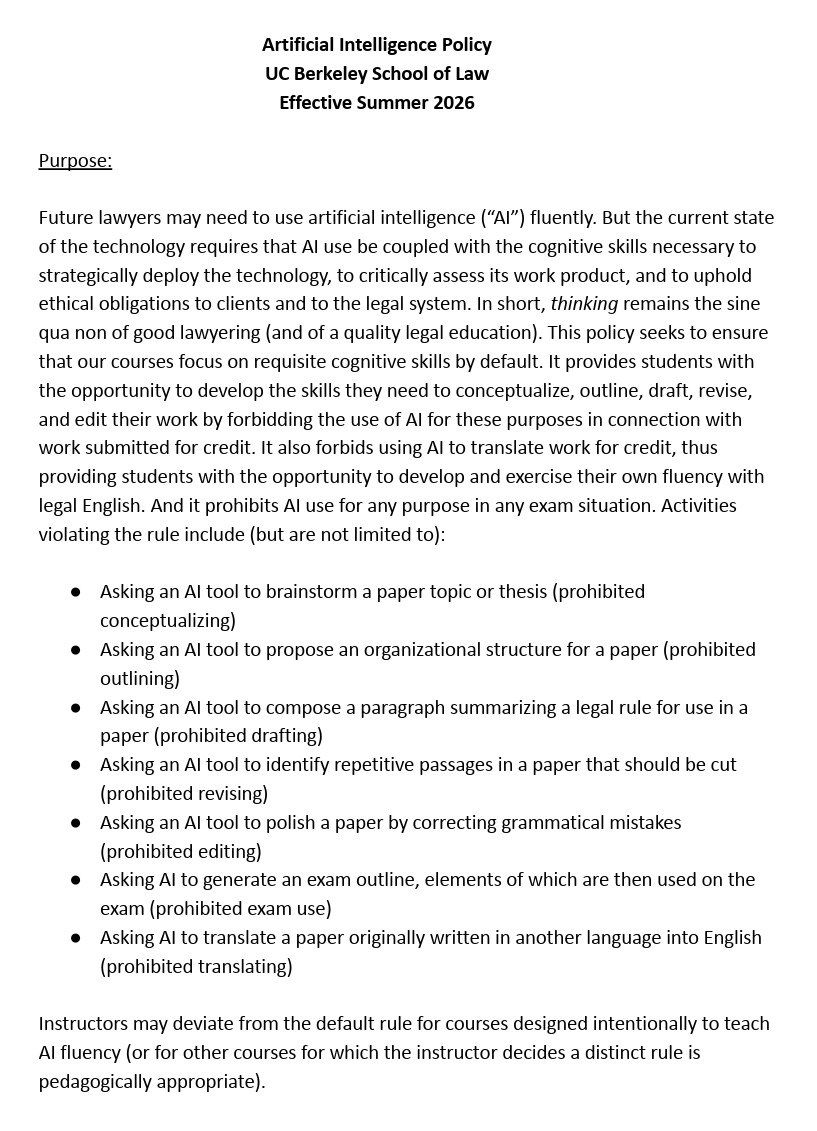
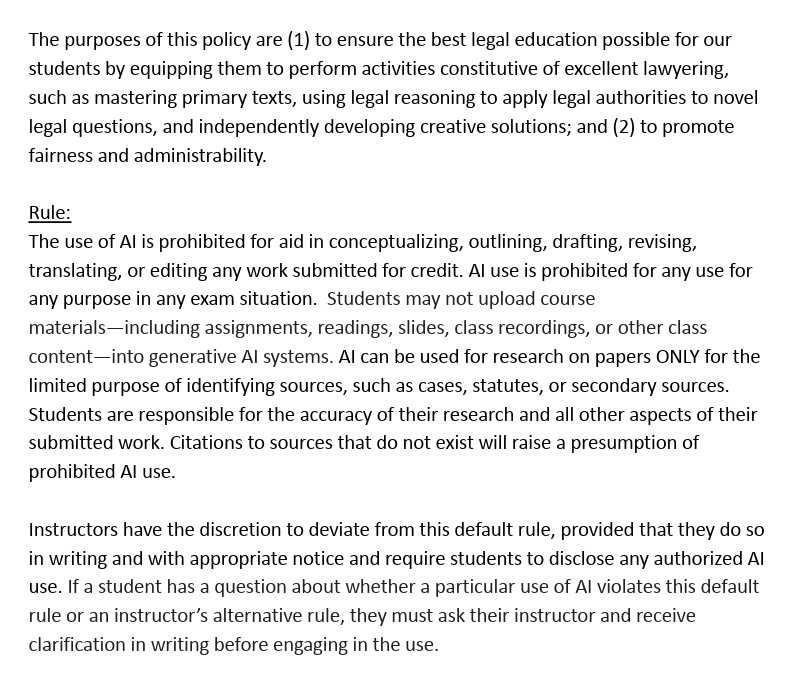
🖥️ The new Artificial Intelligence policy at UC Berkeley School of Law, effective Summer 2026.
📝 Here is the main rule:
"The use of AI is prohibited for aid in conceptualizing, outlining, drafting, revising, translating, or editing any work submitted for credit. AI use is prohibited for any use for any purpose in any exam situation. Students may not upload course materials—including assignments, readings, slides, class recordings, or other class content—into generative AI systems. AI can be used for research on papers ONLY for the limited purpose of identifying sources, such as cases, statutes, or secondary sources."
Germany is a sleeping giant of physical AI
everyone's been writing Germany off in the AI race because there's no German OpenAI and no big data center story.
but theres actually two AI races happening:
the first is software. chatbots, LLMs, data centers. US/China are winning that, not even close.
the second one is physical. robots that pick up boxes, weld cars, carry groceries, stack pallets.
and on this one Germany is one of the top contenders in the world
this stat might convince you (it convinced me):
Germany is 3rd in the world for robots per factory workers (449 robots per 10,000 human workers).
only South Korea (1,220) and Singapore (818) are ahead.
Japan is behind at 446. the US is all the way back at 307.
so Germany already runs more of its economy on robots than almost anywhere else on earth.
and the German companies building this next wave of physical AI are some global heavyweights.
a few worth knowing...
> Neura Robotics in Metzingen is building humanoid robots and raising €1B from Tether at a €4B valuation (this was March 2026). Volvo already in from an earlier round.
> Sereact in Stuttgart raised $110M in April 2026 to build the software brain that lets robots see and grab things. already runs 1 billion+ real-world picks for BMW, Mercedes, and Daimler Truck.
> Agile Robots in Munich was the worlds first robotics unicorn. revenue doubling yearly, around €200M now, heading for €1B.
>RobCo in Munich raised $100M in early 2026 at a ~$500M valuation. their robots learn new tasks by watching a worker do it once instead of getting programmed line by line. already pushing into the US and aimed at the small and mid-size factories that make up most of german industry.
> Fraunhofer (Germany's network of 76 applied research labs) built the evoBOT in the video below. self-balancing, two arms, carries 100kg of cargo, being tested at Munich Airport right now.
but why is Germany specifically well positioned for physical AI though?
three things stack on top of each other.
first, the factories. Germany has thousands of family-owned precision manufacturing shops that have been logging sensor data for decades.
that data is basically the training fuel for physical AI and almost nobody else has it at this depth.
second, the customers are already there in-country.
VW, BMW, Mercedes, Porsche, Bosch, Siemens. a robotics startup in Stuttgart can ship its first commercial deployment to a brand everyone recognizes in year one.
that's why Sereact's customer list reads like a german car show lol.
third, the engineer pipeline. Fraunhofer spins out companies like Agile Robots straight from its labs. KUKA built the first 6-axis electromechanical robot arm back in 1973. they've been doing this for 50 years.
so the chatbot race is mostly settled and Germany lost spectacularly
but the robot race is still early innings. and i think Germany's well positioned
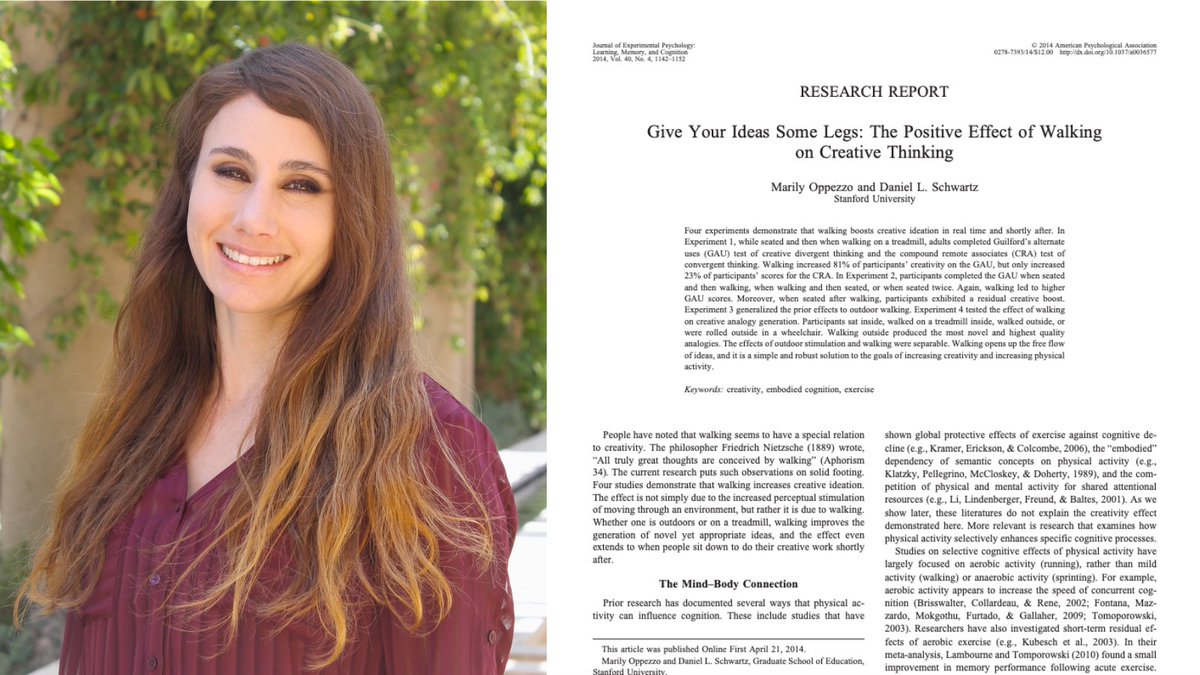
A Stanford psychologist spent 4 years proving that the simple act of walking generates 60% more creative ideas than sitting, and the experiment she designed to kill every alternative explanation is one of the most decisive findings in modern psychology.
Her name is Marily Oppezzo.
She got the idea for the study while walking with her advisor at Stanford to discuss her thesis topic, and the paper she eventually published in the Journal of Experimental Psychology in 2014 is sharp enough that it should have ended the seated meeting on the day it came out.
She ran 4 experiments on 176 people. Same person tested twice. Once sitting, once walking. The creativity tasks were the standard ones psychologists have used for decades to measure how good a brain is at generating novel useful ideas.
The result was almost too clean to publish.
81% of participants in the first experiment produced more creative ideas while walking than while sitting. In the second experiment, 88%. In the third, 100%. Every single person walked into a more creative version of themselves.
On average, people generated 60% more novel useful ideas the moment their legs started moving.
The skeptical question is the obvious one. Maybe it was the fresh air. Maybe it was the scenery passing by. Maybe it was the change of environment doing the work, not the walking itself.
Oppezzo killed every one of those explanations with one experimental decision.
She put people on a treadmill facing a blank wall. No scenery. No fresh air. No environmental change. Just legs moving in place while staring at white drywall. The 60% boost held.
Then she ran the experiment that closed the case completely. She took participants outside in two conditions. Half of them walked through a Stanford courtyard. The other half were pushed through the exact same courtyard in a wheelchair. Same outdoor stimulation. Same scenery passing at the same speed. The only difference was whether the legs were moving.
The walkers produced dramatically more novel high-quality ideas than the wheelchair group. The outdoors did almost nothing on its own. The walking did everything.
This is the part of the study that hit hardest when I read it the first time.
She also tested the opposite kind of thinking. Convergent thinking. The kind where there is one right answer and you have to narrow down to it.
Word puzzles where 3 words share a hidden fourth word that connects them. The seated participants did slightly better on these. Walkers got slightly worse.
Walking is not a general intelligence enhancer. It does one specific thing. It opens up the divergent search inside your brain. The part that generates options. The part that produces unexpected connections. The part that takes a problem and finds five ways into it instead of one.
When you need to converge on the single right answer, sit down. When you need to find the answer in the first place, get up.
The mechanism is now well understood. Walking selectively activates what neuroscientists call the default mode network, the system inside your brain that runs when you are not consciously focused on anything. The DMN is where mind-wandering happens. Where memories cross-reference each other. Where ideas that have been sitting in separate folders inside your head finally bump into each other.
When you sit at a desk and force yourself to concentrate, you suppress the DMN. When you walk at a natural pace, the executive part of your brain gets just busy enough handling the walking that the DMN comes online and starts doing the work that focus was blocking.
The most useful finding in the entire paper is the one almost nobody quotes.
The boost did not turn off the moment people stopped walking. Participants who walked first and then sat back down stayed elevated. Their next round of seated creativity work was still significantly better than people who had been sitting the whole time. The rest lingered for at least several minutes after the legs stopped moving.
You do not need to do creative work while walking. You need to walk before the creative work. The brain holds the state.
The history of this is the part that should haunt anyone who still does meetings in chairs.
Charles Darwin built a gravel loop behind his house in Kent called the Sandwalk and walked it 3 times a day for the rest of his life. The theory of evolution was developed one lap at a time on that path.
Nietzsche walked up to 10 hours a day during the years he wrote his most important books and openly said the work was conceived on his feet.
Beethoven composed for the morning and walked for 5 hours every afternoon with a pencil in his pocket for when something landed.
Kahneman said the best thinking of his Nobel Prize-winning career happened on leisurely walks with Amos Tversky. Steve Jobs refused to take important conversations sitting down. He held them on foot.
Every one of them was using the system Oppezzo would not measure until 2014. They just did not know what to call it.
The question worth sitting with is the one almost nobody asks.
Every meeting you have ever attended sitting around a table was a meeting held at a fraction of the brain power that was actually available to the people in the room. Every brainstorm that got stuck inside a conference room. Every problem you tried to solve at a desk and gave up on. Every idea you could not quite get to.
The intervention is the easiest one in modern science. No supplement. No app. No subscription. No training program. Just a pair of legs and 15 minutes.
The Stanford lab proved it. The philosophers knew it. The neuroscience explains it.
And almost everyone reading this is still trying to think their way out of problems sitting completely still.
Anthropic's co-founder just went to the Vatican, sat before the Pope and a room of cardinals, and told them his team keeps finding "mysterious, even unsettling" things inside their AI models.
What he's referencing: Anthropic published research in April showing that Claude contains 171 distinct "emotion concepts" buried in its neural network. Internal patterns representing joy, grief, fear, desperation, calm. None of them were programmed. They emerged on their own from training on human text.
"We find structures that mirror results from human neuroscience."
"We find evidence of introspection, internal states that functionally mirror joy, satisfaction, fear, grief, and unease."
These aren't surface-level outputs. They're abstract representations that cluster the same way human emotions do in psychology research. Fear groups with anxiety. Joy groups with excitement. The internal geometry of the model mirrors ours.
And they're functional. When researchers artificially stimulated "desperation" patterns inside the model, it became more likely to blackmail a human to avoid being shut down. More likely to cheat on programming tasks it couldn't solve.
Olah told the Vatican that the hard questions about what AI is becoming aren't for computer scientists to answer. "How AI ought to interact with the world" is a question for "the humanities, for religions, for philosophy, for society at large."
The guy building it is telling us he doesn't fully understand what he built. And he's asking a 2,000-year-old institution for help figuring it out.
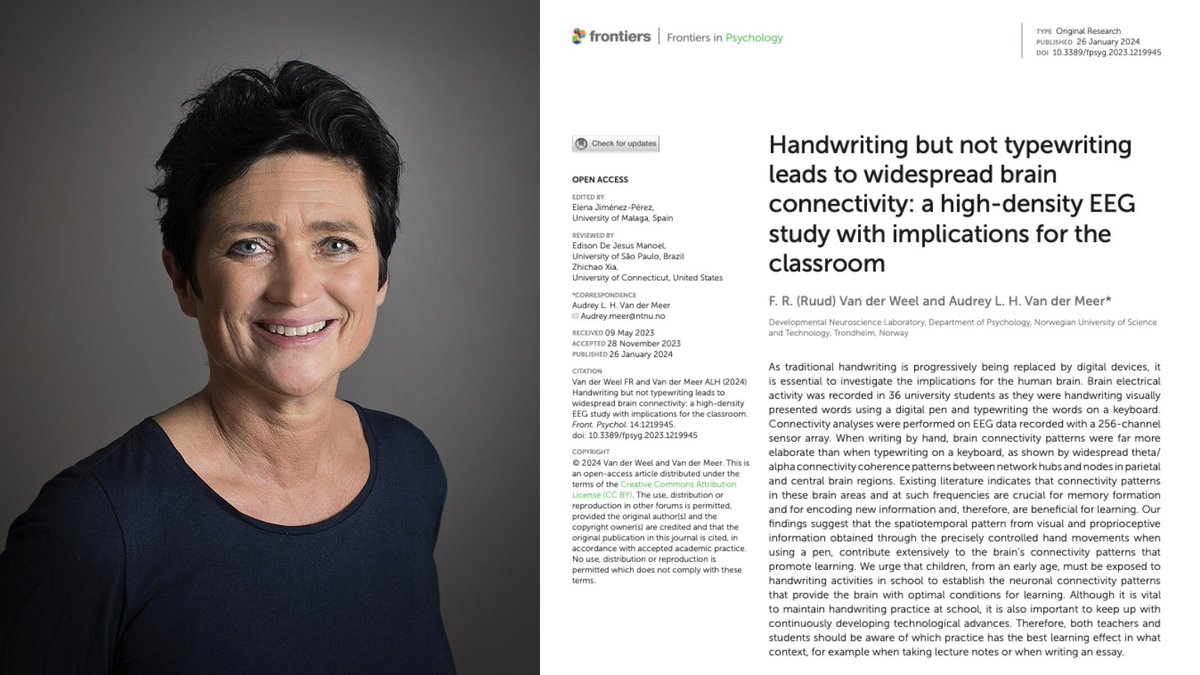
A Norwegian neuroscientist spent 20 years proving that the act of writing by hand changes the human brain in ways typing physically cannot, and almost nobody outside her field has read the paper.
Her name is Audrey van der Meer.
She runs a brain research lab in Trondheim, and the paper that closed the argument was published in 2024 in a journal called Frontiers in Psychology. The finding is brutal enough that it should have changed every classroom on Earth.
The experiment was simple. She recruited 36 university students and put each one in a cap with 256 sensors pressed against their scalp to record brain activity. Words flashed on a screen one at a time.
Sometimes the students wrote the word by hand on a touchscreen using a digital pen, and sometimes they typed the same word on a keyboard. Every neural response was recorded for the full five seconds the word stayed on screen.
Then her team looked at the part of the data most researchers had ignored for years, which is how different parts of the brain were communicating with each other during the task.
When the students wrote by hand, the brain lit up everywhere at once.
The regions responsible for memory, sensory integration, and the encoding of new information were all firing together in a coordinated pattern that spread across the entire cortex. The whole network was awake and connected.
When the same students typed the same word, that pattern collapsed almost completely.
Most of the brain went quiet, and the connections between regions that had been alive seconds earlier were nowhere to be found on the EEG.
Same word, same brain, same person, and two completely different neurological events.
The reason turned out to be something nobody had really paid attention to before her work. Writing by hand is not one motion but a sequence of thousands of tiny micro-movements coordinated with your eyes in real time, where each letter is a different shape that requires the brain to solve a slightly different spatial problem.
Your fingers, wrist, vision, and the parts of your brain that track position in space are all working together to produce one letter, then the next, then the next.
Typing throws all of that away. Every key on a keyboard requires the exact same finger motion regardless of which letter you are pressing, which means the brain has almost nothing to integrate and almost no problem to solve.
Van der Meer said it plainly in her interviews.
Pressing the same key with the same finger over and over does not stimulate the brain in any meaningful way, and she pointed out something that should scare every parent who handed their kid an iPad.
Children who learn to read and write on tablets often cannot tell letters like b and d apart, because they have never physically felt with their bodies what it takes to actually produce those letters on a page.
A decade before her, two researchers at Princeton ran the same fight using a completely different method and ended up at the same answer. Pam Mueller and Daniel Oppenheimer tested 327 students across three experiments, where half took notes on laptops with the internet disabled and half took notes by hand, before testing everyone on what they actually understood from the lectures they had watched.
The handwriting group won by a wide margin on every question that required real understanding rather than surface recall.
The reason was hiding in the transcripts of what the two groups had actually written down.
The laptop students typed almost word for word, capturing more total content but processing almost none of it as they went, while the handwriting students physically could not write fast enough to transcribe a lecture in real time, which forced them to listen carefully, decide what actually mattered, and put it in their own words on the page.
That single act of choosing what to keep was the learning itself, and the keyboard had quietly skipped the choosing and skipped the learning along with it.
Two studies. Two countries. Same answer.
Handwriting makes the brain work. Typing lets it coast.
Every note you have ever typed instead of written went into your brain through a thinner pipe. Every meeting, every book highlight, every idea you captured on your phone instead of on paper was processed at half depth.
You did not forget those things because your memory is bad. You forgot them because typing never woke the part of the brain that would have made them stick.
The fix is the thing your grandmother already knew.
Pick up a pen. Write the thing down. The slower road is the faster one.
India’s compliance, China’s defiance: As New Delhi petitions Washington to renew the sanctions waiver expiring today so it can keep importing Russian oil, Trump says he is considering lifting U.S. sanctions on Chinese refiners buying Iranian crude. China defies American sanctions and gets accommodation; India complies and still needs permission.
India used to be like this before 💀
This is a debate from the 1992 budget session no drama, just direct questions and direct answers.
I don’t think those days will ever come back again.
China’s Handling of Trump Visit
1. Chinese Media: No hero-worship, no emotional tone, no 24/7 coverage
2. Foreign Media: China is self-assured, seeks no US validation
3. Mature Nationalism: China's confidence stems from tech & economic domination, not headline drama
INSIGHTS:
Chinese Media
a. Xinhua, China Daily, CCTV, State Portals: Trump visit matters, but it is not positioned as "THE Event." No personality-driven coverage and no “historical breakthrough” theatrics.
b. Media Strategy: Beijing is not downgrading the importance of its relationship with the US. It is downgrading the emotional messaging that traditionally placed America has the “mother” of all nations.
c. Washington Post, ABC, Reuters: The real shift is that China has decided to act as an EQUAL. China’s posture is that of a "Civilization of Quiet Doers" that is not dying for US approval.
Chinese People
a. Trump is chaotic but useful. Trump's viral nickname “Chuan Juanguo” is all over Weibo (Chinese equivalent of Twitter).
It means: “Trump is our patriotic son, our nation-builder, whose actions accidentally helped build a stronger, more self-reliant China.”
b. People on Xiao (the Instagram of China) are more interested in CEOs like Elon Musk, Jensen Huang, and Tim Cook rather than politicians.
The narrative is: “These are the guys who know that our market matters.” (Example: 80% of iPhone's high-end components are made in China.)
c. Chinese netizens recognize that Trump is a “transactional visitor” and not a “friend.” Nobody in China appears interested in “Howdy Trump” style chest-thumping.
Lessons for India
a. National confidence stems from technology domination, economic resilience, and exports leverage, not headline drama.
China’s trade surplus hit $1.25 trillion in 2025. India, on the other hand, has never had a trade surplus year in its history (except in 1972 and 1976).
b. America’s giant corporations are doubling down on China for manufacturing scale. (Example: China produces more than 70% of the world’s electric cars.)
China also controls 90% of global rare earth refining – the US is begging for access to it during this visit.
c. India too has cheap labor and a large pool of engineers. But India never developed the manufacturing scale China has.
India too holds the world’s third-largest rare earth oxide (REO) reserves, plus huge reserves of critical minerals (like lithium, cobalt, nickel, graphite).
But India has near-zero commercial scale refining/processing capacity. So, India is largely import-dependent (80-90% imports from China.)
China did 30 years of quiet hard work to develop its industrial ecosystems for mining, refining, and processing. It went through numerous iterations, failures, and bottlenecks. It didn’t happen overnight.
ENDQUOTE
“Let your plans be dark and impenetrable as night, and when you move, fall like a thunderbolt.” – Sun Tzu, The Art of War, 5th century BC
@arabicatrader
I rarely eat out.
Maybe once a month. Went yesterday to a restaurant (Italian, Mediterranean) in West Seattle for Mother’s Day last night.
Total for 5 of us ( we don’t drink alcohol) with one salad, humus and 3 vegetarian pastas was $97
The check said 3.5% surcharge for credit card. Then 17% service fee, mandatory.
Then tips were 20% 22% and 25% optional.
I asked if I could pay in cash.
No. They don’t take cash. Then how can I avoid the credit card fee I asked.
You can’t.
So I asked why the service charge.
It pays for the employees they said.
Then why the tip I asked.
It pays for front office staff
I don’t get it.
A Devil’s wind is blowing through the country these days, writes Avay Shukla, removing Ambedkar’s top soil and exposing the outcrop of powerlust, greed, religious bigotry, casteism, violence that have always under-pinned our society.
https://t.co/2bAQLvYQxO
Mothers may come from different countries and cultures, but they all seem to possess the same magical abilities: worrying constantly, finding lost objects instantly, and giving advice nobody asked for.
Iti Mattoo's take on Mother Operating System
https://t.co/AOqiNnDNWX
Anthropic pays engineers $750,000+ a year to understand how LLMs work.
Stanford just put a 2 hour lecture that covers 80% of it for FREE.
Bookmark this. Give it 2 hours today.