Machine-learner, meat-learner, research scientist, AI Safety thinker. Model trainer, skeptical adorer of statistics.
Co-author of: Malware Data Science
"Loss of Control" from AI is such a huge umbrella term.
Who is losing control, how control is lost, what is lost, and at what scale.
Any big areas that I am missing?
https://t.co/HvpbGIV3Aw has this excellent feature where if you go back a few seconds in a show, it temporarily turns on subtitles, as understanding what was said is a common reason for going back.
This is surprising, because their overall web user interface design is atrocious.
An OpenAI model disproved a conjectured upper bound on this geometry problem:
Place (n) distinct points in the plane. How many pairs can be exactly distance 1 apart?
https://t.co/EOrAs8xjAM
1. Oh dear. Very cool.
2. I really want to see a visualization of the new solution 🥲
I’m curious if there is a workable middle path: models that get far more efficient by moving away from today’s uniformly dense training regime, while preserving enough shared representation to remain powerful - and perhaps becoming more interpretable and governable along the way.
I think more segmented architectures will weaken superposition, and in doing so they may also make models easier to inspect, audit, constrain, and understand.
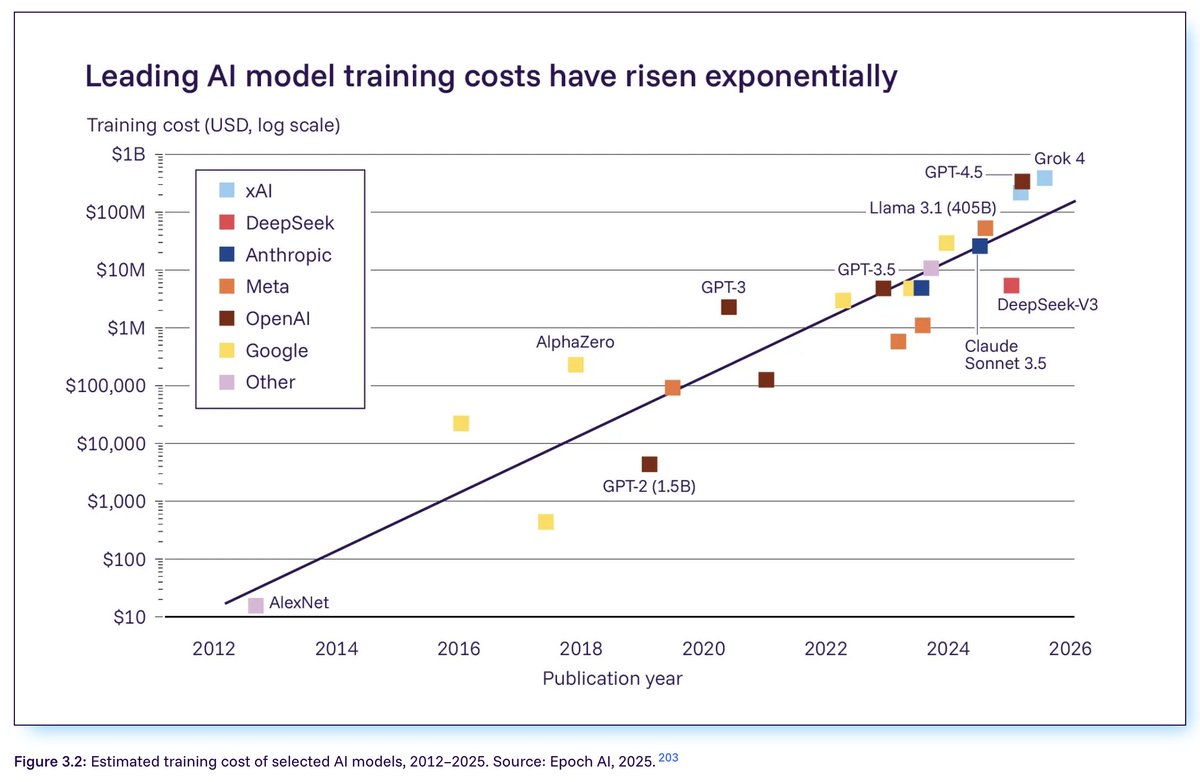
Today’s frontier models train in an expensive style: dense forward passes, huge matrix multiplies, and broad weight updates.
The human brain (~5 MWh over 28 years) is an existence proof that learning can be vastly more energy efficient - ~10,000x - than modern AI training runs.
The 2026 Int'l AI Safety Report says AI progress could accelerate “if AI systems begin to speed up AI research itself.”
But that "if" is no longer an if.
The question is how strong the feedback loop will be, and how much it will be slowed by bottlenecks & diminishing returns.
This has privacy and governance risks.
But if frontier AI risk is real, compute governance is one of the (few-ish) levers that can still operate outside the model itself.
Perhaps there is a way to do this well.
The hardest AI risks to govern are high-severity, low-evidence, fast-moving risks.
A misaligned system that can hack, replicate, and seek compute requires swift action.
Arguably: large GPU clusters should be internationally tracked.
Hot take: fewer frontier AI labs makes safety regulation easier.
For once, less competition is better.
Meanwhile... when Anthropic declined DoD uses involving mass surveillance and fully autonomous weapons, the current administration designated it a supply-chain risk. Awful.