There are three key stakeholders involved here:
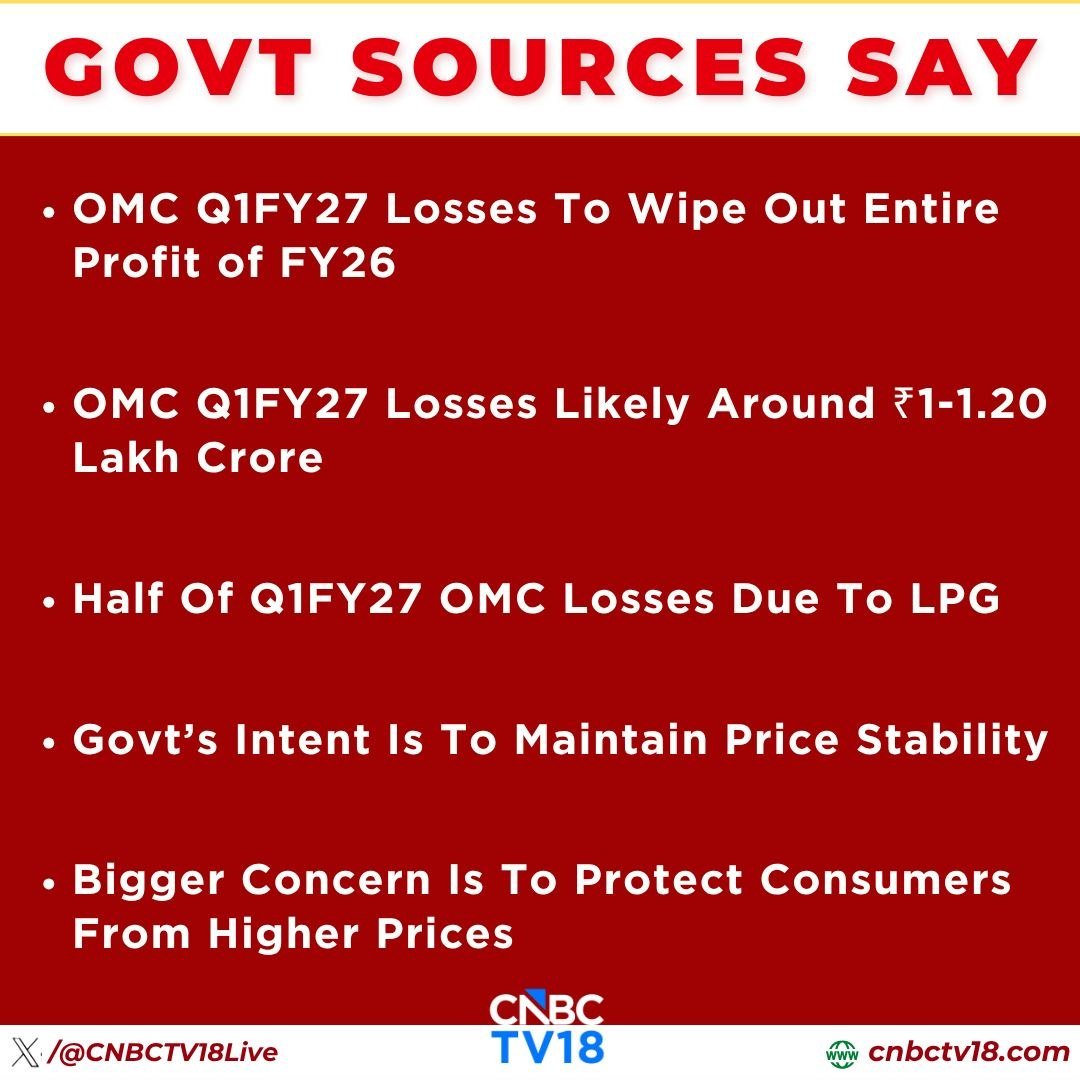
Government — wants to keep fuel prices under control so consumers are protected from sharp price increases and inflationary pressure.
Consumers — prefer stable prices and do not want persistently high inflation to erode purchasing power.
OMCs (Oil Marketing Companies) — do not want to incur losses, but their pricing flexibility is limited because the government is the majority shareholder and heavily influences pricing decisions.
The key question is: who ultimately bears the cost of this price mismatch?
Most likely, the burden falls on the government, either directly through subsidies or indirectly through pressure on OMC balance sheets. This can strain government finances and widen the fiscal deficit if sustained for a long period.
On the other hand, if the government allows the full increase in costs to be passed on to consumers, fuel prices rise sharply, which can feed into broader inflation across the economy. That creates political and economic challenges, especially in an inflation-sensitive environment.
So, in essence, the government is balancing two trade-offs:
protecting fiscal health, or
protecting consumers from inflation.
Most microfinance players have recovered well, both technically and fundamentally. A few companies, such as Equitas Small Finance Bank, managed the downturn relatively better by reducing their microfinance exposure at the bottom of the cycle. At the same time, credit costs have been consistently declining across most of the industry, which is an encouraging sign.
Among the sector, the more interesting opportunities appear to be the players that recover faster than the rest. Microfinance stocks have rallied sharply over the past few days, but missing the exact bottom does not necessarily mean the opportunity is gone.
From a techno-fundamental perspective, a few names still look interesting due to their ongoing consolidation patterns, including Arman Financial Services, ESAF Small Finance Bank, and CreditAccess Grameen. On the other hand, it may be better to avoid relatively weak or negatively trending stocks such as Utkarsh Small Finance Bank.
It also may not be the ideal time for equity dilution through share issuance, especially in the case of Equitas Small Finance Bank, which is reportedly considering raising equity capital. The reason is that valuations for most players are only around historical averages rather than at peak valuations. Since equity is generally the most expensive form of capital compared to debt, dilution at these levels may not be the most efficient option for shareholders. However, management may have a longer-term strategic view regarding growth, capital adequacy, or regulatory requirements.
This is not a buy or sell recommendation. It is purely for educational and discussion purposes only.
Thanks @goindiastocks for the summary. My comment is specifically on R&D spend. Bernstein makes valid points but misses the full picture.
India has genuinely done well where its strengths (large scale, low cost, and practical problem-solving) have given room to grow. ISRO delivering world-class space missions on a shoestring budget, Indian pharma supplying generics and vaccines to the world, UPI becoming a global benchmark for digital payments. These are not small achievements. They reflect real, hard-earned capability.
The real gap is not talent or money. It is the system.
India has excellent IITs, capable scientists, hungry entrepreneurs, and increasingly active investors. What is missing is the bridge between all of these. In Germany, the Fraunhofer Institutes (https://t.co/ZnNeojMt4k?) play exactly this role: they sit between universities and industry, taking raw research and turning it into real products. India has the two ends of this chain but not the middle.
What will actually make a difference:
Private sector must lead R&D: Right now, most research funding comes from government. Industry needs to step up, with the right tax incentives, co-funding models, and procurement policies that give domestic deep-tech companies a fair chance.
Fix universities: Filing patents and spinning out startups should be a career milestone for Indian academics, not an afterthought. Incentive structures need to change.
Create patient capital for deep tech: Indian VC is good at funding consumer apps and SaaS. Deep tech needs 10-15 years to pay off. We need sovereign funds and long-term investment vehicles with real tax support.
Pick your battles: India cannot do everything at once. For example, Semiconductors, renewable energy, pharma and biotech, defense technology, and AI are the right bets, areas where we already have a base and global demand is strong.
Improve execution, urgently: This is perhaps the biggest unlock. Indian policy ideas are often quite good. What kills them is slow approvals, unclear regulations, and poor coordination between ministries and agencies. Fix the plumbing, and everything else will follow.
South Korea and Taiwan did not build world class technology industries through motivation alone. They built patient, focused, well-coordinated systems over decades.
India has the talent, the ideas, and the entrepreneurial energy. What it now needs is the institutional architecture to convert all of that into something durable and the political will to make hard choices.
Thanks @goindiastocks for the summary. My comment is specifically on R&D spend. Bernstein makes valid points but misses the full picture.
India has genuinely done well where its strengths (large scale, low cost, and practical problem-solving) have given room to grow. ISRO delivering world-class space missions on a shoestring budget, Indian pharma supplying generics and vaccines to the world, UPI becoming a global benchmark for digital payments. These are not small achievements. They reflect real, hard-earned capability.
The real gap is not talent or money. It is the system.
India has excellent IITs, capable scientists, hungry entrepreneurs, and increasingly active investors. What is missing is the bridge between all of these. In Germany, the Fraunhofer Institutes (https://t.co/ZnNeojMt4k?) play exactly this role: they sit between universities and industry, taking raw research and turning it into real products. India has the two ends of this chain but not the middle.
What will actually make a difference:
Private sector must lead R&D: Right now, most research funding comes from government. Industry needs to step up, with the right tax incentives, co-funding models, and procurement policies that give domestic deep-tech companies a fair chance.
Fix universities: Filing patents and spinning out startups should be a career milestone for Indian academics, not an afterthought. Incentive structures need to change.
Create patient capital for deep tech: Indian VC is good at funding consumer apps and SaaS. Deep tech needs 10-15 years to pay off. We need sovereign funds and long-term investment vehicles with real tax support.
Pick your battles: India cannot do everything at once. For example, Semiconductors, renewable energy, pharma and biotech, defense technology, and AI are the right bets, areas where we already have a base and global demand is strong.
Improve execution, urgently: This is perhaps the biggest unlock. Indian policy ideas are often quite good. What kills them is slow approvals, unclear regulations, and poor coordination between ministries and agencies. Fix the plumbing, and everything else will follow.
South Korea and Taiwan did not build world class technology industries through motivation alone. They built patient, focused, well-coordinated systems over decades.
India has the talent, the ideas, and the entrepreneurial energy. What it now needs is the institutional architecture to convert all of that into something durable and the political will to make hard choices.
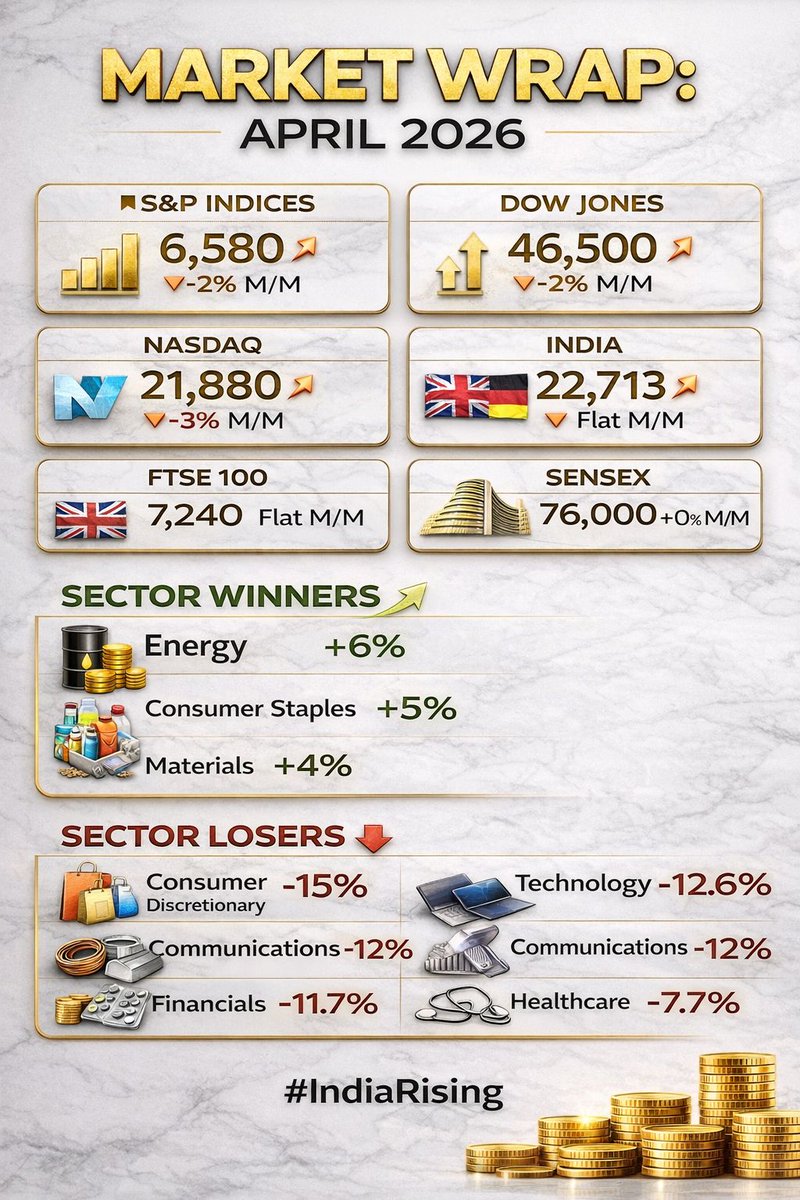
The world is on fire. And markets are finally listening.
April 2026 is not a regular month. This is a full blown reset. 🧵
Two wars. Russia-Ukraine still burning. Middle East escalating.
Oil doesn't care about your portfolio.
Brent crude is sitting at $110. Energy ETFs are up 38.4%. The world runs on oil, and right now, oil runs the world.
Meanwhile, the fear gauges are screaming.
OVX at 61. Multi-year highs. VIX at 24. These are not just numbers. These are the market telling you it has no idea what happens next.
Nasdaq down 13%. Tech stocks bleeding. Consumer spending freezing up. Financials cracking.
The sectors that made everyone rich in the last decade? They are taking the hardest hits right now.
But here is what is interesting.
India's Sensex? Flat. Nifty holding at 22,713. While the US, UK and Europe wobble, India is just standing there. Quiet. Steady.
Gold is at $4,680 per ounce. Silver at $73.
Safe havens are not cheap anymore. The world is paying a premium for safety. That tells you everything about where sentiment is right now.
Global markets have shifted into risk off mode.
That means money is moving away from growth and tech. It is chasing energy, staples, and materials instead. The playbook has changed overnight.
The question is not whether the storm is here.
It is whether you are watching it from the wrong side of the window.
What are you doing with your portfolio this month? Drop it below.
The future of Indian energy is looking incredibly bright right now. A massive ₹30,000 crore investment is flowing straight into the solar sector. The clear goal here is to hit 50 GW of solar cell capacity by FY27. This is a huge signal for the markets and a massive step toward clean energy.
Are you tracking the renewable space yet?
7/7
Watch this space.
When India's defense manufacturing scales, the companies building the backbone behind it will matter just as much as the ones making the weapons.
TVS Supply Chain just raised its hand. 🇮🇳
India's defense sector just got a serious supply chain upgrade.
TVS Supply Chain Solutions has partnered with ALA Group to tap into a $28 billion aerospace and defense opportunity.
Here's why this is a bigger deal than most people realize. 🧵
6/7
The bigger picture?
India wants to cut defense imports and build more at home.
Every partnership like this one adds another layer to that foundation.
This is not just business. This is nation building with a supply chain.
India is about to make a move that could change how the world thinks about AI infrastructure.
And it's not coming from Silicon Valley.
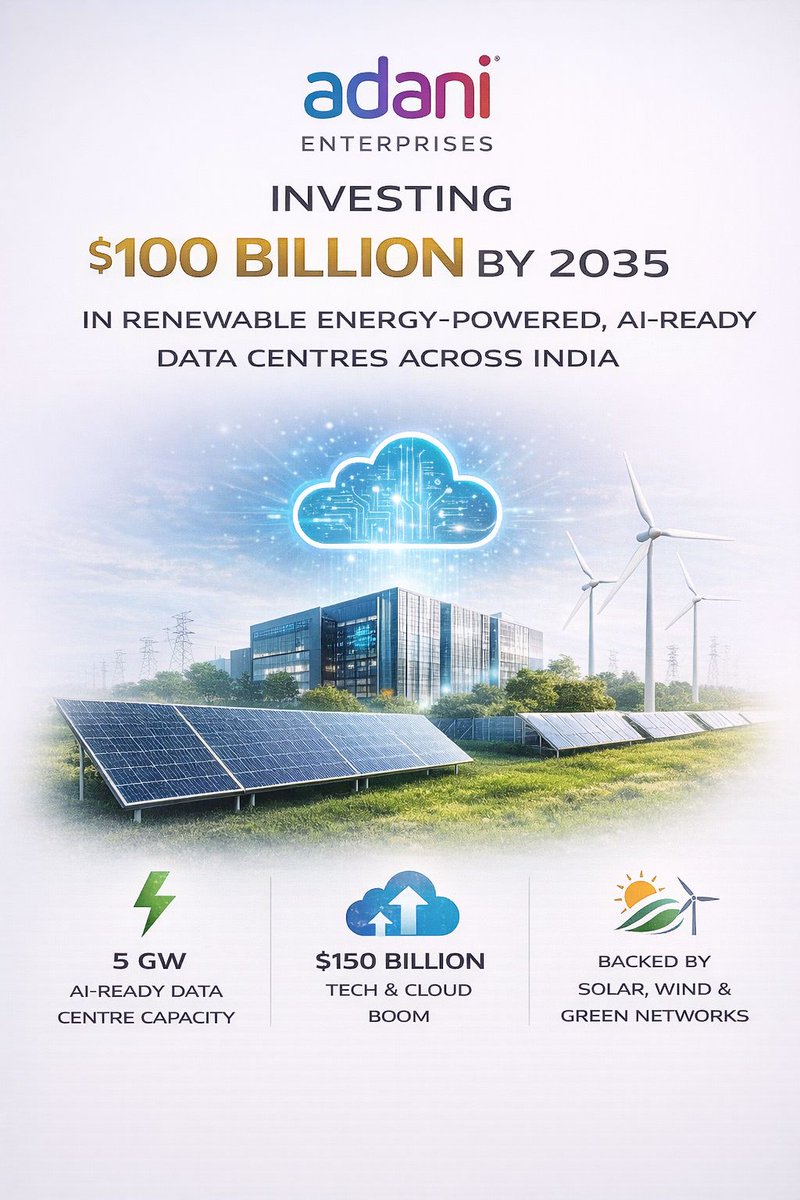
Adani Enterprises just announced a $100 billion investment in AI-ready data centres across India by 2035.
That's not a typo. One hundred billion dollars.
But here's what makes this different from every other data centre announcement you've seen.
These won't run on coal. They'll run on solar, wind, and green energy networks.
5 GW of capacity. Clean. Powerful. Future-ready.
Why does this matter to you?
Because India is sitting right in the middle of a $150 billion tech and cloud boom.
Faster apps. Smarter AI tools. Better digital services. All of it needs infrastructure. This IS that infrastructure.
Think about it this way.
Every time you use an AI tool, stream a show, or make a UPI payment, a data centre makes it happen.
India is now building the ones that will power the next decade.
The West built the internet age.
India might just build the AI age.
And Adani just placed a $100 billion bet on that future.
Watch this space.
Looking for an investment partner that prioritizes long-term wealth creation? 📈
At Hillview Global, we believe in building robust portfolios rooted in deep fundamental research and advanced financial analytics. We don't just chase trends; we identify high-quality businesses with massive opportunity sizes using our rigorous SQML framework.
India imports $13.9 billion worth of LPG from the Middle East every year.
That's nearly half of what we burn in our kitchens.
And right now, that supply is sitting on a knife's edge. Here's why 👇
46.9% of India's LPG comes from the Middle East.
Not a small number. That's almost every second cylinder you use at home coming from thousands of miles away across one of the world's most tense regions.
Here's the scary part.
80 to 85% of those LPG shipments pass through a tiny stretch of water called the Strait of Hormuz.
One disruption there and the ripple hits your gas bill faster than you think.
The Strait of Hormuz sits between Iran and Oman.
UAE ships pass through it. So does most of the Gulf's energy exports.
It's basically the world's most important energy corridor and it's surrounded by conflict on all sides right now.
This isn't a foreign policy problem.
It's a kitchen problem.
If that route gets blocked or even slowed down, LPG prices in India go up. Simple as that.
We need to talk more about energy security. It affects every single household.