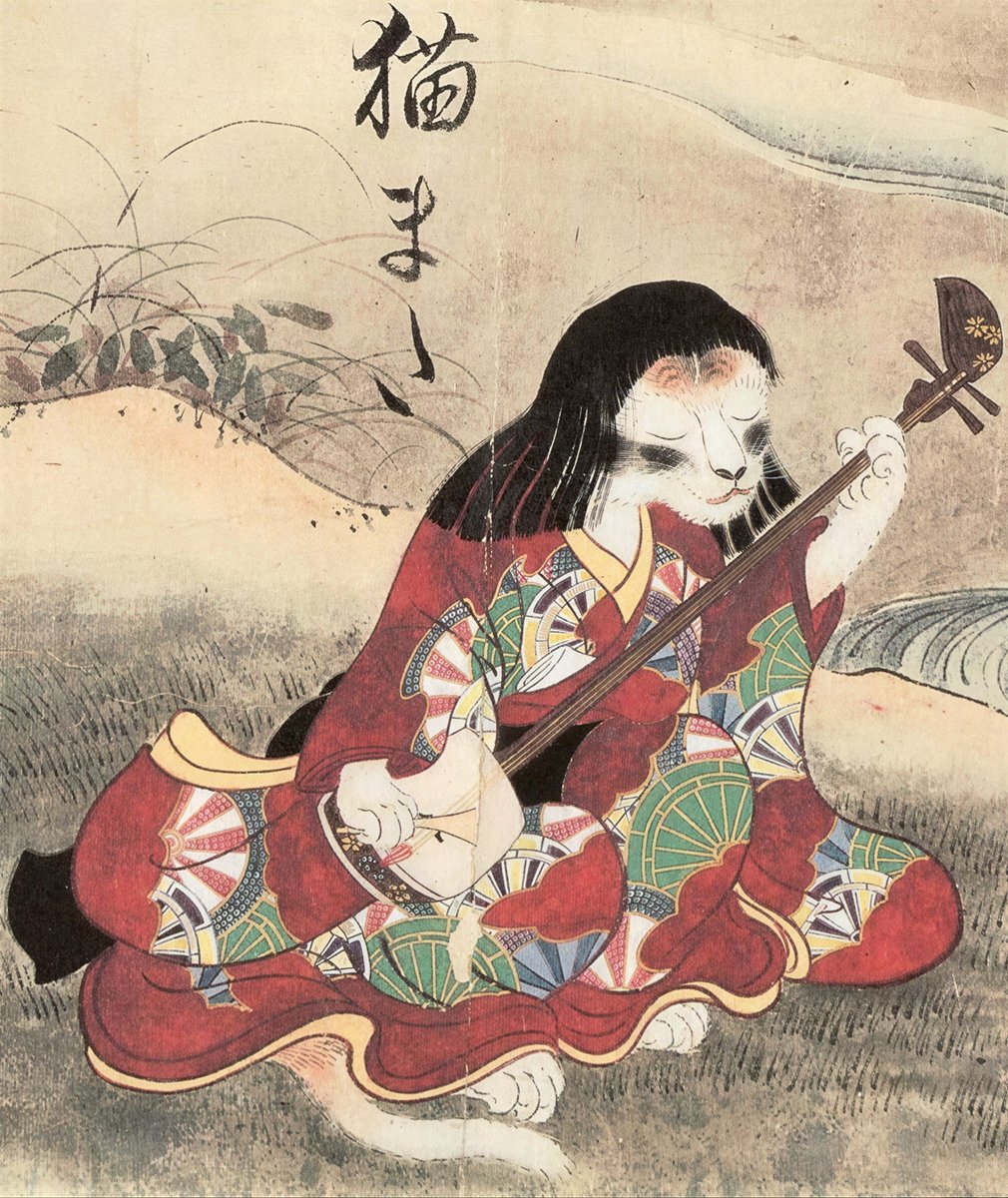
An elegant figure wearing a red kimono, her eyes closed, peacefully playing music. But this isn't a human. As the calligraphy in the top-left corner clearly declares: This is the Nekomata (猫又) -Japan's most mysterious cat yōkai.
So, what's a yōkai? Yōkai (妖怪): the general term for supernatural beings in Japanese folklore. Not ghosts. Not demons, either. Think of them more like this: something ordinary -an animal, an object, or even an emotion- transforms over time and acquires extraordinary powers. Yōkai are these transformed beings dwelling in the invisible layer of the world.
The cat yōkai is born from exactly this logic: a cat lives a very long time, and its tail splits in two. This split symbolizes an ordinary animal's transition into a yōkai. It's now stepped outside the laws of nature. Its name comes from this physical change: Neko = cat, mata = forked - - - Nekomata (猫又).
Sawaki Suushi painted this in 1737. He was a student of the master painter Hanabusa Itchō. He didn't achieve great fame in his own era - but the scroll he left behind contains 30 yōkai and became one of the cornerstones of Japanese iconography. Pay attention to the figure: long dark hair, a white cat face bearing pale spots on its forehead, and a layered, flamboyant red kimono. And from beneath her skirt, that famous white tail curls out.
Cat, or woman? Both. And that's exactly the dangerous part. The instrument in her hands: the Shamisen.
A traditional three-stringed, long-necked Japanese instrument - still played today, with a timbre somewhat reminiscent of a banjo. Traditional shamisen bodies were mostly covered with cat skin (while the strings were made of silk). The Nekomata is playing an instrument whose body is made from the skin of her own kind. Both victim and musician. The cycle is complete.
An Edo-period viewer would've understood this immediately: this isn't a portrait of a beauty. This is the depiction of a hidden rage. According to folklore, the Nekomata:
Can haunt the living by making them dance like puppets..Can control the dead,Can summon ghosts,
It was believed that abandoned old cats transformed into them. A rage returning as a curse. But Suushi drew the figure neither aggressive nor ugly. Calm. Elegant. Peaceful. This is a deliberate choice ,- and much more effective. It's more unsettling precisely because it looks familiar.Suushi's scroll became a major point of reference. In 1776, Toriyama Sekien drew heavy inspiration from this scroll for his yōkai depictions in the famous Gazu Hyakki Yagyō series.
Today, this scroll is housed in the Fukuoka City Museum. That cat figure playing the shamisen has been asking the same question since 1737:What does the one who abandoned me deserve? Perhaps music. Perhaps more..