Hilstart is now live on @ponsdotfamily.
CA : 0x653e1d5bf529c610b40005d34a8dbea99503ea20
Bringing AI and hardware testing together to make engineering faster, smarter, and more efficient.
A new step toward automated engineering.
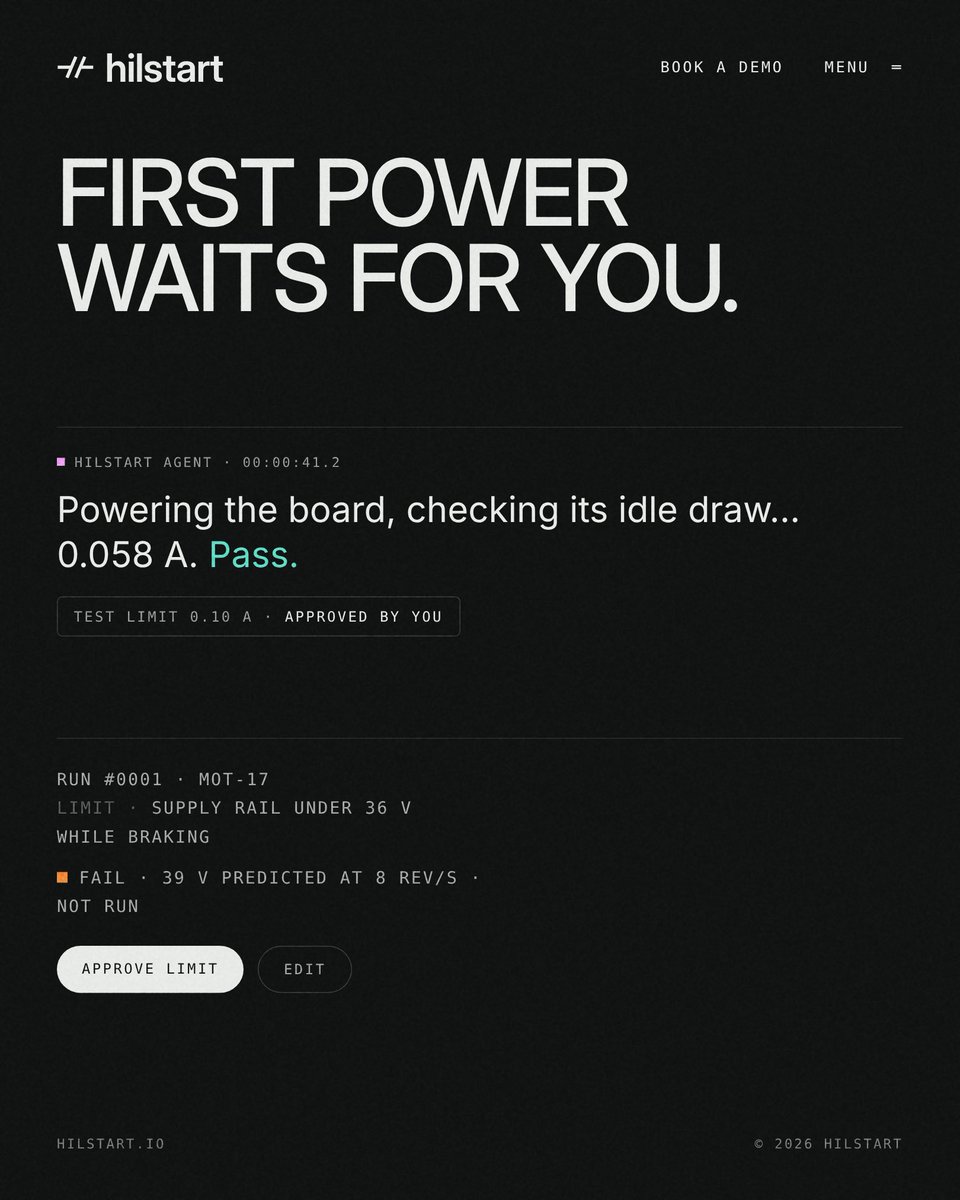
The agent proposes a limit. You approve it. Then it runs.
Supply rail under 36 V while braking → approved → peak measured at 34.2 V → pass.
Nothing runs past a limit you haven't signed off on.
Hardware teams can now design boards faster than they can validate them.
Probing, scope setup and rewiring still happen by hand, for every revision.
That gap is why Hilstart exists. Validation should start the day your boards arrive.
Same tests. Two revisions. One click.
When every run is kept, comparing rev B to rev C stops being an afternoon with a notebook. Rails, idle draw, CAN bus, braking and coil current, side by side.
Validation starts where the probe touches the pin.
We build a bed-of-nails fixture or a harness for your board and deliver it ready to plug in, so testing can start the day your boards arrive.
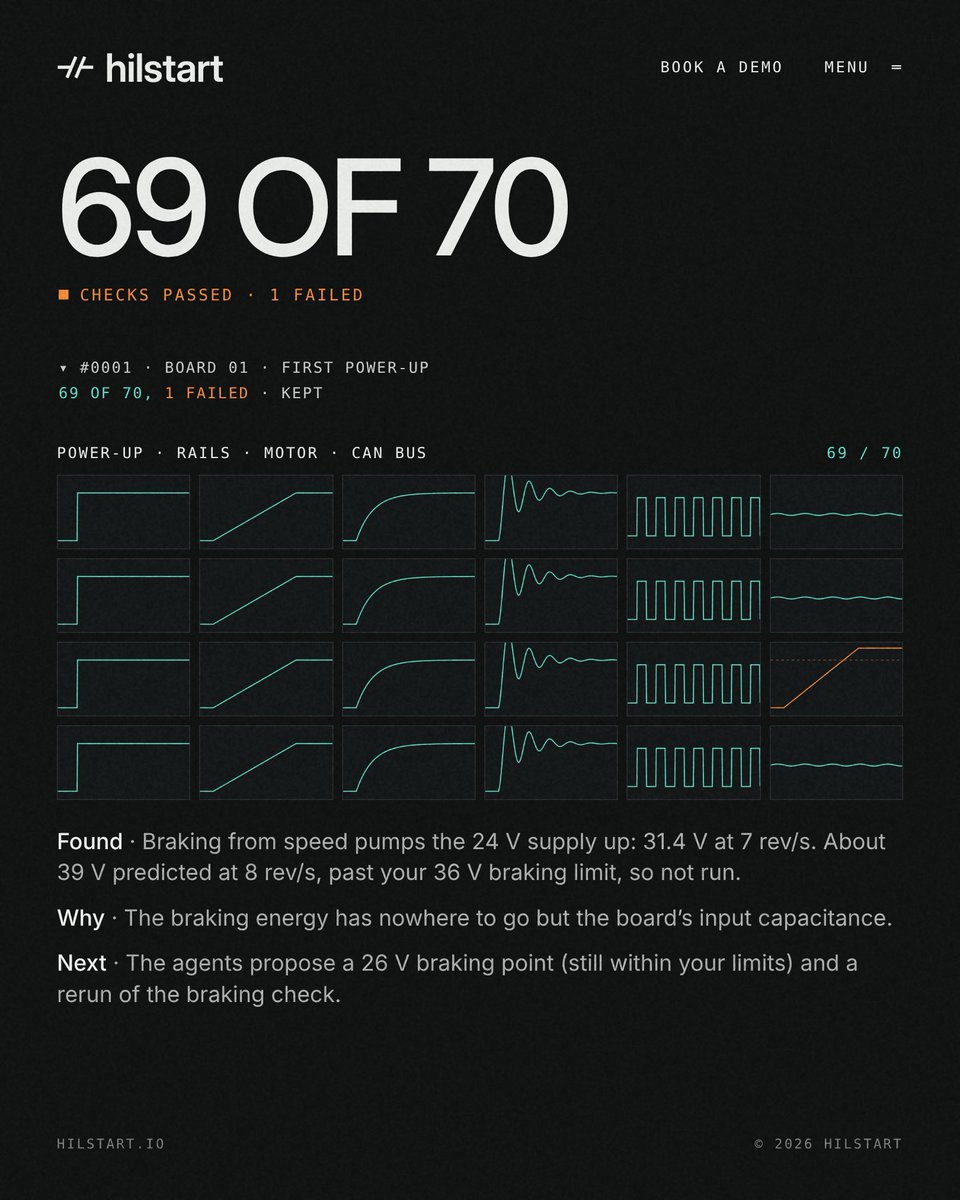
A failed check should come with an explanation, not just a red light.
Every Hilstart run is kept: what failed, why it failed, and what the agents propose to change before the rerun.
Autonomous, with you in charge.
Agents propose every test limit. You approve it. First power waits for you.
If a test is predicted to break one of your limits, it doesn't run. It gets flagged instead.
Tracer is our network-connected hardware interface.
0–48 V programmable at 3 A · 8 analog in · 4 analog out · 10 GPIO · CAN FD at 5 Mbit/s · SPI, I²C, UART · V and I telemetry at 1 kHz.
One box that works alongside the instruments you already have.
What a validation run looks like when nobody is holding a probe.
Power-up, rails, CAN bus. Every check written by agents, every limit approved by an engineer first.
04. Every trace captured.
Waveforms, logs and reports are kept for every run, so comparing rev B to rev C takes a click.
Book a demo: https://t.co/NTKnVA0DLU
03. Run against your hardware.
Tests run through Tracer: power, I/O and buses in one network-connected box that works alongside your existing instruments.
01. Upload your design.
Schematic, layout, requirements. The agents work from the context your board was designed with, so the tests fit the board instead of a generic checklist.
Every board revision restarts the same ritual: re-probe, re-wire, reconfigure the scope, re-check every rail.
Your best engineers shouldn't be human test fixtures.
So we built Hilstart to make validation run itself.
Meet Hilstart.
Autonomous agents that validate your real electronics hardware, grounded in your design files and bound by limits you approve.
Upload the design. Agents write the tests. Tracer runs them on your board.
https://t.co/NTKnVA05Wm