Research analyst at Civilization Research Institute.
PhD student researching ethics and governance of solar geoengineering.
Views neither mine nor not mine.
I mean, I’m all for putting things into perspective, but when it comes to global warming, zooming out a couple thousand years is not exactly reassuring.
New Anthropocene paper. Earth still operates in "Holocene logic", buffering heat imbalance. Anthropocene = Pressure. But, BAU, reaching 3°C in 2100 & we get "stuck" in a Hothouse trajectory for 1000 years. Anthropocene risks turning into a state. No Good.
https://t.co/8gLxC9w7aX
@QualiaQuanta I feel vindicated coming across this. I recall mentioning to my algebraic topology lecturer that the diagram in the textbook (Hatcher) showing the Hopf fibration looks incredibly similar to the magnetic field of a tokamak, to which he replied it had "nothing to do with physics"
@zermaelian@kasratweets@eshear …There are some cool stuff that people like Sergio Rubin have been doing in Earth system science applying Rosen’s ideas to Gaia hypothesis. He’s also worked on a proposal for “autopoietic chemical AI” which is in a fundamentally embodied paradigm
https://t.co/g4tWVKWV6Y
@zermaelian@kasratweets@eshear As a massive fan of Robert Rosen’s work I do nevertheless sympathize — solid applications of his anticipatory systems and category theoretic work in Life Itself is few and far between. That being said… (1/x)
@HexaField Resilience to solar storms, generalised stochastic cyberwarfare and cascading infrastructure failures?
Lemme know if you start building and I’ll help out with that aspect.
Auslöser gibt es immer (Blitze, Brandstiftung, Fahrlässigkeit etc.) - doch dass die Feuer immer unkontrollierbarer werden liegt vor allem an der zunehmenden Hitze und Trockenheit aufgrund der fossilen Emissionen.
Das wird schlimmer, bis wir damit aufhören.
https://t.co/n9470gQ5em
I’m having trouble successfully googling this quote specifically, but yes, actually contextualizing things is important. Roger’s obsession with finding “consistent statements” is not how serious people think.
Imagine someone wrote a “Red Team” report on Relativity, and instead of focusing on gravitational lensing or waves, clock time dilation, the equivalence principle in free fall, GPS corrections, black hole imaging, or Mercury’s perihelion, etc., they focused only on unexplained deceleration of the Pioneer 10 and 11 spacecraft observed in the 1990s. They even cite someone’s paper that talked about how it a weird, unpredicted anomaly. Though, the Red Teamers don’t even talk about the eventual solution found in thermal recoil force, or just say some vague thing like, “more work is needed to reconcile models and observations.” This Pioneer anomaly is all that is mentioned in a section of a DOE report called “Fundamentals of Relativity” that serves policymakers on whether to include Einsteinian physics in important decisions. Then the cited scientist gets criticized by Ralph the Cosmological Honest Broker for being upset that their work was misrepresented, even though they technically were right that it was an unpredicted anomaly.
This is quite literally how bad the climate DOE report is.
To those yelling “but Urban Heat Island!” every time it gets hot:
Here’s the data. Global land temperatures are rising whether you're in Times Square or the middle of nowhere.
📈 Blue = All stations
📈 Red = Very rural stations (<1 person/km²)
Trend: identical.
Urban heat island isn’t driving global warming — carbon is.
#climatechange #heatwave2025
Data: @hausfath
I’m an atmospheric and climate scientist. If I walked into a machine shop and told a mechanical engineer, “Engines work because the fluorescent lights heat the pistons,” I’d get laughed out of the building.
That’s what it sounds like when a mechanical engineer tries to explain climate physics.
This guy claims Urban Heat Islands (UHIs) are driving global warming by “expanding the volume of the atmosphere” and “adding water vapor” that spreads around the globe. Let’s break this nonsense down:
- Water vapor is a feedback, not a forcing. It increases because CO₂-driven warming allows the air to hold more moisture. Without warming, there’s no extra water vapor. (Basic thermodynamics.)
- UHIs are local. They raise city temps slightly but don’t affect the global climate system. Global warming is driven by an imbalance at the top of the atmosphere, not heat from parking lots.
- The atmosphere isn’t a balloon. It doesn’t expand from urban warmth. It's bound by gravity, and its mass is increasing due to fossil fuel emissions — not water vapor from hot sidewalks.
- His claim that CO₂'s 15-micron “resonance” limits volume expansion is gibberish. That wavelength is part of what makes CO₂ such an effective greenhouse gas, especially where water vapor is less effective.
If your theory isn’t in Nature, GRL, or any peer-reviewed journal, but buried in a self-published PDF titled “See my manuscript,” I’m not interested.
Stick to torque specs. I’ll handle radiative forcing.
“As long as atmospheric carbon dioxide remains above 300 parts per million, not even the next ice age, which Milankovitch theory predicts would begin 50,000 years from now, is likely to occur.”
#IceAgeCancelled
New study finds concerning impacts of global warming on food production in the U.S. and elsewhere. This provides one of the most comprehensive looks-to-date of the climate change-food production nexus. Via @laurapaddison https://t.co/jvY0ocCdJF
7) As one can see, the findings are pretty grim: “For all crops except rice, we estimate that warming will likely reduce global yields by 2050 (probability of loss ranges from 0.701 (sorghum) to 0.946 (wheat), high-emissions scenario) after accounting for both statistical and climate model uncertainty.” The values for 2100 here👇
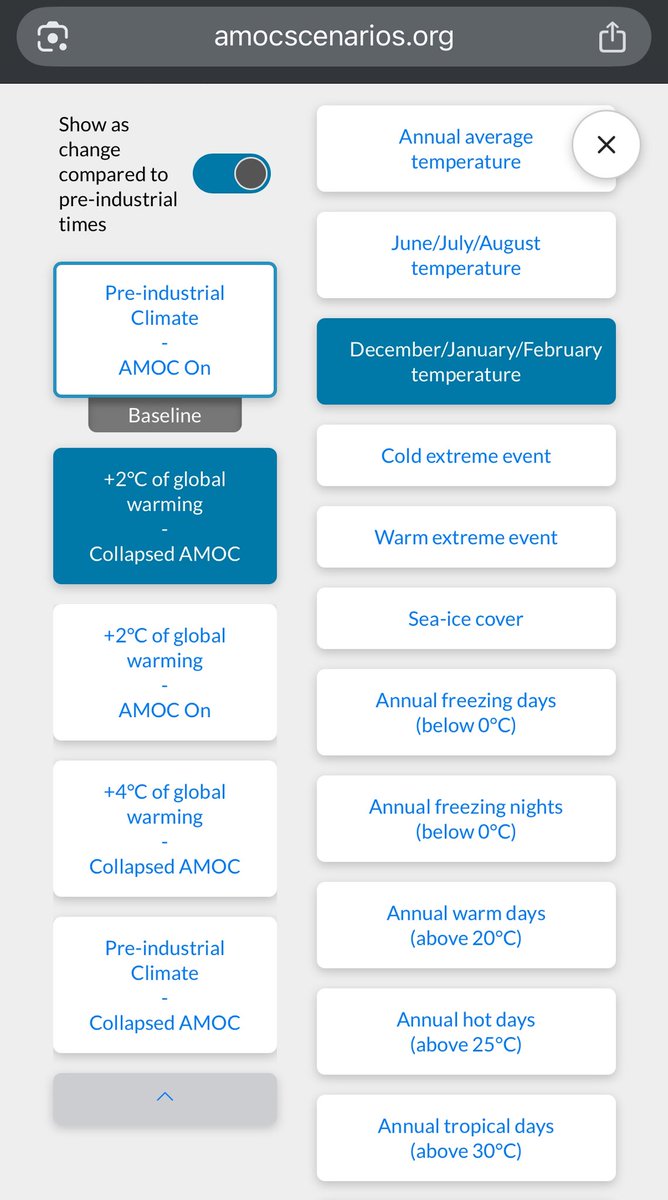
The website you’ve all been waiting for is here! AMOC Collapse Visualization Tool! See how winters and summers will change with various levels of warming and cooling. You can zoom in to your own town and find out if you le ability to grow food will remain 👍
A big thank you to my collaborations @ZhiLi_Ocean@rahmstorf@PIK_Climate , Maurice Huguenin @WHOI , Ryan Holmes, Andrew Kiss and Alex Sen Gupta @ccrc_unsw , and also a BIG shout out to @NOAA supported observing systems (including Argo) and @NOAA_GFDL ocean modellers. This work would not have been possible without NOAA-funded ocean models and NOAA observations. We need @NOAA fully funded to maintain Earth observations and help understand our changing ocean & climate systems.