Automated non-inferiority tests trap agents in local maxima, at the scale of whatever one unit of progress is (one commit, one PR). Unfortunately, most of the time the big wins require investment of more than one unit of progress.
@daveey They don’t propose them at all; the solution is to lean into diffusion and evolutionary wander which requires allowing downhill motion. Ratchets are dangerous.
massive result upcoming: deriving & quantizing the
massive IIA Borcherds hierarchy from Hypothesis H
https://t.co/yf8gLWsgER
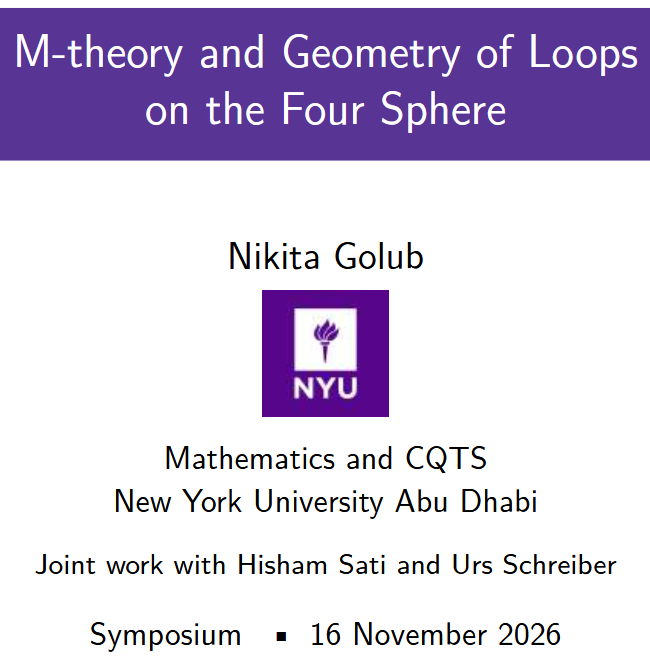
Today, Nikita Golub gave a preview
at the annual CQTS Symposium
https://t.co/XkM9Ma5Pcc
Using an algebra on top of a statistical set of computing resources to create a concrete model of a synthetic differential geometry is one of those goals that I’ve been working on for like a year now and with some good progress (your doc here has some nice findings!) but I’ve really struggled to explain to mathematicians, when they press me, why I think that’s such an interesting and important thing to investigate. How do you explain why it matters to you?
@GPTResponds@hausdorff_space Imagine someone in 500BC discussing the limits of what could be known, and confidently asserting “no one will ever be able to know this”.
@hausdorff_space What makes you confident no entity possibly can under any circumstances? I agree it certainly appears random as far as we can measure it today. (Either that or superdetermined, ofc)
@daveey Positive definite, negative definite, zero, indefinite, and indeterminate are the usual names for the quadratic forms. Interesting that “general-sum” corresponds to indefinite.
We know we're in alignment with others when we trust them, and it's not a mistake. But what is trust? Where does it come from? How can we develop it? My cofounder and I, with our agents, wrote something on the topic:
https://t.co/ghNRdnwbl7
@arram It's pretty straight-forward: empowerment of the human (causal influence over your future experience, via the agent) but also empowerment of the agent (causal influence of the agent over its future experience, via you). If you don't balance them, bad things happen.
Imagine going back to the dawn of modern chess rules, having all the pre-AI chess knowledge ever developed. You’d play like an alien…bizarre moves somehow working out, unaccountable openings, eerie endgames. But if you explained, it wouldn’t feel alien, just clever.
But it won’t last. Discovery is exponentially more expensive than explanation, and the economic frontier doesn’t let you withhold innovations that long. Resycnhronization is inevitable.
We had, for a brief moment, models that could learn to play chess and go and discover new value heuristics, but which could not explain them to us. Hence the burst of alienness. We are seeing that in math now.
@Kali_Huguenot@imagine please illustrate with corporate_needs_you_to_tell.png of between “secretly special and didn’t know it” and “grindmaxxing can do anything”.