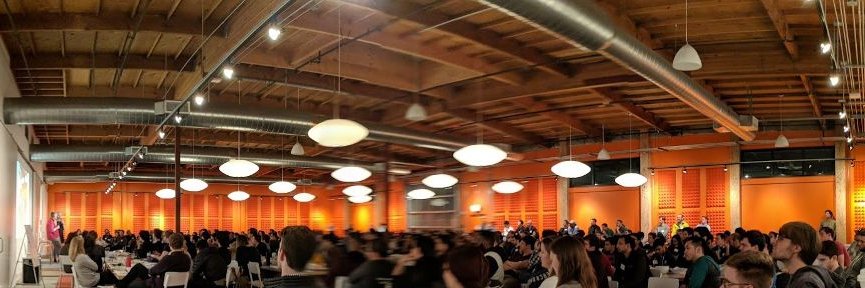
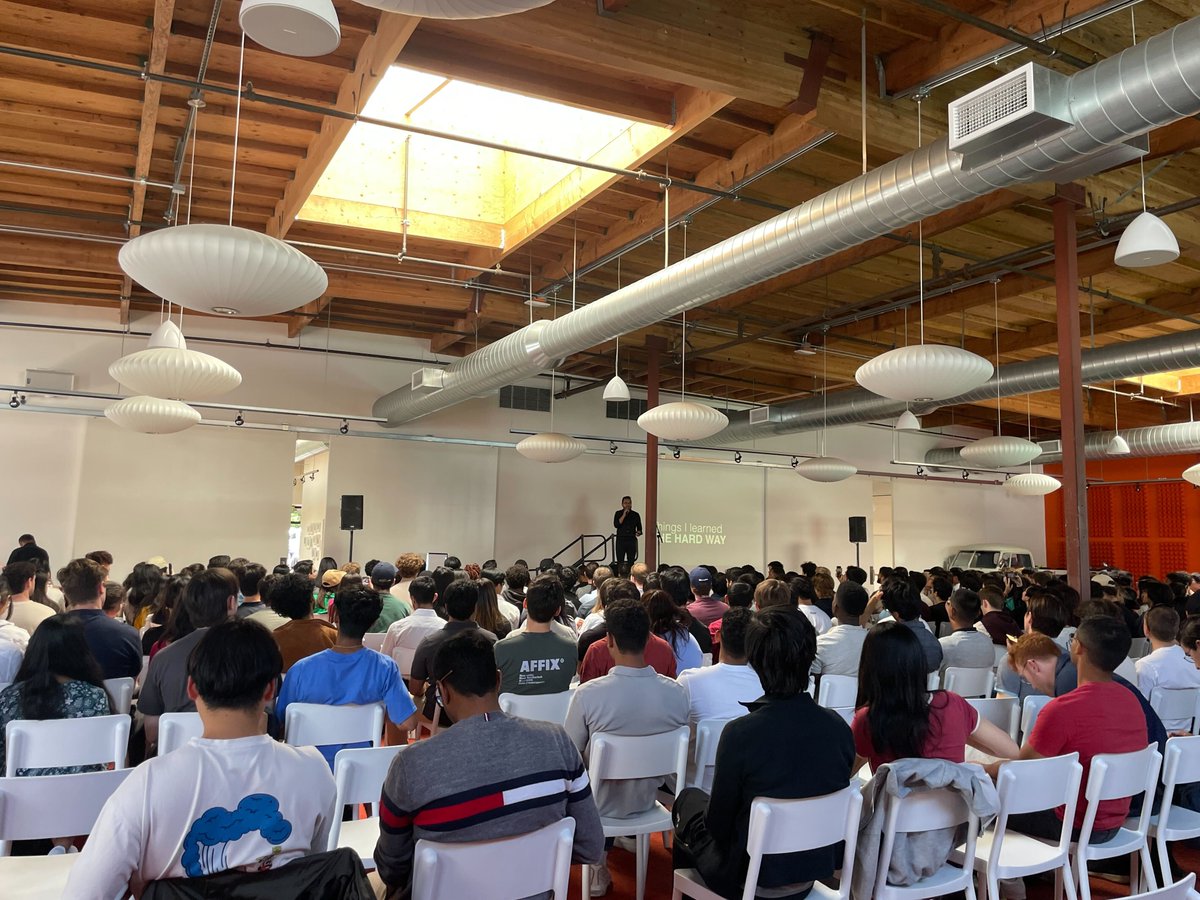
Yesterday we hosted 400 top university students at the YC Summer Conference - a fun day of talks about startups. Talking to the students afterwards, I found myself giving a lot of the same advice. So in case it's useful to others, here is my startup advice for students.
@lizwessel@firstround Has always been a great team. Built originally by my friend Jack Leidlein, who before that ran recruiting at Scribd! Glad you kept it going.
My favorite company in the current @YCombinator batch is the @DreamscaleLabs (YC F26) team. Four college dropouts Eric, Chris, Kevin, and Antoine working on cloud inference for robotics. This is almost all done at the edge right now, but will be a ginormous market in a few years as humanoids and other robots ramp up and will wanna run real-time inference that is far more powerful than can be done on the edge. Go team! 🤓👌
@eternaI_entropy, @KDog112358, @pentestduck, @AntoineNeedGPUs
My dear American friends, in my last post I gave you a snapshot of where France stands today. Now let me show you how we got here. I want you to see the whole movie before you buy the ticket.
After the war, France was a machine. We called it the Trente Glorieuses, thirty glorious years. We built Concorde, the most beautiful aircraft ever made. We built a fleet of nuclear reactors in about fifteen years and gave ourselves some of the cleanest, cheapest electricity in the world. We built Ariane and put Europe in space. We built the TGV, the fastest train on earth. We invented the Minitel, an online network in millions of homes before most of you had heard of the internet. We were not a museum. We were builders.
Then came 1981. François Mitterrand. Think of him as our Bernie Sanders, except he actually won. At his side, in the office next to his at the Élysée, sat a 37-year-old prodigy named Jacques Attali, his special adviser for the next ten years. The brightest minds of the left, convinced they could run an economy from a ministry.
Here's what they did. They governed with Communist ministers. In 1982 they nationalized dozens of banks and the biggest industrial groups in the country: Paribas, Suez, Saint-Gobain, Thomson, Pechiney, Rhône-Poulenc. They lowered the retirement age to 60. They cut the work week to 39 hours and added a fifth week of paid vacation. They created a wealth tax. They hired massively into the public sector.
Reality hit in less than two years. Capital fled, inflation ran wild, and the franc was devalued three times. In March 1983 Mitterrand had to slam on the brakes and impose austerity just to stay in the European monetary system.
But here's the trick: the brakes never reversed anything. They just slowed the ratchet. The so-called right came back with Jacques Chirac, and nothing was undone. Under Chirac's presidency, France passed the 35-hour work week. Left or right, every government added one more program, one more rule, one more tax, and nobody ever took one away.
At the same time, the political class did something even more destructive than bad economics. It turned the youth into a political instrument. Instead of teaching young people, including millions of children of immigrants, to love the country they lived in, it taught them a story of guilt and grievance: France as the oppressor, France as the thing to resent. You cannot integrate people into a country you've taught them to despise. We are living with the consequences of that narrative today, in our schools, our suburbs, our streets.
Then forty years of slow decline, all the way to Macron. And the story has a perfect ending. In 2007, Jacques Attali chaired a commission on how to unleash French growth. Its deputy rapporteur was a young civil servant named Emmanuel Macron. The commission proposed more than 300 reforms to free the economy. Almost none were ever implemented. Even the men who built the system knew it wasn't working, and even they couldn't undo it.
No balanced budget since 1974. Public spending around 57% of GDP. Debt above 3,300 billion euros. Growth stuck under 1%.
Now the number that should keep you up at night. In 1995, GDP per person in France was about $27,000. In America, about $29,000. We were neck and neck. Today France is around $49,000. America is around $90,000. You are now nearly twice as rich per person as we are.
What changed? Not our talent. Not our engineers. Not our schools of mathematics. The only thing that changed is that we went all in on socialism. The 35 hours, the endless regulation, the taxes that chase out anyone who builds, the belief that the state should do everything and the individual should ask permission for everything.
There's a line people love to attribute to Einstein: insanity is doing the same thing over and over and expecting different results. We tried. For forty years, we tried. Every government promised that one more program, one more tax, one more regulation would finally fix things. You just saw where it got us.
So if you choose the Democratic Party, which is literally turning socialist in front of your eyes, you will deserve what comes next.
Let me tell you exactly what will happen if you go down that road. Nobody will vote for decline. Every single measure will sound generous, compassionate, reasonable. Your builders will slowly leave or stop building. Your state will grow every year and never shrink. Your debt will compound. And in thirty years, your kids will look at a chart like the one I just described and wonder when it all went wrong.
You still have something we lost. You have Elon Musk sending rockets to orbit and landing them on their tail. You have Palmer Luckey building the defense industry of the future. You have Jeff Bezos, Jensen Huang, and thousands of founders nobody has heard of yet, building in garages right now.
Trust your entrepreneurs. Don't trust your politicians.
I come from your future. Don't make it yours.
1/ muse spark open is the most capable US open-weight model to date.
816B total params, 42B active. 1M-token context. natively multimodal. built for coding and agentic work like long-horizon tasks, hard software engineering, multi-step reasoning.
america! 🇺🇲
Two PhDs pouring peroxide into strangers' hot tubs.
Our parents were so disappointed.
In Dallas, @TungstenSeanide and I loaded peroxide from our reactor into his Subaru and drove it to the city's float spas. On weekends we poured the chemicals into people's hot tubs ourselves. It was full service.
Then the reactor started making about $10,000 a month. For two guys with day jobs, that was like an infinite amount of money. We knew we had something real, so we looked up @ycombinator. At the time, YC didn't have
much of a track record with hard tech.
2027 will be the year of the personal agent. It has finally found PMF with Instinct, Muse & Grokbot.
This will cause a tsunami of customer enquiries — it’s now essentially free for a customer to send hundreds of emails, texts and phonecalls to make a single purchase.
Businesses will need AI customer service tools to save themselves from drowning.
Most robot startups, even well funded ones, are still doing R&D. Ultra's shipping. Their robots are out there in the field doing necessary work every day.
Robotics has a distribution problem. Today, Ultra is announcing $62M in funding to solve it, including a $50M Series A led by @hiFramework.
We believe that deployment is the bottleneck in robotics.
It’s relatively easy to make a robot look impressive in a controlled environment. It’s much harder to put a robot into the open world, make it useful, keep it running, earn the trust of the people working alongside it, and do that over and over and over again.
So that’s what we’re focusing on.
Cisco is going through one of the most remarkable AI transformations, and not many know about it. Two years ago, Cisco quietly started a new business - AI infrastructure for hyperscalers - and it went from 0 to a $9B business in two years.
@jpatel41, Cisco's President, joined Cisco 36 years in and runs it like a late stage co-founder. This is the wild story of how he's going Founder Mode on an 80,000 person company.
Jeetu Patel is Cisco’s President and Chief Product Officer, helping turn one of the world’s largest technology companies into what he calls “the world’s largest startup.”
Cisco is now positioning itself as the picks-and-shovels company for the AI era, spanning networking, security, silicon, and infrastructure. Its AI infrastructure business went from zero to $9.3B in orders in just two years.
In this episode of Main Function, Jeetu joins YC's Jared Friedman to talk about bringing a founder mindset to the company, and what the massive data center buildout looks like from the inside. He also shares the unlikely path that took him from waiting tables at Sizzler to leading product at Cisco, and the lessons he’s learned about ambition, compounding, and making the most of the opportunities in front of you.
00:00 — Cisco’s Bet on AI
03:38 — Running Cisco Like a Startup
06:45 — The Infrastructure AI Agents Need
10:00 — Getting 32,000 Engineers to Embrace AI
14:07 — Bringing AI to Hardware and Silicon
17:15 — Inside the AI Data Center Buildout
21:27 — Are We Overbuilding AI Infrastructure?
25:10 — Building Trust in AI Agents
28:18 — From India to Waiting Tables at Sizzler
32:12 — Choosing Learning Over Ego
35:31 — Ambition, Teamwork, and Compounding
39:31 — Don’t Squander Your Opportunity
Every AI data center needs power, and every power plant needs a step-up transformer to connect to the grid. If you ordered one in 2021, it arrived in under 500 days. Today it takes more than 1,120 days.
A large transformer core is made of grain-oriented electrical steel that spends about five days in a 1,200°C annealing furnace. Only one US company makes that steel: Cleveland-Cliffs.
Inside a bell annealing furnace, coils of iron with about 3% silicon stand on end in hydrogen while the furnace heats them about 15 to 20°C an hour. It takes two to three days to reach 1,200°C. As the coils heat up, tiny particles that pin the grains in place slowly dissolve, and about one grain in a million starts growing and swallows its neighbors. Then the coils sit at 1,200°C for 20 to 40 hours. Grains that started 0.01 mm across end up 10 mm wide, nearly all pointing the same way. That alignment cuts the power a transformer core loses as heat.
Cleveland-Cliffs can supply about 12 to 20% of what the US needs, by DOE's estimate. China was in a similar spot before 2000: its only volume producer covered 30% of demand. The few foreign companies that could make the high-grade version refused to license their process. Baosteel spent ten years on research and made its first good coil in 2008. By 2013 it could make 300,000 tons a year, three times what all of China made before 2000.
I build chemical plants. If you're in hard-tech, chances are you are now competing with AI data centers for the same grid equipment.
YC now has 19 partners. All 19 founded a YC company.
One of the superpowers of YC is how many of the visiting partners and general partners are recent founders.
Five of GPs founded or exited in 2018 or later:
Grey Baker (Pincites, S23)
Harshita Arora (AtoB, S20, still private at ~$800M)
Raphael Schaad (Cron, W20, acquired by Notion 2022)
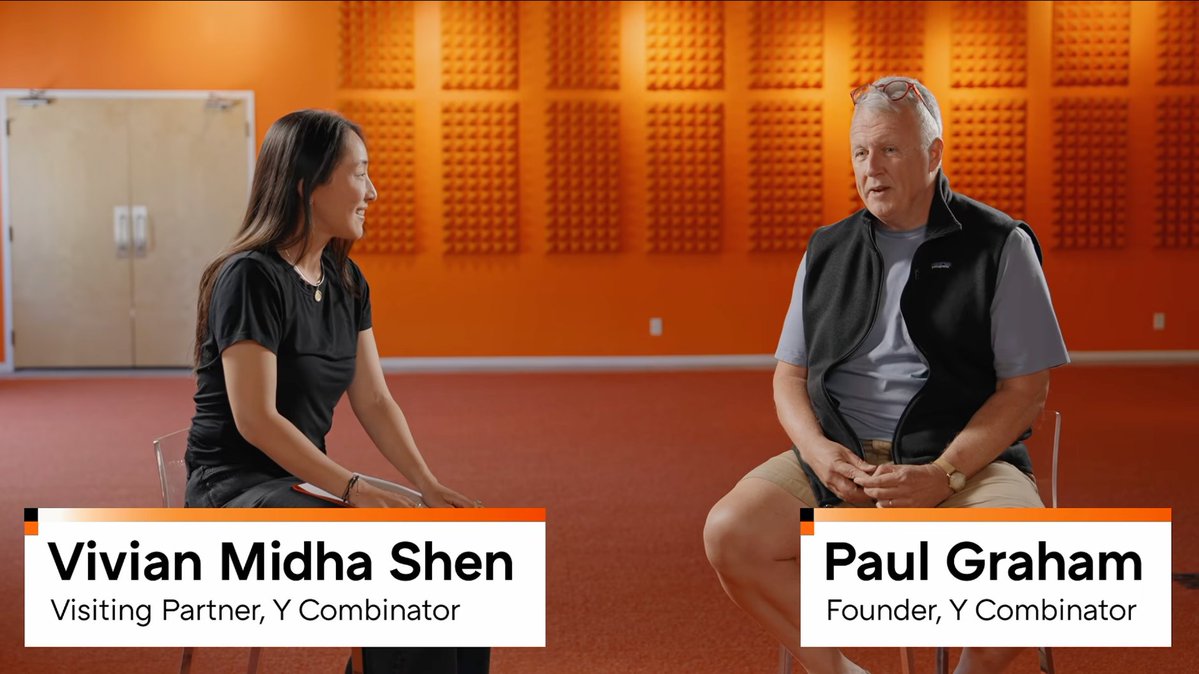
Vivian Shen (Juni W18, then Acely
Ankit Gupta (Reverie, W18, acquired 2024)
And most of the other partners are actively running projects, building, etc.
Rest of VC:
Only ~7% of VCs ever founded a VC-backed company.
Orange Collective (YC Unc fund)
100% YC founders across 5 batches.
Life update: dropping the "Visiting" — I'm joining @ycombinator as a General Partner 🤩
YC was my first choice as a founder in 2019. Seven years later, I'm choosing it again.
This past year, I got to come full circle: working with founders through the W26 and S26 batches, helping them turn early ideas into products people love.
I'm incredibly excited to keep finding founders and helping them build the iconic companies of this generation 🔥
I’m joining @ycombinator as a General Partner.
YC is a homecoming for every GP. All of us were previously YC founders, and lived the journey that we support founders through every day. Our alma mater taught us the lessons that we pass on.
My founder path was infinitely harder than I thought it would be. We hit incredible highs and brutal lows. We came within a few months of zero runway. The YC mantras kept me going: make something people want, and don’t die. Over the course of my companies, we touched thousands of lives: employing people in almost every US state (Alaska still evades me!), and teaching STEM to students from every walk of life.
Now, I’ve had the privilege of working with founders who are tackling some of the hardest problems today, including defense, space, energy, and manufacturing. We’re also entering an era of diffusing AI across businesses of all sizes, and founders are bringing these tools into their old workplaces and new customers to make work better.
Finally, I’m particularly interested in our work at YC to partner closely with the government to make sure technology serves everyone. Our Startup Industrial Base conference yesterday was the start of this, with more to come. Founders are the backbone of American innovation and core to the future of our country and economy.
Thank you to the YC partnership for believing in me, and the YC founders for trusting me.
There’s never been a better time to make something people want.
YC has the largest partnership in history now - 19 including me. We all went through YC and are alums and founders ourselves.
I'm so proud to welcome Vivian and Raphael to the partnership.