There is such a profound shift occurring in the way that Agents alter our infrastructure requirements.
We are entering a networking supercycle. It’s not because humans are consuming more content. It’s because machines are beginning to think, act, and transact continuously.
Cisco's latest research on AI traffic patterns points to something much bigger than incremental bandwidth growth. Enterprise WAN traffic without agentic AI was projected to grow roughly 2.5x over the next
decade. With agentic AI, that projection jumps to ~9x.
And here’s the craziest part! After following this data closely, I believe even those numbers may prove to be wildly conservative. This is the first time when we have published a study like this where I feel that the projections might be off significantly and what we might think takes a decade happens in 3 years.
Why?
Because most people are still modeling AI like software. It is not. AI behaves more like a new species of digital labor. A SaaS app waits for humans. Agents do not. Agents continuously reason, retrieve, coordinate, negotiate, execute, and loop. At software
speed. Without pause. 7x24. They never get sick. Don’t need a vacation. Dont get tired. Don’t need sleep.
That creates a fundamentally different traffic architecture. The industry spent decades optimizing networks for bursty downloads, video streaming, and
human-paced interactions, almost all of it flowing downstream to a person on the other end.
AI traffic inverts that. A single agentic task can generate 450% more traffic than a human doing the same work.
Roughly 70% of that is inference. And nearly 10% of AI flows now carry more upstream than downstream data, versus 0.5% for typical web traffic, because context continuously moves back into models. Network traffic is not just increasing in bandwidth. It is fundamentally getting reshaped.
This last point matters most. The internet was built as a distribution system for content. AI is turning it into an active system for cognition. The path between agents and models is becoming the spinal cord of intelligence itself. When that path degrades, the agent degrades.
Networking stops being a passive transport layer and
becomes part of the intelligence stack. That changes everything about how we think about resiliency, observability, security, and capacity at the edge. We may be grossly underestimating what is coming. The future will not simply have more users online. It will have trillions of digital coworkers operating continuously on behalf of humans, enterprises, applications, and eventually physical systems.
Humans click.
Agents swarm.
That difference is what creates a supercycle. This supercycle of inference infrastructure will not just be compute bound, but also memory and network bound.
Take a look at the report here: https://t.co/4MCTDiDvC5
Indistinguishable from a human voice. Assuming this works reliably well, interfaces could change quite materially for machines.
Really impressive breakthrough 👇🏾
💥 Introducing Warp Sciences, a new company applying AI and robotics to help the world develop new medicines faster.
We’ve raised a $215M Series A led by @lightspeedvp to bring frontier AI out of the browser and into the lab, and build scientific capacity here in America.
I co-founded Warp with my long-time friend @dpatil, FAIR co-founder @manohar_paluri, and drug hunter Sol Reisberg. The early team is full of incredible people like @bkspears9, who helped achieve Q>1 fusion at LLNL.
1/ muse spark open is the most capable US open-weight model to date.
816B total params, 42B active. 1M-token context. natively multimodal. built for coding and agentic work like long-horizon tasks, hard software engineering, multi-step reasoning.
america! 🇺🇲
As we enter into the phase of personal agents, the infrastructure requirements will continue to ride the exponential curve.
Today, a tiny percentage of humanity (sub 2%) uses agents in any kind of power user capacity. I predict that in the next 12 to 15 months, we might have 30% of humanity using agents. If we live in a supply-constrained world with only 2% of humans using agents, we are gonna need to get far more creative when a much larger population becomes dependent on agents. The point being that the supply shortage on infrastructure for power, compute, memory, network bandwidth, and data center capacity seem durable.
The answer to this is not just to build more datacenters, but also get the most out of existing ones. This is why USFP is such an important innovation.
The demand will evolve to not just for a couple hundred thousand GPUs coherently clustered within a datacenter which is where we are today, but a future where we approach close to a million or more GPUs coherently clustered within a single datacenter.
We at @Cisco are delighted to continue to keep partnering with @nvidia to push the limits of physics. We are also obsessed with combining the bandwidth density with the practicality of easy implementation.
USFP scales bandwidth 4x with 16 lanes at 400Gb/s scalable to 32 lanes, coupled with 1.3x power efficiency. The other key point is that it’s built, deployed, serviced, and managed the same way as today’s pluggables.
Thanks to all the members of both teams that worked tirelessly to making this happen. Read the details below on post from @ChuckRobbins 👇🏾
In a world of agents where we are largely supply constrained in Datacenter capacity starting from land, power and shell to compute, memory, networking, the solution is to not just build more data centres, but to make sure that the current data centers we already have are operating in a far more efficient and performant manner.
Innovations on getting more tokens per dollar spent on existing data centers is going to be necessary in this supply constrained world we will be living in for the foreseeable future.
Congrats!
CEOs & execs posting to the public directly on 𝕏 is the best way to get your message out and drive product sales.
Vastly more powerful and effective than a press release.
It's nuts that with @theworldlabs Atlas, you can just keep generating different angles to generate the whole world from a single starting image.
Image to world with true consistency and control is finally here.
https://t.co/tODQxoWFIU
As we enter into the phase of personal agents, the infrastructure requirements will continue to ride the exponential curve.
Today, a tiny percentage of humanity (sub 2%) uses agents in any kind of power user capacity. I predict that in the next 12 to 15 months, we might have 30% of humanity using agents. If we live in a supply-constrained world with only 2% of humans using agents, we are gonna need to get far more creative when a much larger population becomes dependent on agents. The point being that the supply shortage on infrastructure for power, compute, memory, network bandwidth, and data center capacity seem durable.
The answer to this is not just to build more datacenters, but also get the most out of existing ones. This is why USFP is such an important innovation.
The demand will evolve to not just for a couple hundred thousand GPUs coherently clustered within a datacenter which is where we are today, but a future where we approach close to a million or more GPUs coherently clustered within a single datacenter.
We at @Cisco are delighted to continue to keep partnering with @nvidia to push the limits of physics. We are also obsessed with combining the bandwidth density with the practicality of easy implementation.
USFP scales bandwidth 4x with 16 lanes at 400Gb/s scalable to 32 lanes, coupled with 1.3x power efficiency. The other key point is that it’s built, deployed, serviced, and managed the same way as today’s pluggables.
Thanks to all the members of both teams that worked tirelessly to making this happen. Read the details below on post from @ChuckRobbins 👇🏾
Scaling AI infrastructure requires massive bandwidth and power efficiency. Today, @Cisco and @nvidia announced design plans for USFP, the industry’s first 400G-per-lane pluggable form factor delivering 6.4T capacity and 1.3x greater efficiency. Let's go! https://t.co/Ypcw5w6nxm
If you want to know where all the tokens will get consumed in the future, here it is. Agent swarms will have massive implications in a number of enterprise domains like software development, cyber, life sciences research, AI research, finance, and more.
The ability to parallelize agents against a unified goal where the volume of work is large, or where the search space not entirely known upfront, is going to be massive.
Agents can fan out and coordinate work together on a specific mission in completely different ways from what humans are able to do. Today even in the most resource-abundant organizations, your ability to parallelize work on most projects is quite limited. Humans run into constraints on being able to communicate with one another, share status, deal with conflicts in work, keep shared context, and so on.
As AI models can handle larger context without getting confused, and as they’re able to communicate effectively across their work with shared infrastructure, they can avoid many of the pitfalls that people have.
You can see how this can lead to not just faster execution of tasks, but qualitatively different outcomes in medicine, research or defending against cyber attacks, scientific and math discoveries, and so on. This is why we’re going to need 1,000X more compute.
None however are contradictory concepts. Great to see you @villaumbrosia. Congrats on a fantastic event. Love enthusiastic product people that want to learn. This is an exciting time to be alive in tech. Possibilities are limitless.
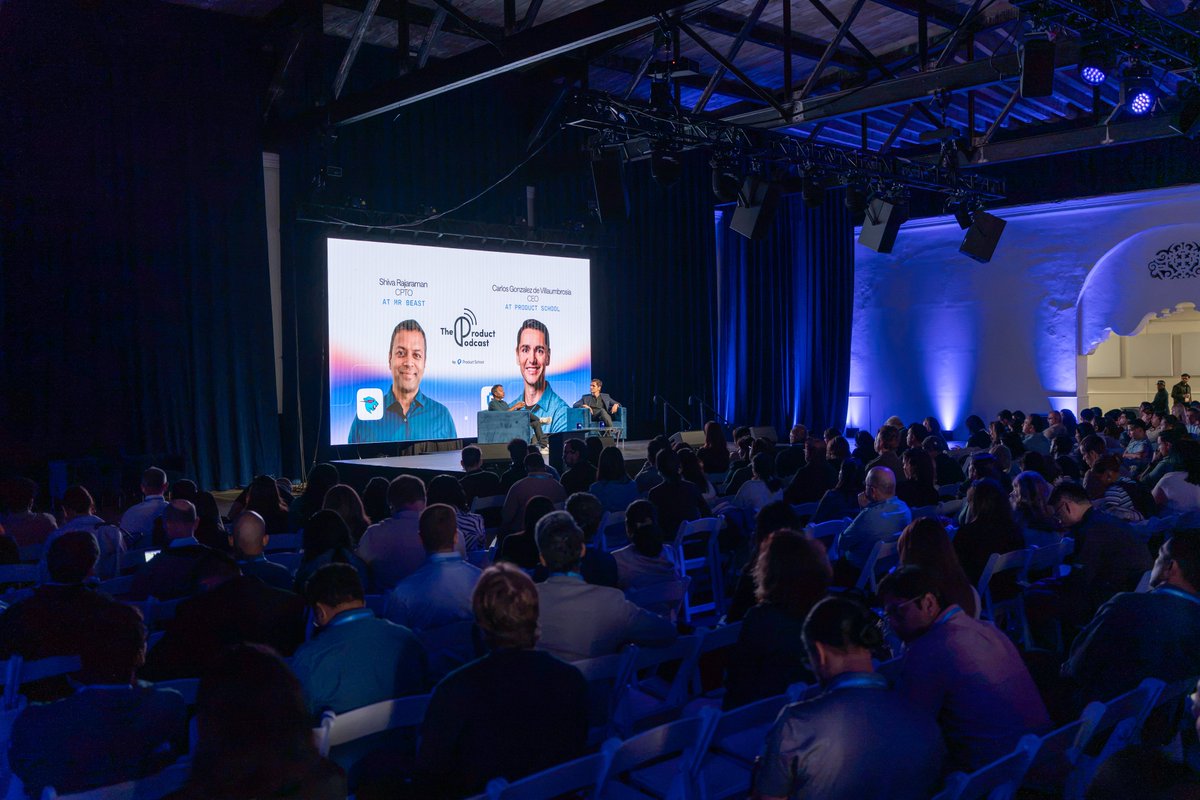
I sat down on the ProductCon San Francisco stage with @amasad, CEO at Replit, @jpatel41, President and CPO Cisco and Shiva Rajaraman, CPTO MrBeast for 3 live episodes of The Product Podcast.
All three proved my point: the fundamentals are not the same.
Amjad thinks not knowing how to code is an advantage. MrBeast stopped buying tools and built its own operating system. Cisco has feature managers instead of product managers.
Podcast episodes dropping from next week!
@karlmehta thanks for having me at the event. Was great to chat with you. Appreciate the range of questions you were able to cover in 30 mins. Great to see you again.
Cisco President Jeetu Patel (@jpatel41) says Silicon Valley has only sold fear about AI:
"Most people buy for one of two reasons, fear or greed. We have only sold fear. I think we should appeal to the greed side."
"When I say greed, I don't mean it in a negative way. I mean the possibility of opportunity, of abundance of all the things that we can do."
- Jeetu Patel, President and Chief Product Officer of Cisco, at our AI Assurance & Governance Summit at Stanford on October 1.