@CheerupR@luke_leisher_ Ah, I once write a paper on that question. You need a rocket about 100x larger for the same payload. With chemical propulsion that's borderline sensible. Nuclear will work fine but have risks. Paper: Int.J. of Astrobiology, Volume 18, Issue 5, pp. 393-395 https://t.co/v1iAWXUGaM
@Astro_Wright@skdh I only found this "authorized translation" from 1914 which is not a literal translation of the original paper, but of a book which appears to contain a re-write of the original paper https://t.co/IpyWhwNYqz pp.222ff
@InvariantPersp1@david_kipping@frgsimpson We're about in the middle of the galactic/universe planet-production as-we-know-it (at z=0). The first generation of stars had too few heavy elements for life, the next generations will be increasingly metal-rich, with unknown (likely negative) consequences for life-as-we-know-it
@david_kipping@frgsimpson The proper measure is not years but biomass production (or total number of cell divisions per Myr, or similar). In that regard we're already in strong decline today, and a second/third Gyr with a few microbes left won't matter
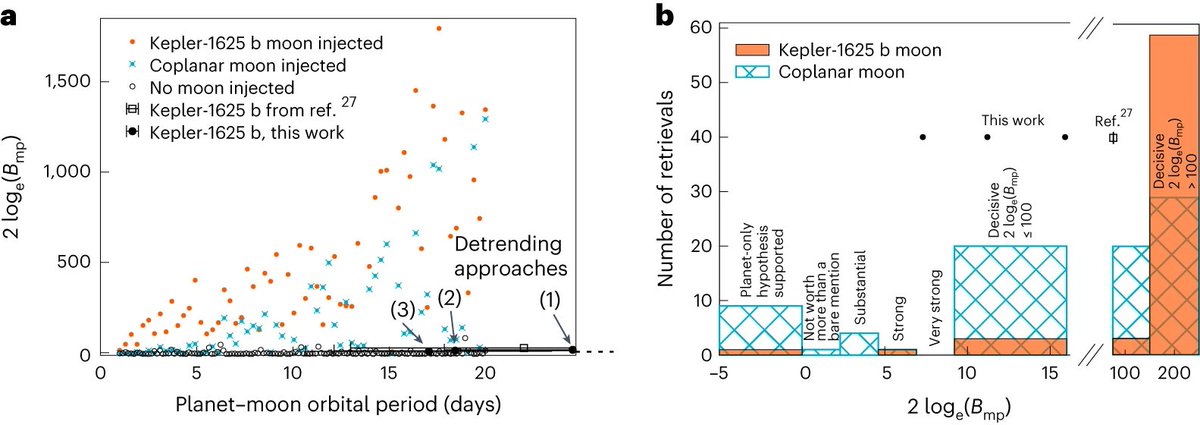
Large #Exomoons unlikely around Kepler-1625 b and Kepler-1708 b: https://t.co/S1GveKn7we -> "Our injection-retrieval experiments of simulated transits in the original Kepler data reveal false positive rates of 10.9% and 1.6% for Kepler-1625 b and Kepler-1708 b, respectively."
That's no moon! Reanalysis of HST and Kepler observations throws doubt on whether Kepler-1625 b and Kepler-1708 b have large exomoons after all. @DrReneHeller and @Hippke: https://t.co/aTliNgCzGg
@ExoDransfield Great to see wotan+TLS in use! I'm curious to learn about the fate of the second planet-like signal in the future, with more observations. 👋Nice paper, congratulations! @DrReneHeller
@Astro_Wright@funfactscience Yes, but active control requires maintenance by Aliens or their machines. Such maintenance may end, leading to catastrophy.
@Astro_Wright@funfactscience I think the major maintenance issue of Dyson spheres (if left alone) is stability: "The ringworld is unstable" for those who read the Larry Niven books. That instability wouldn't need Gyr to cause a collision.
@jradavenport arXiv expenses are ~10 USD per new papers (year 2022: 200k new papers, 2m expenses) incl. hosting of 2m historical papers https://t.co/rr8fmD4ppY
@DrReneHeller Interesting: Loosing a moon seems to be common (Fig. 6). Almost all of these collide with the planet, destroying any live (if present). Major issue for biosphere+habitability of O(50%) of planets?
@jgreaves6@david_kipping As discussed on 21 Nov, your Fig.1 (right panel https://t.co/sV8SnCMsFp) is an average of 4 "sections" (!). Can you show them individually incl your detrending, zoomed in so that we can see the details? +for comparison, plot Fig.3 (right panel https://t.co/PN0ATRHwqo) same scale