The belief in transferable skills is perhaps the most common chimera among teachers of reading. Imagine a handful of universal tools we could teach students and in so doing enable them to understand every text they read. Who wouldn’t seek out “the key to all inferences,” for example, knowing that once mastered this skill would allow our students to unlock what was unspoken in every story? Who among us would not dream such a beautiful dream?
The problem is that for all the beauty of the dream, the evidence is squarely against it.
https://t.co/XELekAo112
Today is exactly one month since Borno & Oyo State schoolchildren were kidnapped! ONE WHOLE MONTH, & our children are not back!
They are eighty-one in number, including seven teachers. We lost a teacher in a beheading.
From public outcry to street protests. Then we move on. Please we shouldn’t forget them.
It’s the rainy season in Nigeria, they must be cold. There are mosquitoes, their immune system is not that strong. Then there is acute malnutrition otherwise called kwashiorkor.
There are waterborne diseases as well.
Diarrhea, malaria, acute malnutrition, etc. The children are dealing with all of these elements. Then there is the human factor — trauma in the form of constant trepidation. My paranoia is justified! They risk becoming child brides. Child marriage is not a thing to sweep under the rug.
Who is going to give them the closure they so desperately need? Closure is a psychological support to move on & achieve your life dreams.
I’m sure they have a bucket list, goals or things they want to achieve during their lifetime. I’m sure we have engineers, doctors, teachers, nurses, pilots, architects, etc among them.
This is their formative years. They shouldn’t miss out on a sheltered life; the promise of a better tomorrow. We shouldn’t forget them!
They stay in the bush so that politicians can soirée & party harder. Nigeria is the father that abandoned his children. Please remember them today & say a prayer for them. They remind us that Nigeria is a country of particular concern.
This is heartbreaking. This is solidarity. Children are praying for their friends to be rescued. A mother who is a teacher is crying for help. The significance of “May 15” is not lost on us.
They are our children dealing with adult problems. They shouldn’t become part of an ongoing statistics. I am only pleading.
At this point? Your silence will fail the children. PLEASE LEND YOUR VOICE TO THIS. 💔🙏
I have followed with rapt attention the discourse that followed my conversation at the Platform Nigeria on May Day. The stark reality is this - opportunities are few and far between, unemployment/underemployment is high and sadly there are too few employers for a huge market such as ours, at least when compared to other markets such as China, India that have similar youth bulge.
We Nigerians are some of the most hardworking and gritty people in the world.
But we must tell ourselves the truth. Nigeria currently doesn’t have enough highly skilled technical talent resident in Nigeria to build companies that can scale globally.
Interestingly, I have also read a lot of employers double down and agree with my current diagnosis around our country’s technical talent pipeline gap and confirmed it is true. Former Minister, Kemi Adeosun also referenced Africa’s richest man, Alhaji Aliko Dangote comments around finding the right quality and quantity of talents for his refinery project.
Let me ask a hard question - can we say that Nigeria has enough highly skilled technical talent still resident in Nigeria? That's a huge conundrum that any organization that wants to maintain market leadership must solve for.
How many engineering executives do we have remaining in Nigeria that lead a payments team that handles payments infrastructure processing tens millions of transactions daily without fail?
How many senior data scientists do we have in Nigeria that can create data models to appraise millions of customers while managing prudent NPLs?
How many senior growth executives in Nigeria have the experience of growing a digital apps towards acquiring 80k customers a day through digital and offline channels while maintaining prudent CACs?
It is important to note that this is not about Nigerians generally, this is about senior Nigerian talents still resident in Nigeria.
Nigeria is not producing enough high quality senior technical talent and the little we have are emigrating.
I can explain these to be that Nigeria does not have too many feeder industries across the board. As such, there are fewer starter companies that young talent can come from to feed into senior roles in other companies. Every one then ends up fighting for the same pool of senior leaders that have experience and bandwidth to deliver and win in the market.
The effect of the Japa wave has been very well chronicled and I must add that this has been a trans-generational challenge. Remember that time in the early 80s where a lot of our medical professionals left for places like Saudi and the UAE? As at March 2024, Nigeria had lost around 16,000 medical doctors to other countries, most especially the US and the UK.
The quality of technical education is also falling as our standard of education is lagging behind global counterparts.
Can we say we have enough senior technical talent in Nigeria to compete with global competition especially China? But Moniepoint, Dangote, Flutterwave, LemFi are competing with them.
Training young talents can fill the gap for the future but is inadequate for today. Companies need senior talent and cannot wait the eight to ten years needed to get them to senior levels to compete.
In training young talent, Moniepoint has seen a lot of bright spots through our various interventions that are aimed at deepening the talent pool. So we are indeed doing something about improving talent density for the ecosystem. Through our DreamDevs programme, which is in its second year, we're training talented young engineering graduates with the skills they need to enter the workforce as top talent. We have supported the government's 3MTT agenda as well as a partnership with Unilag’s NITHUB to push the HatchDev initiative. Our Women in Tech internship programme, which now in its sixth year, provides women with the access, training and opportunities they need to build careers in tech. I also personally have a scholarship program for STEM students across select Nigerian universities in every geo-political zone.
Competing globally also means that you spend top dollars to retain top Nigerian talents that you have nurtured. We routinely retain Nigerians that emigrate and pay them according to their local market standards.
A recent example is an exceptional first class graduate we nurtured through our women in Tech program and had to go to school just as a path to emigrate and we had to retain abroad and offer an alternative naturalization path for her.
Moniepoint has over 3,500 full time employees with over 90% Nigerian talents, and we’re growing 20% YoY. We’d love a world where this is at 99% while building for the world.
Self deception isn’t a virtue and we must tell ourselves the home truth - we need to raise the quantity and quality of our technical talents resident in Nigeria to compete. No organization can rise above the quality of its output and execution is everything in this game.
Nigeria will be great. Let’s all do the work together.
By the way, top tech talents still resident in Nigeria, we need you badly. We pay above market rates and you will make real impact. Please apply here: https://t.co/hrBbhCWj1k
For top Nigerian talents out of the country, we hire out of the UK, Portugal, Spain, India and Pakistan. Also apply, we are building digital banking infrastructure that provides financial happiness for emerging markets.
Thanks for taking the time to explain your position in this conversation in detail, but I couldn't help but notice your repeated references to talent residing in Nigeria.
Why do you think talented individuals who are at a certain level do not want to remain resident in Nigeria? Maybe by answering that question, you could find answers in a shorter time frame than one decade.
Nigeria is a difficult place to live and work in. If people have a choice, they would rather leave. I had the choice and left. I still do a lot of work in Nigeria and serve on boards there, but I cannot live there anymore.
It is about where people want to live and work, and their quality of life, more than the remuneration. People in Europe are paid considerably less than those in America, yet they remain in Europe rather than migrate to America. This is why people misunderstand the reason for the current mass migration of Nigerian talent.
I moved to Ghana instead of Europe and built a team to support Africa from there because it was a place where I could work and live a normal life. We had a diverse team from multiple African countries who would travel briefly to work at client locations, then return home, but the Nigerians typically wanted to avoid Nigeria, as I did, for obvious reasons.
The problem is beyond Moniepoint and beyond the talent pipeline. We trained 120,000 tech professionals at Edo Innovates, but they all left because they didn't want to live in Edo State. Nigeria can keep investing in training talent, but they will keep leaving unless the problem of living conditions is addressed.
Poor healthcare was what eventually forced me out of Nigeria, and after I left, I found productivity. If we want to grow world-class companies from Nigeria with world-class talent, we should ensure they don't have to endure third-world living conditions.
This is the toughest part, and the truth is that many founders building venture-backed companies have their families residing outside Nigeria. I cannot be living in Ghana and complaining that people don't want to live in Nigeria. I decided to create a more flexible company that would let people live where they want. This is going to increasingly become our reality until something drastic changes our trajectory.
Everytime the DSS/Army/Police picks up based on social media posts, I marvel at the efficiency.
Seemingly anon accounts get nabbed under 24hours - anywhere they are, within the country. 48H max.
Makes you wonder.
Makes you also confirm the truth about Nigeria's insecurity.
29 people met their end in Adamawa, yesterday.
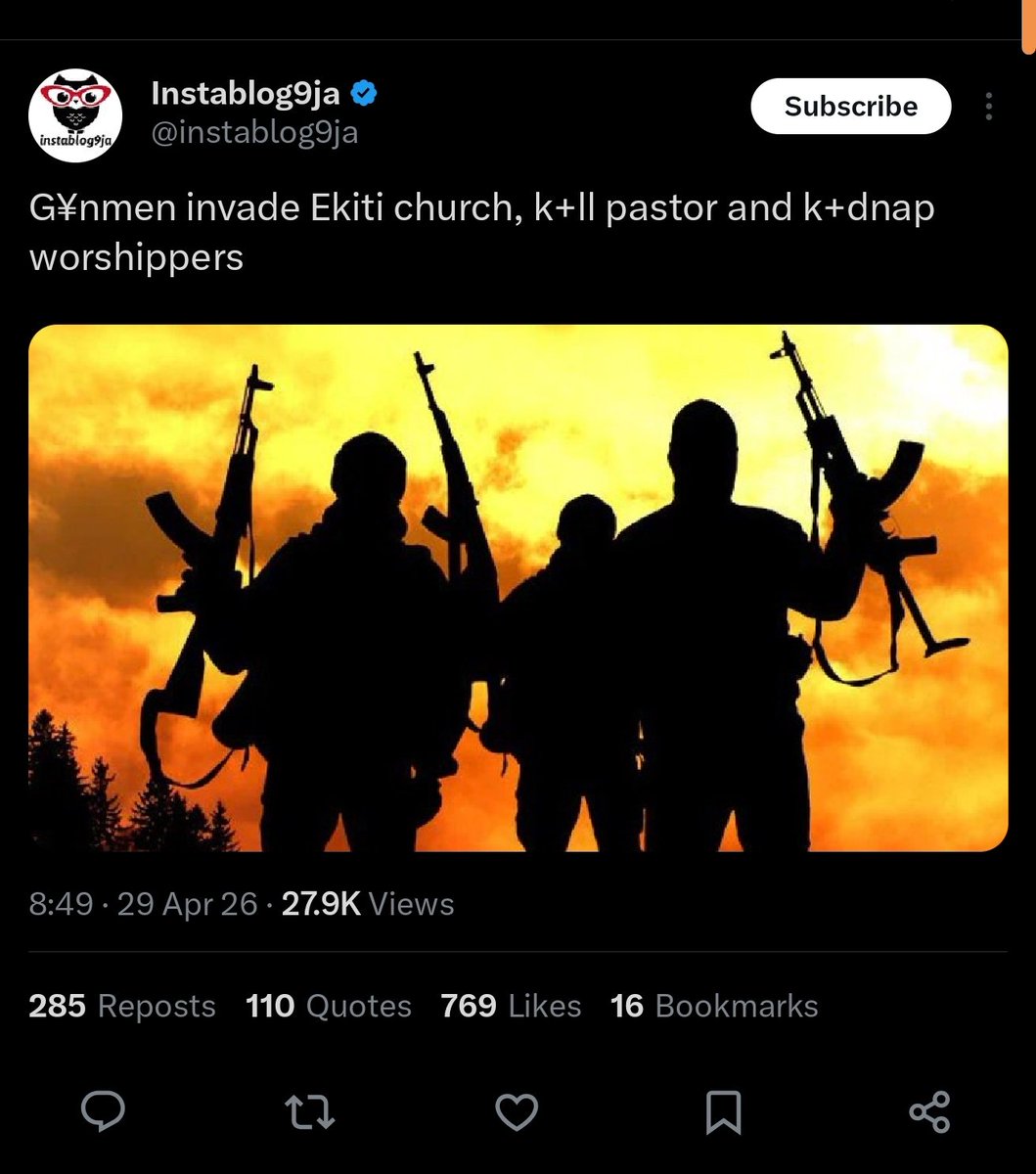
Today, it is happening in Ekiti.
This is supposed to be a country "not at war".
Iran that's been officially at war hasn't recorded one fifth of the terorrism-related deaths in Nigeria.
There's no worth for human lives.
The best thing my students ever gave me. One semester I thought they were just *really* focused on taking notes. Turns out they were compiling a book of all the slightly unhinged things I'd said. It's 152 pages long.
Retrieval practice is so important in helping learners retain knowledge. Love to see more and more of it.
One of the most common opportunities to improve though is in avoiding very general questions. Eg “What’s one thing you remember from yesterday’s lesson?”
This Q will likely result in learners recalling the easiest thing, the most familiar… Ie “low hanging fruit.” Much better to say: “Yesterday we talked about four key principles of x. What were they (or even: how many can you recall?) and which one did we discuss as being the most important?” Now learners are prompted to recall full schema and to recall things that don’t come easily.
The dispute over Mukhtar Muhammad’s legitimacy became the immediate spark that lit the fire of the September 7, 2001 Jos riots.
The Hausa and Fulani settlers will never tell you that their constant demand for the Jos chieftaincy, and their petition to General Babangida for a settler local government, laid the foundation for the violence that tore through Plateau State.
Their desire to dominate was the spark that set the conflict in motion
They will never tell you that when Babangida created a new local government, indigenes did not riot, even though the appointed chairman then was a settler and most of his appointments were fellow settlers as-he sidelined natives on their own land.
They will never tell you that they were first to go on a rampage of violence after the Abacha’s government reversed an appointment which they had earlier given to a settler for the Jos North chairmanship in 1994.
The British built Jos from Anaguta, Afizere and Berom land
I keep saying we are lucky in the Middle Belt that these land grabbers are illiterates or we would have suffered!
British split Jos into two: Jos Township and Jos Native town but left a section of the bulk of native lands
Township was for Europeans & other skilled migrants, while Jos native town was for migrants like Igbo, Yoruba, Hausa etc
The third part remained reserved for the indigenes who were majority
What is strange in this dynamic is that despite Igbos, Yorubas, the Hausa and Fulani coming around the same time and staying in those residential areas created by the British,
only the Hausa and Fulani want to use it as a medium to claim ownership of the lands of the indigenes
None of the others are attempting to do such
What the British did was to ask the Emir of Bauchi to appoint a Chief Laborer for the Hausa and Fulani labor camp
However those settlers eventually tried to elevate a Chief Laborer to have authority beyond the mining camps and to include the indigenes - the British rejected this
This is evidenced in 1921, these settlers asked to be placed to rule over the natives in the 1921 Provincial Report and even the British rejected it
It shows that they have always been land grabbers. Their descendants are only doing what their ancestors had always tried but failed to do
What they won’t tell you is that, the Bulk of the Hausa and Fulani settlers came in the 80s - in a second wave,
after the establishment of the University of Jos and settled on University of Jos land illegally,
(which is why their primarily settlements are littered around the University of Jos environment
Despite them clearly knowing this, many of them claim to be part of the original 2000 initial laborers who came from Bauchi, Kano etc to work as laborers to the British (everyone is now a laborer - because they want to grab lands)
The Plateau people have been peaceful and have always handled their expansionism peacefully
In 1987, the tensions grew sharper in 1987, when Alhaji Saleh Hassan, a well-known Hausa politician, openly called on Hausa and Fulani youth (who call themselves Jasawa) to “recover” the Jos chieftaincy as their rightful inheritance.
That debate of wanting to rule the natives was reignited
In 1991, the settlers wrote Ibrahim Babangida (a self professed Hausa man whose father migrated from Sokoto in his recent biography) to create a local government specifically for them
Ibrahim Babangida created Jos North Local Government Area, drawing boundaries that favored Hausa settlements.
For the indigenous groups, this looked like a deliberate attempt to hand the political heart of Jos to the settlers.
Matters escalated in April 1994, when the military administrator of Plateau State Col Muhammed Mana imposed Alhaji Aminu Mato a Hausa, as caretaker chairman of Jos North. Indigenous groups protested, and the appointment was suspended, but soon after, Jasawa youths launched riots
The Jasawa were hurt and decided to take the law into their own hands a few days later as they went on a rampage, killing, maiming, burning, looting, and causing unquantified havoc.
From that moment, Jos North became the flashpoint of recurring violence.
The cycle of conflict did not stop. In 1996, violence flared again near Jos Central Mosque after the killing of Azi Chai, a young Afizere man, during an election dispute by Hausa settlers.
The next big riot followed in 1998 when Mukhtar Muhammad, another politician, identified as Hausa but admitted to be Kanuri at the commission of inquiry, was imposed again as chairman of Jos North but forced to step down after allegations of falsified credentials.
Yet in August 2001, he resurfaced again as Poverty Eradication Coordinator, a highly sensitive and lucrative post.
To indigenes, this was a provocative imposition; but to the Hausa community, it was a triumph.
Let me use my own life to explain why some politicians suddenly start complaining about Nigeria once they leave power.
When I’m at work in Nigeria, my life is heavily subsidized. I live in an apartment with 24/7 electricity, armed security, cleaners, and house help, all paid for. I even get food at work. I’m driven everywhere, from work to shopping. In that environment, you’re almost shielded from what's really happening on the streets.
But the moment I’m off duty and back in my house in Lagos, Omo, reality hits differently. I suddenly realise that fuel is actually 1334 Naira per liter. Yes, I still have a driver and a cleaner, but now, I’m the one paying their salaries.
In less than 14 hours outside that comfort zone, I’ve already spent 83,600 Naira on fuel for my car and generator.
As I am typing this, my gateman just switched off the generator. I don't know if he's trying to save fuel or if it has finished. All I know is that I’m lying here on my bed, starting to sweat.
That contrast is real, and it explains a lot.
From a purely institutional and governance perspective, every media aide and senior government official that the press may interview should have training in adversarial media questioning.
That training was compulsory when I worked in the UK, and I had it then although I was just a senior government official and not an official spokesperson. I was trained by the interviewers of BBC ‘Hard Talk.’
Here, we just appoint people and expect them to know. As an example, we appoint Ministers of Labour and expect them to have negotiation skills. The lack of training means that Ministers of Labour agree to terms during industrial disputes that the government cannot fulfil, leading to incessant strikes by people like ASIU.
You cannot always blame the government for this though. When appointed, YOU are expected to arrange any training YOU need to be effective at your job.
I am Ezemmuo. I know things.
And this is why education is stuck in such a rut, and constantly regresses back whenever we make an inch of improvement: because the progressive tropes are so intuitively attractive, easy, and simple, and the reality of learning is much more complex and difficult.
You don't learn very well by watching an amusing or entertaining video; you retain the information in it like a river running through you. You're aware of it temporarily until it is replaced by the next packet of facts, but you don't retain it well or in a way you can retrieve easily later. You might remember novel, surprising, amusing, or shocking parts well enough, but miss the details that weren't obvious, or the links between them.
Knowledge and skills are acquired through scaffolded explanations/ demonstrations followed by the student processing it, using it, thinking about it. The teacher then checks their understanding and offers high quality feedback, reinforces, corrects, redirects or reconstructs. Then the next lesson connects meaningfully with the last one in a similar way, infused with retrieval and revision of prior concepts to ensure deep learning.
Videos can be part of that, but they are not that. We actually do know a lot now about how we learn, and how we teach, and collectively they tend to be called the Learning Sciences, or Evidence-Informed Education. It's urgently required across the world as an antidote to both the winner-takes-all grindhouse of poorly led-lecturing, or more commonly, the inane performative pantomime of progressive flim-flam.
Mr B's references here demonstrate the old Keynesian adage of how so-called practical men who believe themselves free from bias, are usually in the grip of some long dead economist or philosopher. He trots out the most pedestrian and reactionary dogma about learning while believing himself to be a common-sense revolutionary. It's not his fault. I don't know anything about being a social media megastar.
But tech, no matter how shiny, cannot replace the architecture of the human brain. There is a 1300g bag of neural porridge inside every one of us that isn't going anywhere fast, so we better get busy using it to understand how to replicate and build on how we already actually learn, rather than what we wish it was like- or what sells content.