Check out the historical "Land Of No Return" in Badagry, Nigeria with us.
You can watch the entire video on our YouTube channel by clicking the link below.
Don't forget to subscribe and follow us for more enlightening historical insights about Lagos.
https://t.co/DEi644nKgD
Sixty years ago, Lagos authorities launched a massive two-week operation against unlicensed drivers and vehicles. Checkpoints appeared across the city, traffic laws were strictly enforced, and offenders were swiftly apprehended.
What do you think has changed today?
Standing proudly in the heart of Ebute-Ero, Holy Trinity Church remains one of the oldest and most historically significant Anglican landmarks in Lagos. Its story dates back to 1861, when the site first became a centre of Christian worship during the early years of colonial Lagos
University of Lagos, 1973.
A glimpse into student life at UNILAG over five decades ago, young scholars arriving with books in hand, long queues that captured the realities of campus life, and the familiar rush up the stairways between lectures.
#HistoricalLagos#UNILAGHistory
APONGBON: THE LAGOS DISTRICT NAMED AFTER A RED-BEARDED GOVERNOR
Many of Lagos Island’s most familiar place names carry remarkable stories that connect the city to its colonial past, returning diaspora communities, and the evolution of Lagos as a commercial hub.
#historicallagos
Captured in this 1975 photograph, Jankara Market stands as one of the oldest and most vibrant commercial centres in Lagos. Its origins stretch back to the mid-19th century, traders from across present-day Nigeria including Hausa, Yoruba, Igbo, Nupe, and other ethnic communities
The 1983 Lagos Skyscraper Fire That Shocked Nigeria
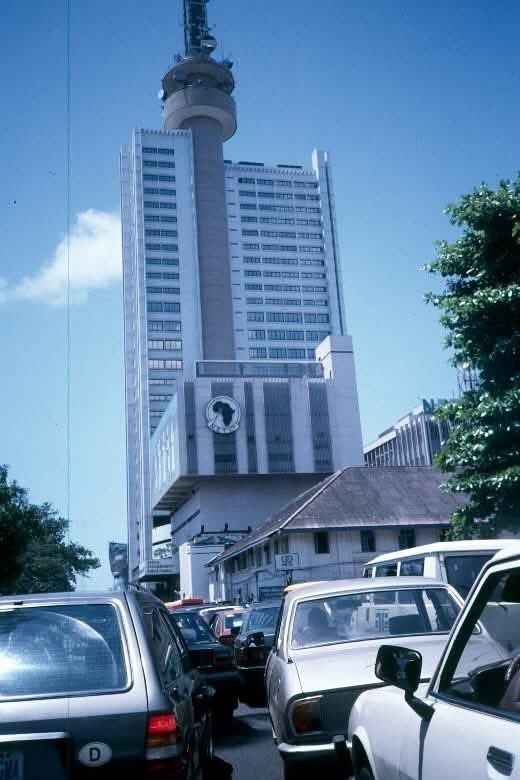
On 24 January 1983, Lagos witnessed one of the most dramatic disasters in its modern history when fire engulfed the 32-storey External Telecommunications Building, then among the tallest and most iconic structures in Nigeria.
Standing quietly on Kakawa Street, Lagos Island, the Vaughan Family House at No. 29 is one of the surviving reminders of the powerful Afro-Brazilian and Saro merchant families who helped shape colonial-era Lagos.
Built around the 1850s.
#HistoricalLagos#LagosIslandHistory
This view captures a section of Idumota, Lagos Island, in the 1960s, an area that once formed part of Victoria Street, one of colonial Lagos’ most important commercial corridors. Visible on the left is the iconic clock tower donated by the Syrian community in Lagos.
Standing quietly on Kakawa Street, Lagos Island, the Vaughan Family House at No. 29 is one of the surviving reminders of the powerful Afro-Brazilian and Saro merchant families who helped shape colonial-era Lagos.
Built around the 1850s.
#HistoricalLagos#LagosIslandHistory
Monday, June 26, 1978, West German Chancellor Helmut Schmidt arrived in Lagos on an official state visit and was personally received by Nigeria’s Head of State, Olusegun Obasanjo. Standing in the background was the Chancellor’s wife, Hannelore Schmidt,
#HistoricalLagos
In this footage, Chief M.K.O. Abiola speaks during one of his final public interviews before his imprisonment by Nigeria’s military government. Just days after boldly declaring himself the lawful winner of the annulled June 12, 1993 presidential election at Epetedo Lagos Island.
November 16, 1960.
At the historic Race Course in Lagos, today known as Tafawa Balewa Square, Dr. Nnamdi Azikiwe stood before a jubilant crowd and was sworn in as Nigeria’s first indigenous Governor-General and Commander-in-Chief of the Armed Forces.
#HistoricalLagos
Hidden within the grounds of Cathedral Church of Christ, Marina, stands a quiet reminder of a transformative chapter in the history of girls’ education in Lagos. An often-overlooked plaque marks the original buildings of the Anglican Girls School, opened on May 2, 1959.
Popular Juju maestro Sir Shina Peters arriving at Lagos Airport in 1972 after a trip to the United Kingdom, warmly welcomed by his mother, Victoria Asake Peters. Long before he became one of Nigeria’s most celebrated musical icons.
#Historicallagos
This is Casa d’Agua ,the famous “Water House” of Kakawa Street, Lagos Island. Built in the mid-19th century, the structure remains one of the finest surviving examples of Afro-Brazilian architecture in Lagos.
1999, Lagos grappled with chronic power shortages and an overstretched national electricity system , the administration of Bola Ahmed Tinubu explored an ambitious idea
Captured sometime between 1930 and 1972 on Odunfa Street. In the foreground stands the Nigerian branch of Arnold Schlesinger, a German trading house based in Hamburg, reflecting the strong international trading links that connected colonial Lagos to Europe and the wider world.
Lagos Town Council Health Inspectors, 1960.
Long before environmental agencies, waste management authorities, and modern public health campaigns, these men were on the frontlines of keeping Lagos healthy.
Do you remember Health Inspectors visiting you? Share your memories below