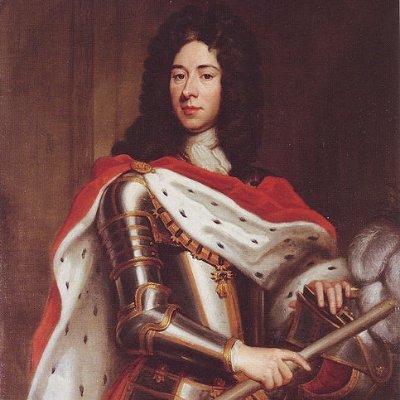
August von Kotzebue was a man fighting against history. Born in the 18th Century Holy Roman Empire and steeped in its Enlightenment and cosmopolitan sensibilities, he found himself constantly at loggerheads with the burgeoning Romantic and nationalist movements in the early 19th Century German confederation. A famed playwright and prolific author, he had written some 200 plays and had his novels and novellas translated into over a dozen languages.
He had spent his life in a somewhat peripatetic manner, travelling hither and thither throughout Europe, having spent stints in Paris, Vienna and St. Petersburg. Highly successful, by time he was 57 years old, he would draw pensions from two Emperors and one King: the Emperors of Austria and Russia and the King of Prussia. 1816 would see him settled in the town of Mannheim in the grand duchy of Baden, where his primary pursuit for the next several years was penning weekly columns mocking the politics and antics of university age liberal nationalists.
He was - to use modern terms - a conservative influencer.
This would mark him for death.
He would see his windows smashed and his book on German history ceremonially burned at a student rally. The worst would come, though, on March 23rd, 1819.
Karl Ludwig Sand was a young theology student at the University of Jena and a devout liberal. A radical, he had hopped from university to university seeking out like minded students and professors. By 1819, Sand had decided that Kotzebue had to die for the good of the fatherland, and that he was the one to do it.
On March 23rd, 1819 Karl Ludwig Sand would walk into the house of August von Kotzebue as a guest and leave as a notorious assassin. Out on the streets outside Kotzebue’s house, he would praise God for the success of his murder, and stabbed himself twice in the chest. Sand would fail to kill himself.
Kotzebue’s assassination would shock not just the German speaking world, but Europe as a whole. Despite Sand having acted entirely alone, the conservative and repressive forces of Europe almost unanimously saw a grand conspiracy afoot. A transcontinental cabal readying plans to assassinate all the sovereigns of Europe and plunge the continent into an orgy of Revolutionary violence. Metternich would take advantage of the hysteria and roll out the Karlsbad decrees, further tightening the grip of the state over the press and severely curtailing the independence of universities and professors.
But just as equally as Sand’s act struck fear and revulsion it also excited and inspired. All throughout the German states, students would switch to studying theology, just as Sand had. Sand’s mother would receive a letter from a theology professor at the University of Berlin, stating that Sand’s assassination was going to be rewarded in heaven and the killing was ‘a beautiful sign of the times.’ When Sand was publicly executed a year later in 1820, handkerchiefs would be dipped in his blood and passed around as relics.
The movement which drove Sand to strike down Kotzebue, his death now inflamed. The forces of repression would manage a temporary victory, but ultimately it would be Sand who be vindicated. Metternich would be exiled from Austria. Germany would confederate, its Kaiser eventually deposed. Liberal Democracy spans the globe.
The assassin won.
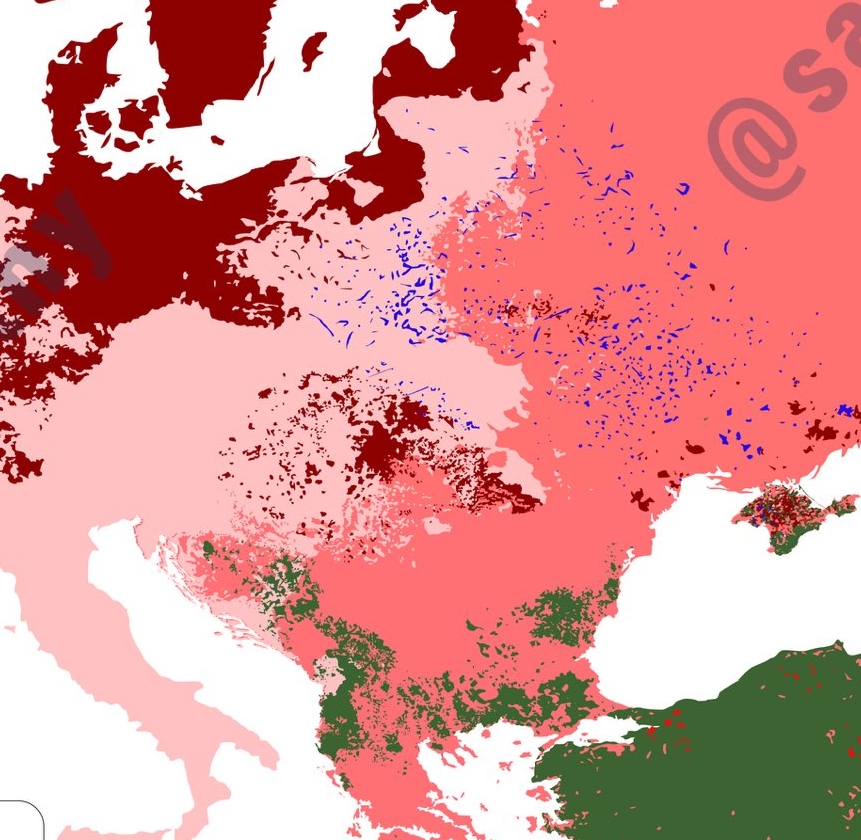
Notice how the dots signifying Protestantism overlap with the historic territory of Kingdom of Hungary.
The reason why Protestantism survived in Kingdom of Hungary but was eradicated from neighboring territories goes back to the complex situation of the Habsburg-Ottoman wars, in particular the events leading to the Treaty of Vienna (1606), which secured the rights of Protestants in Habsburg-controlled parts of Kingdom of Hungary (but not in their other lands).
I can give a quick overview of how this happened and why the religious situation in Hungary was different than in other Habsburg ruled lands, as this is a very interesting topic and important part of wider Central European history.
In 1526 Kingdom of Hungary suffered a crushing defeat to Ottomans at the Battle of Mohács where King of Hungary Louis II died. This not only led to a direct occupation of Hungarian territories by the Ottomans but also to a succession crisis.
The Habsburgs, ruling over neighboring Austria, claimed the Hungarian crown and established control of western and northern part of Hungary, while a rival faction of Hungarian nobles supported their own pretender John Zápolya as the king and had control over eastern territories of the kingdom, including Transylvania. The Ottomans pragmatically supported the latter faction against their bitter rivals the Habsburgs. Eastern Hungarian territories, which would be known as Principality of Transylvania from 1570 onward, would effectively become an Ottoman vassal state.
Because of this, the Habsburg-Ottoman wars in Kingdom of Hungary would have elements of civil war, as the said anti-Habsburg faction of Hungarian nobles would cynically side with the Muslim Ottomans despite being Christians, pursuing their own pragmatic politics of survival as Principality of Transylvania, while also having ambitions to one day reclaim entire Kingdom of Hungary.
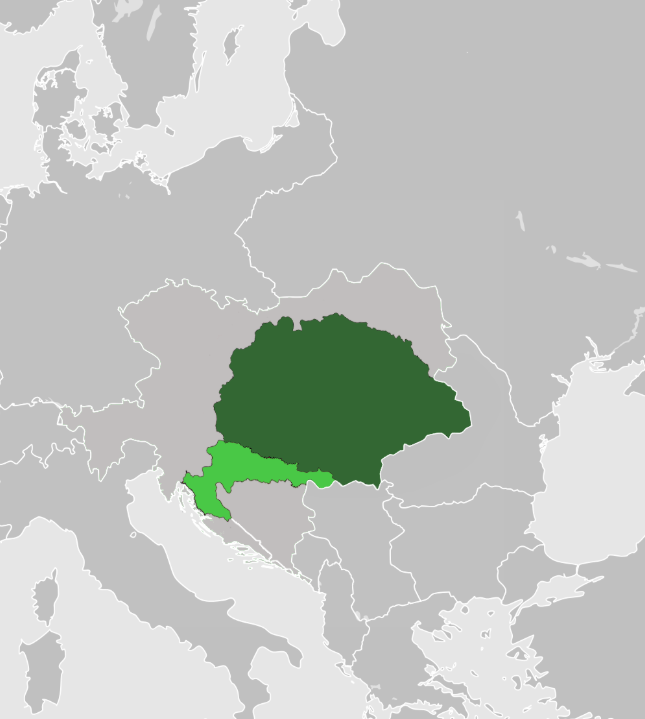
Religious situation in Hungary would also play an important part in this. In 16th century, Protestantism spread rapidly over entire Kingdom of Hungary and by 1600, 75% of population of historic territory of Kingdom of Hungary (in dark green on the second map) adhered to some form of Protestantism.
The Principality of Transylvania in particular was famously multi-religious, and had guaranteed religious freedom for Catholics, Lutherans, Calvinists, and Unitarians, going back to Edict of Torda in 1568.
Meanwhile the Habsburgs were pushing aggressive Counter-Reformation policies in the late 16th/early 17th century, as they wanted to eradicate the Protestant heresy and reestablish Catholicism in their lands.
This difference in religious policies obviously meant that Protestant nobles in Hungary had much more reasons to support the anti-Habsburg cause and Principality of Transylvania was trying to establish itself as the protector of Protestants across the entire territory of Kingdom of Hungary, including in the Habsburg-ruled territories in western and northern Hungary, where Protestant communities also existed in large numbers. This was not just out of religious reasons but also political, because Transylvanian princes wanted to portray themselves as legitimate heirs of Hungarian crown and guardians of Hungarian state traditions, so insisting on affirming religious rights across historic borders of this kingdom was tied to their ambitions to one day also entirely reclaim the rule over entire kingdom.
The war that really cemented this attitude was the Long Turkish War (1593-1606), which was an escalation of Habsburg-Ottoman wars along the Hungarian and Croatian frontier. It's interesting that in this war, the Principality of Transylvania under Prince Sigismund Báthory initially sided with the Habsburgs, breaking the alliance with the Ottomans. However Sigismund's rule was unpopular, particular among the Protestant nobles, and as the war was dragging on, there was less and less support for the anti-Ottoman policy.
The Long Turkish War was a long and grueling war which mostly included brutal border raiding and sieges of important border fortresses. It was essentially a stalemate; the Habsburgs had their victories and the Ottomans had theirs. Meanwhile the land and the finances were exhausted due this war.
In the final stages of the war in 1604, Protestant (Calvinist) Transylvanian nobleman Stephen Bocskai started an uprising. Initially loyal to the Habsburgs, serving them as a military commander against the Ottomans, he rebelled against them as the war went on, rallying a large number of Transylvanian nobles behind him, commanding a force of Hajduk border irregulars.
Having to fight a war on two fronts and financially exhausted, the Habsburgs were looking for peace and eventually signed The Treaty of Vienna in 1606 to make peace with Stephen Bocskai, before the negotiations to stop the war with the Ottomans started. The said Treaty of Vienna recognized the legal status of Lutheran and Calvinist denominations in Habsburg-ruled areas of Kingdom of Hungary (historians often refer to this territory as Royal Hungary), thereby affirming Transylvanian princes as protectors of Protestants over the entire territory of Kingdom of Hungary, which was like I explained before tied to their self-portrayal of being legitimate heirs of Hungarian crown. Bocskai would be elected Prince of Transylvania and reverted back to pro-Ottoman policy.
So it was essentially because of this Bocskai's uprising and the policies of Principality of Transylvania that Protestant enclaves were able to survive in Habsburg-ruled territories of Kingdom of Hungary, while the Habsburgs would go on to eradicate Protestantism in their Austrian hereditary lands, Croatia and Bohemia (after the Battle of White Mountain in 1620), as they recognized no rights of Protestants in these lands. This is why there is a "no-Protestant" zone around the historic borders of Kingdom of Hungary on the map of religions in Europe on the left.
The Habsburgs eventually (re)conquered the entire territory of Kingdom of Hungary from the Ottomans and their Transylvanian vassals in 1699, but by then the religious attitudes were already different and a full-scale aggressive recatholicisation was no longer in the plans. While there was a growth of Catholic influence following the Habsburg victory, Protestantism in Hungary survived in significant numbers to this day.
Majors with the highest unemployment rates, per New York Fed.
Anthropology: 7.9%
Computer engineering: 7.8%
Fine arts: 7.7%
Performing arts: 7.0%
Computer science: 7.0%
Architecture: 6.8%
Bison is one of those "zero plurals" in English language (often used for animals), where plural form is the same as singular.
This was not always the case, in medieval English the plural form was bysontes, as the word was directly borrowed from Latin (where plural is bisontes).
I'm writing this because I posted about European bisons a few times in the past, and some people were commenting "you should use 'bison' in plural". But these people are technically not correct in correcting me, because both variants are still officially correct, even though bisons is less preferred and less common, but it can still be used.
The "zero plurals" for animals in English like deer, sheep etc. are apparently traced back to Old English (Anglo-Saxon) patterns, so this is an old tradition in English language. This is mostly used for animals that were hunted or herded in large numbers, so bison fit in that category, whereas for domestic animals like dogs and cats the -s plural was used.
However the word bison was borrowed from Latin and came later (late 14th century), it was first actually used in plural as bysontes. Bison as both the singular and the plural only became prevalent in 17th century.
I know this is a bit random but it's something that I looked into lately and I found it interesting.
I think it's interesting that many converts lament the fact that your average Catholic Church is basically a sacrament dispensary and you have others seeing an attempt at building a space for fellowship is corrupt commercialism.
Catholic churches with cafes represents the condemned Americanism in its final form
It consists in replacing silence and adoration with noise, distraction, coffee and shallow friendships
A small anthropocentric enclosure, modernist prelates delight in managing as a commercial business
They commercialise everything from 'saints' like Acutis, Wojtyla, Fulton Sheen and Mother Teresa, to cafes in the sacral space, kitsch artwork, and news slop shopping networks lik EWTN
Everything is a means of commercialisation in a desperate effort to save their post-conciliar sect from bankruptcy
Notable that Constans II was murdered in Syracuse, a city he was planning make the third Great Capital of the Empire in an attempt to establish a centrally located command center to resist and retake barbarian and Islamic conquests.
#Rom365, July 15, 669, death of Roman Emperor Heraclius Constantine II ('Constans II'), murdered in a bath house, probably by a courtier washing his hair, soap in his eyes, courtier smashed a metal bucket over his head. Sources give several dates, this date from modern research.
#Rom365, July 6, 640, the Battle of Heliopolis, the east Roman Empire lost to the Arabs. The start of the end of both Roman Egypt & Exarchate of Africa, and the Arab occupation. The two Cleopatra's Needles in London & New York were originally built in Heliopolis approx. 1453BC.
BROKE: the U.S. would be so scary at soccer if we tapped in because we have so much raw talent
WOKE: the U.S. would be so scary at soccer if we tapped in because we are so good at being corrupt
I think it's funny that people say Boomers are 'the most selfish generation in history,' and then complain that they also do the most unselfish thing ever and give away all their money to the indigent and downtrodden.
Overheard this 20 something girl talking to her mother about how she's going to get a promotion and a big raise at work because they just got a huge donation from a woman who recently passed and left all their wealth to the non-profit org.
Was curious so did some digging to see if I could find the donation announcement. Found the lady who died and found her children. Her son works as a roofer and probably makes 50k/yr. Her daughter works as a church administrator making roughly the same.
It was a 7 figure donation. You just can't hate boomers enough.
No, they're not Protestants. They're innovating new ways to be schismatic without being formally heretical in a post Vatican I world. Kind of impressive actually
A study comparing 16-to-24-month-old toddlers, untrained companion dogs, and house cats revealed that over 75% of both children and dogs will spontaneously indicate or retrieve a hidden, completely useless object—like a dishwashing sponge—to help a searching caregiver without ever being asked or rewarded.
Cats under the exact same conditions showed a near-total absence of helpful actions, completely refusing to assist despite paying the exact same level of close attention to their owner's dilemma.
This lack of participation is entirely a choice rather than a lack of understanding because the moment researchers ran a trial switching the hidden object to the pet's favorite treat or toy, all species differences completely vanished and the cats became instantly cooperative.
While dogs and toddlers share a cooperative evolutionary drive to view human struggles as shared problems, cats strictly preserve their energy for a guaranteed personal payout.
USA needs to stop with this apportionment nonsense and return to the properly traditional practice of assigning representatives based on total population.
Apportionment Forecast For Next Census
Top Gains:
🔴 Florida: +4
🔴 Texas: +2
Top Loss:
🔵 California: -4
🔵 New York: -1
Net Total:
🔴 Republicans: +8
🔵 Democrats: -9
🟡 Tossup: +1