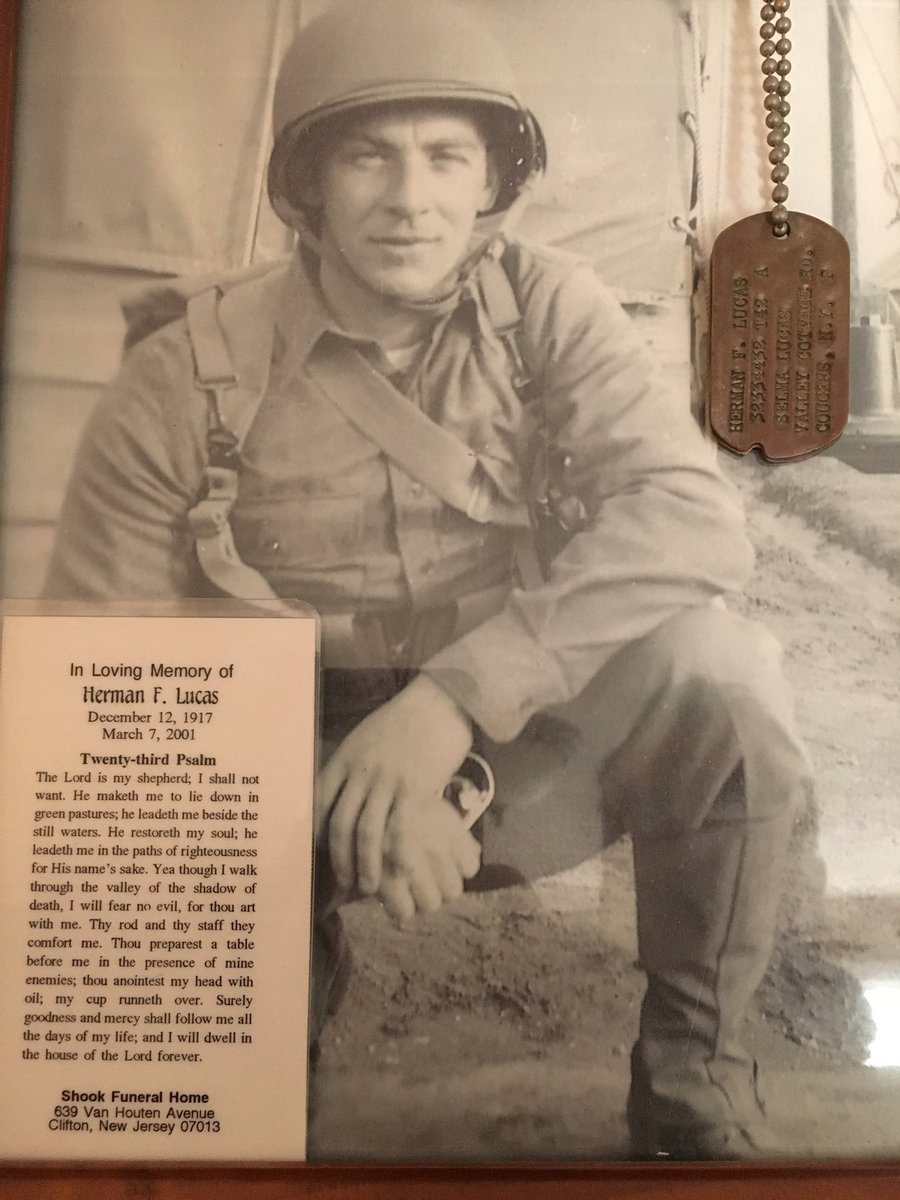
@AGrumpyOldVet@usmc1940 There’s nothing on earth like the bond between a father and a son. Losing your Dad is sad beyond words. Speak about your Dad often and hang pictures of him around the house. I lost Pop in 2001 and make it a point to look at this picture of him on my dresser each day. RIP Marine.
Just a guy with 39 successful combat flight missions on his resume about to dig in with a guy who was a machine gunner at Omaha Beach on D-Day behind the plate. Two men.
In 2006, workers digging a road in Belgium unearthed the body of a soldier who had lain hidden for nearly ninety years.
Most of the battlefield dead were buried in haste, tumbled into shell holes with no time for ceremony. But not this one.
This young man had been laid to rest with unmistakable care — and when they learned who had done it, and why, it broke their hearts...
The place was Polygon Wood, near Zonnebeke, in Belgium's Flanders Fields — ground soaked in the blood of the First World War. A construction crew, breaking earth for roadworks, struck something their machines were never meant to find. Not rock. Not clay. Bones.
In this corner of Belgium, that is not as rare as you might think. More than a century after the guns fell silent, the soil around Ypres is still giving up its dead. The workers stopped at once and called the man who is summoned for exactly this: Johan Vandewalle, a Belgian battlefield archaeologist who has spent his life recovering the fallen of the Great War, and who runs a little café and museum nearby.
Over the following days, Vandewalle and his team carefully uncovered not one soldier but five, all young Australians, buried together where they fell. They would come to be known as the "Zonnebeke Five." Four of the bodies had suffered badly in the earth. But the fifth was different.
The fifth soldier had been wrapped, with great care, in a canvas groundsheet — the standard-issue sheet a soldier used for shelter. The wrapping had protected him so well that his remains, even his boots, were remarkably intact after ninety years. And there was one detail that stopped the excavators in their tracks.
His arms had been folded gently across his chest.
No one does that in the frenzy of battle unless they love the man they are burying. This was not a body dumped in a crater. This was someone laid to rest, tenderly, by a hand that grieved. Someone had knelt in that hell and taken the time to do it right.
The question was: who was he, and who had buried him with such love?
In time, several of the Zonnebeke Five were identified through DNA, matched to living relatives back in Australia. The soldier in the groundsheet was Private John Hunter — known to his family as Jack — of the 49th Battalion, Australian Infantry, a young man from the town of Nanango in Queensland. And when his family's story was traced, through the memories passed down by his niece, the truth of that tender grave finally emerged.
Jack Hunter had not gone to war alone. He had a brother.
His name was James Hunter — Jim — and he was Jack's younger brother. The two of them, boys from the same Queensland home, had enlisted and ended up serving side by side in the very same battalion, in one of the most terrible battles of the most terrible war the world had ever known.
To understand what Jim did, you have to understand where he did it.
The fighting around Polygon Wood in September of 1917 was part of the wider campaign history remembers as Passchendaele — a byword for horror even by the standards of the First World War. The land had been shelled into oblivion. Trees were reduced to blackened splinters. The earth itself had been churned into a bottomless soup of mud and water, so deep that wounded men sometimes drowned in it before anyone could reach them.
It was into this that the Hunter brothers advanced, on the 26th of September, 1917.
Somewhere in that chaos of shellfire and machine guns, Jack was hit. And his younger brother Jim reached him.
Jack died there, in Jim's arms.
What Jim did next is the reason we tell this story at all. He was in the middle of an active battlefield. Shells were still falling. Another attack could come at any moment. Every instinct of survival screamed at him to move, to take cover, to save himself. Instead, Jim stayed with his brother's body — and he buried him.
He wrapped Jack in his groundsheet. He folded Jack's arms across his chest, the way you would lay out a loved one for a proper funeral. He dug a grave as best he could in that waterlogged ground, and he laid his brother in it, and he did his utmost to mark the spot so that he could one day come back and find him.
But Passchendaele did not let anything stay marked. The next barrage reshaped the ground. The rains filled the craters. The mud closed over everything. And by the time the battle had moved on, the little grave was gone, swallowed by the churned and ruined earth.
Jim Hunter survived the war. He went back, afterward, and searched for the place where he had buried his brother — but it had vanished, erased along with the whole shattered landscape. In time, he returned home to Australia. He carried Jack with him for the rest of his life, always believing, always hoping, that one day the two of them would somehow be reunited.
He died without ever finding his brother's grave. He never knew that anyone ever would.
And then, decades after Jim was gone, a road crew broke ground near Polygon Wood — and Jack came back into the light at last, still wrapped in the groundsheet his brother had folded around him, his arms still crossed where his brother's hands had placed them.
In 2007, Private John "Jack" Hunter was reburied with full military honours at the Buttes New British Cemetery, only a short distance from where he had fallen. He has a proper headstone now, carved with his name. It reads: "Beloved son of Harry and Emily Hunter, Nanango, QLD. At rest after being lost for 90 years." And his name was removed from the great Menin Gate memorial to the missing — because he was no longer missing. He had been found.
Johan Vandewalle could not let the story rest there. So moved was he by what one brother had done for another that he set out to build a permanent memorial to it — and to all the brothers who fought and suffered and died side by side in that war. In the years that followed, an Australian sculptor named Louis Laumen created the centrepiece: a life-size bronze of Jim cradling his dying brother Jack in his arms.
That memorial stands in Zonnebeke today, and people travel from Australia and around the world to see it. They stand before the two bronze brothers, and they read the story, and very often they weep — because the loss of seventeen million souls in that war is a number too vast for the human heart to hold, but one brother refusing to leave another is something we understand completely.
Jack and Jim Hunter were not statistics. They were two boys from a Queensland town who grew up together, and went to war together, and in the end lay only a groundsheet apart across ninety years.
One brother would not leave the other behind. And in the end, neither did history.
Had you ever heard the story of the Hunter brothers? Tell us below. And here's one for today: is there a story of devotion between brothers or sisters in your own family that has stayed with you all your life?
In January 1991, Norman Schwarzkopf knew the exact number of body bags the Pentagon had ordered in anticipation of the coming ground campaign. He was 56 years old, and he had been handed a responsibility no American commander had carried since the Second World War: more than half a million soldiers from 34 nations, arrayed across the Arabian desert, waiting to be pointed at one of the most battle hardened armies on the planet.
Saddam Husseins forces had spent eight years fighting Iran. They had fortified every approach into Kuwait with mines, trenches, and pre aimed artillery, all built on a single assumption: that when the Americans arrived, they would come straight through the front door.
Schwarzkopf had no intention of using the front door.
He had learned something during two tours in Vietnam that desk generals never quite grasp. He had been decorated three times with the Silver Star for gallantry under direct fire. The most famous of those moments came in May 1970, when he received word that soldiers under his command had stumbled into a minefield. He flew in by helicopter and found the men trapped, with a wounded soldier lying on the ground screaming and a very real danger that the mans panic would cause him to set off another mine. Schwarzkopf crawled across the minefield to the wounded soldier, pinning him down safely so another man could splint his shattered leg.
Believe me, it wasnt a heroic act, he said later. It was something that somebody had to do, and I was the man in charge. Because of experiences like that, he knew, in a way that cannot be taught in a classroom, exactly what he was about to ask his soldiers to do.
For six weeks before a single ground soldier moved, coalition aircraft worked methodically. They struck command centers, severed supply lines, silenced communication networks, and systematically blinded the Iraqi military, all while Iraqi generals watched the Kuwaiti border and waited for the frontal assault they were certain was coming.
It was not coming.
Instead, two hundred thousand soldiers and thousands of armored vehicles moved west, deep into the open desert. They moved at night, in total electronic silence, far away from cameras and away from every position the Iraqi army had spent months preparing to defend. All the while, the Iraqi generals kept their eyes fixed on the coast.
When the ground war finally began on February 24, 1991, coalition forces were already hundreds of miles to the west. They swept through open terrain no one had bothered to defend, drove deep into Iraq, pivoted east, and struck the Republican Guard from behind. Every escape route was already closed.
The ground war lasted just 100 hours. One of the largest armies in the world collapsed in a mere four days of combat. Kuwait was liberated, and coalition casualties were a tiny fraction of the numbers that had been feared.
The Left Hook, Schwarzkopfs famous flanking maneuver, is still studied at war colleges today, and military historians still marvel at its elegance.
Six months later, the offers poured in: Senate seats, presidential conversations, corporate boards, and television contracts. The full machinery of American celebrity was pointed directly at the man who had just won the most precisely executed military campaign in a generation.
Yet, he retired in August 1991, moved to Tampa, Florida, and went fishing. He wrote just one memoir, It Doesnt Take a Hero, published in 1992, and gave a small number of speeches. He did not spend the following decades reminding the world of what he had achieved. He had led, he had brought his people home, and the job was finished.
Norman Schwarzkopf died on December 27, 2012, in Tampa, Florida, at the age of 78, from complications of pneumonia. Veterans mourned him, and military historians wrote long assessments of his career. His ashes were buried at the West Point Cemetery alongside those of his father, another general, also named H. Norman Schwarzkopf, who had famously directed the investigation of the Lindbergh baby kidnapping in the 1930s.
The operational records of Operation Desert Storm are preserved in military archives. His name is on all of them, quietly and permanently, because a record like his doesnt require his presence to stand.
In April 1967, a 20-year-old farm boy from South Dakota did something that would change the Vietnam War—he fell off his ship.
Seaman Douglas Hegdahl was standing on the deck of the USS Canberra when the recoil from a five-inch gun knocked him overboard into the Gulf of Tonkin. He treaded water for five hours, then swam for seven more. When fishermen finally pulled him from the sea, they handed him to North Vietnamese forces.
The interrogators didn't believe his story. They thought he was a spy, a commando, someone important. They beat him and threw him into the Hanoi Hilton—the most notorious prison of the war.
But Hegdahl made a choice that would save hundreds of lives. He became "The Incredibly Stupid One."
He played up his country accent. He stared wide-eyed at things he'd never seen before. When they ordered him to write a confession, he claimed he couldn't read or write. The guards, used to illiterate peasants in their own country, believed him completely. They even assigned someone to teach him—who eventually gave up, convinced Hegdahl was hopeless.
What they didn't know was that Hegdahl had a photographic memory and the discipline of a soldier.
Because they thought he was harmless, the guards let him sweep the prison yards. He walked between cellblocks. He memorized the layout of the camp and the route into Hanoi. He even sabotaged enemy trucks by adding dirt to their fuel tanks.
But his real mission was gathering intelligence.
With the help of fellow prisoner Joe Crecca, Hegdahl set out to memorize something impossible: the names, ranks, Social Security numbers, and personal details of over 250 fellow American prisoners. How do you remember 250 names under torture, starvation, and the constant threat of death?
He used "Old MacDonald Had a Farm."
Every day, Hegdahl repeated the names to the tune of the children's song. Over and over. Names became melodies. Data became memory. While the guards laughed at the "stupid" American humming in the prison yard, he was conducting one of the most important intelligence operations of the war.
When North Vietnam offered early release as a propaganda tool, Hegdahl initially refused—prisoners had sworn an oath to leave together or not at all. But his commanding officer, Captain Dick Stratton, ordered him to go. "You're carrying the names," Stratton told him. "Their families need to know they're alive."
On August 5, 1969, Hegdahl walked out of the Hanoi Hilton.
When he returned to the United States, he recited every single name. Every rank. Every identifying detail. His memory transformed 250+ missing men into confirmed prisoners of war. At the Paris Peace Talks in 1970, he confronted North Vietnamese negotiators with firsthand accounts of torture—and the pressure he brought helped secure the eventual release of all American POWs.
That farm boy who "fell off a ship" had just freed an entire army.
Decades later, in 1998, Hegdahl stood before an audience of veterans and families at the Richard Nixon Library. Thirty years after his release, he stood and sang—to the tune of "Old MacDonald Had a Farm"—the names of 256 men he'd memorized in captivity.
Not one name forgotten.
Sometimes the most dangerous people are the ones your enemy thinks are harmless. Sometimes genius wears the mask of stupidity. And sometimes, a child's lullaby becomes the most powerful weapon of all.
Ever know anyone that smart that could play that dumb for that long?
Amazing!
On June 6, 1944, a 56-year-old general with a secret walked onto Utah Beach under fire, armed with a cane and a pistol.
The secret: his heart was failing. He had hidden it from the army doctors so they wouldn't pull him from the mission.
His name was Theodore Roosevelt Jr. Son of the President. He had begged three separate times to lead the first wave ashore at Normandy before his commanders finally said yes.
When his landing craft drifted 2,000 yards off course, every instinct said redirect the following waves to the correct zone. Instead, Roosevelt walked the beach himself, alone, under artillery fire, cane in hand, reading the terrain.
His verdict: "We'll start the war from right here."
He then stood on that beach and personally greeted every regiment that landed after him, pointing them inland, cracking jokes under shellfire, steadying 18-year-olds who had never seen combat. He did this for hours.
Years later, Omar Bradley was asked to name the single most heroic act he had ever witnessed in combat.
His answer, without hesitation: "Ted Roosevelt on Utah Beach."
Roosevelt's son, Captain Quentin Roosevelt II, also landed at Normandy that same morning. He was named after his uncle, Quentin Roosevelt, who had been shot down as a fighter pilot over France in World War I.
Three generations. Three wars. One family.
Theodore Roosevelt Jr. died in his sleep 36 days later. Heart attack. The thing he had been hiding finally won. He never learned he had been awarded the Medal of Honor.
He was buried at the Normandy American Cemetery.
In 1955, his family had his brother Quentin, killed in WWI, exhumed from where he fell in France and reinterred right beside him. Quentin is the only World War I soldier buried there.
Two brothers. Two world wars. The same French soil.
Their father had once said: "Do what you can, with what you have, where you are."
Both of his sons did exactly that.
Ray Lambert had already been shot twice and blown up once before he ever set foot on Omaha Beach.
He had survived the invasion of North Africa in 1943. Then Sicily. Each time he had been wounded. Each time he had gone back. By June 6th, 1944, the 23-year-old Staff Sergeant and head medic of the 16th Infantry Regiment's 2nd Battalion was on his third invasion in two years. He had already won a Silver Star for running through German lines in North Africa to drag wounded men out.
He was not supposed to survive a third one.
Lambert landed in the first wave at Omaha Beach. Of the 31 men in his landing craft, only 7 survived the day. The other 24 were killed before they even reached the sand.
He started working immediately.
The first bullet hit his right arm and shattered the bone. He kept going. A second round tore through his right elbow as he was pulling a wounded soldier through the surf. He kept going. Something hit his leg and opened it down to the bone. He put a tourniquet on himself, injected himself with morphine from his own kit, and kept going.
He found a slab of concrete on the beach that offered a few inches of cover. He set up a treatment zone behind it, dragging men out of the water and working on them one by one under constant fire. That piece of concrete is still there today. People who visit Omaha Beach call it Ray's Rock.
Then a loose landing craft ramp swung loose in the surf and slammed into him. It broke his back.
He kept going.
Lambert lost count of how many men he treated. The official record credits him with saving at least 15 lives that morning. Other accounts say closer to two dozen. He worked until his body physically stopped, collapsing unconscious at the edge of the surf, bleeding from multiple wounds, his back broken, still in the water.
A doctor spotted him. A landing craft pulled him out.
Here is the part that does not feel real.
Lambert's brother, Euel, had also been wounded at Normandy that day. The two brothers were loaded onto the same evacuation landing craft. They were placed in the same wheeled ambulance. They were taken to the same tent hospital in England. They were brought into the same operating room at the same time.
Lambert spent almost a full year recovering before he could walk properly again.
He went home. He lived quietly for decades, rarely talking about what happened. In 2019, at the age of 98, he went back to Normandy and stood on the beach again. He published a memoir called Every Man a Hero. It became a New York Times bestseller.
In 2021, Ray Lambert died peacefully at home. He was 100 years old.
He had three invasions, four serious wounds, a broken back, a Silver Star, multiple Bronze Stars, multiple Purple Hearts, and two dozen men who came home because he refused to stop moving on the worst morning in American military history.
Today is June 6th.
Remember him.
"This was filmed last Wednesday afternoon at Riverside Veterinary Clinic in Indianapolis, Indiana. The officer is Sergeant Paul Greer. He's 41 years old. Fourteen-year veteran of the Indianapolis Metropolitan Police Department. The dog is Bruno. A ten-year-old German Shepherd who served eight years as Paul's K9 partner before a joint condition ended his working career two years ago. When Bruno retired from active duty, Paul adopted him immediately. Brought him home. Bruno spent his retirement on Paul's couch, on Paul's bed, in the passenger seat of Paul's personal truck. The transition from working partner to household companion was seamless. Bruno had always been Paul's dog. The badge and the vest were just part of the job. Over the past several months, Bruno's condition had declined steadily. The joint condition spread. He had difficulty getting up. Stopped eating regularly. Paul had been managing Bruno's comfort with guidance from Dr. Angela Reese at Riverside for months. Last Tuesday evening, Bruno stopped getting up entirely. Paul called Dr. Reese that night. Wednesday afternoon, Paul drove Bruno to Riverside. He carried Bruno in from the truck himself. Wouldn't let the techs take him. Paul's partner, Officer Dana Choi, came with him. She filmed quietly on her phone from the corner of the room. She told us afterward that she asked Paul's permission before she started recording. He nodded. Paul sat on the exam table with Bruno cradled across his lap and chest. Bruno's head rested against Paul's shoulder. His eyes were half-open. His breathing was slow and easy. Paul bowed his head and pressed his face into Bruno's fur. Bruno lay still for a long moment. Then slowly — carefully — he raised both front paws. One at a time. And wrapped them around Paul's shoulders. And held on. Paul made a sound that Dana said she will never forget. Dr. Reese, who was standing nearby preparing, went completely still. Her assistant took a step back. Nobody moved. Dana told us: 'Bruno could barely lift his head that morning. But he lifted his paws and he held Paul. In that moment, with everything he had left, he held him. I think he was saying thank you. I think he was saying goodb"
Heartbreaking message from mother, Lucica Antohi. 💔
“I don’t even know how to write this…
Today we received the results from the latest scan.
And my heart is breaking as I say this — the tumor is growing very fast. It has become very large, and surgery is no longer possible.
The doctors have told us there is nothing more they can do… only painkillers to try to keep him comfortable.
But how can a mother accept this? How can I just sit and watch my child suffer, knowing there must be something, somewhere, someone who can help?
I refuse to believe this is the end. I refuse to stop fighting for my child.
Please… if you are a doctor, a researcher, or you know anything about treatments, experimental drugs, clinical trials — anything at all — I am begging you to help us.
We are searching for even the smallest chance. One idea. One contact. One opportunity.
Please share this message. Help it reach the right person. Because somewhere out there, there might be someone who can save my child.
Thank you for standing with us in this fight. ❤️
Please repost to give Matia a chance to live. 🙏🏻
If you can help, please reach out to Matias’s mother:
https://t.co/NYUBRqFjm6
On a freezing December morning in 1957, President Dwight D. Eisenhower was reviewing budget proposals when his secretary nervously informed him that a 73-year-old woman named Mrs. Eleanor Mitchell from Abilene, Kansas—his childhood Sunday school teacher—was in the White House lobby asking to see him without an appointment, and instead of having staff politely redirect her, Eisenhower literally ran down the hallway, swept this elderly woman into a huge bear hug, and cleared his entire afternoon to have tea with her in the residence. What makes this moment so breathtakingly beautiful is that Mrs. Mitchell had taught a scrappy young Dwight Eisenhower Bible verses every Sunday from 1907 to 1911 in a tiny church basement, making him memorize Proverbs and Psalms when he'd rather be playing baseball, and she'd written him letters throughout his military career—through both world conflicts, through his rise to Supreme Commander, through his election—always addressing him simply as 'Dwight' and reminding him that 'character matters more than rank.' Eisenhower told his staff that Mrs. Mitchell once made him apologize to the entire Sunday school class for being prideful after he'd bragged about winning a spelling bee, teaching him a humility lesson that shaped his entire leadership philosophy, and he'd never forgotten how she'd pulled him aside afterward and said, 'Dwight, you're going to do important things someday, but never let success make you forget where you came from or who helped you along the way.' During their White House tea, Eisenhower introduced Mrs. Mitchell to every cabinet member who passed by, saying with genuine reverence, 'This woman taught me everything that matters—respect this lady,' and she gently scolded him for not attending church regularly enough, which made the most powerful man in the world laugh and promise to do better. When Mrs. Mitchell left that evening, Eisenhower walked her personally to her taxi, kissed her cheek, and pressed an envelope into her hand containing a check for her church and a note: 'For the place that built my foundation—thank you for seeing potential in a troublemaker farm boy. Your student always, Dwight.' What absolutely destroys you is understanding that Eisenhower commanded armies and led nations, but he never forgot the Sunday school teacher who taught him that true strength was moral courage, proving that the greatest leaders never outgrow gratitude and that honoring the people who shaped you when nobody knew your name is the most presidential thing you can do.
@44MagnumBlue1 RIP HERO. I HOPE YOU CAN HEAR THIS ONE IN HEAVEN. THANK YOU FOR YOUR SERVICE, SIR. George Jones - 50,000 Names https://t.co/yuOmhwhgF2 via @YouTube
@44MagnumBlue1 RIP HERO. I HOPE YOU CAN HEAR THIS ONE IN HEAVEN. THANK YOU FOR YOUR SERVICE, SIR. George Jones - 50,000 Names https://t.co/yuOmhwhgF2 via @YouTube
@44MagnumBlue1 RIP HERO. I HOPE YOU CAN HEAR THIS ONE IN HEAVEN. THANK YOU FOR YOUR SERVICE, SIR. George Jones - 50,000 Names https://t.co/yuOmhwhgF2 via @YouTube
@FJHalle@44MagnumBlue1 RIP HERO. I HOPE YOU CAN HEAR THIS ONE IN HEAVEN. THANK YOU FOR YOUR SERVICE, SIR. George Jones - 50,000 Names https://t.co/yuOmhwhgF2 via @YouTube
@44MagnumBlue1 RIP HERO. I HOPE YOU CAN HEAR THIS ONE IN HEAVEN. THANK YOU FOR YOUR SERVICE, SIR. George Jones - 50,000 Names https://t.co/yuOmhwhgF2 via @YouTube
@44MagnumBlue1 RIP HERO. I HOPE YOU CAN HEAR THIS ONE IN HEAVEN. THANK YOU FOR YOUR SERVICE, SIR. George Jones - 50,000 Names https://t.co/yuOmhwhgF2 via @YouTube
@44MagnumBlue1 RIP HERO. I HOPE YOU CAN HEAR THIS ONE IN HEAVEN. THANK YOU FOR YOUR SERVICE, SIR. George Jones - 50,000 Names https://t.co/yuOmhwhgF2 via @YouTube
He was already dying when he fired the shot.
Three bullets in his body. Blood spreading across his uniform. His guard booth shattered around him.
And the man moving toward the President was still coming.
It was November 1, 1950, in Washington, D.C. President Harry S. Truman was upstairs at Blair House, resting while the White House was under renovation. Outside, a small group of officers stood watch.
One of them was Leslie Coffelt.
At around 2:20 PM, two armed men approached from opposite directions.
Oscar Collazo and Griselio Torresola opened fire without warning.
The street turned into a gunfight.
Torresola moved fast. Precise. Advancing toward the entrance, firing as he went. Officers were already down. The path to the President was closing.
Coffelt was inside his booth when the bullets came through.
Chest.
Abdomen.
Another shot.
Wounds doctors would later say he could not survive.
He went down.
Then he moved.
Dragging himself out of the booth, bleeding, barely conscious — but still holding his revolver.
Torresola was twenty feet away.
Still advancing.
Coffelt raised his weapon.
And fired once.
The shot struck Torresola in the head.
The attack ended.
Coffelt collapsed.
He was taken to the hospital. Doctors worked for hours. He died about four hours later, never fully regaining consciousness.
His last action — the final thing his body managed — was stopping the man who would have reached the President.
Upstairs, Truman had heard the gunfire and gone to the window. Agents pulled him back.
He lived.
Because of what happened below.
Collazo was captured, later sentenced, and eventually pardoned years later.
Coffelt was buried at Arlington National Cemetery.
Truman wrote to his widow. Attended memorials. Honored him as best he could.
But there’s no way to balance that exchange.
A man doing his job — someone the President may have passed without a second thought — gave his life so the President could keep living his.
In the years that followed, the story faded.
A plaque remains at Blair House. Most people walk past it.
Coffelt is still the only White House Police officer ever killed protecting a sitting president.
If you’ve ever seen something extraordinary happen quietly… and watched the world move on… you understand this story.
He didn’t go to work expecting to die.
He went to stand his post.
Something happened.
He made sure it ended.
One shot.
The President lived.
The officer did not.
And most people passing that plaque today…
don’t know his name.