Knolo’s DFINITY ICP Canister Adapter is now live on `knolo-core`.
Deterministic `.knolo` pack retrieval directly on-chain.
No vectors. No cloud. No middleware.
Rust adapter + CLI + working local `dfx` e2e.
https://t.co/5M87cHkgQe
AI knowledge shouldn’t require a cloud service, a vector database, or permanent infrastructure.
Knolo packages knowledge into portable, local-first `.knolo` files with fast, deterministic retrieval and optional semantic reranking.
This is Knolo.
https://t.co/LAjX7c7zVY
Qwen 3.5 is a 35B parameter model built using a Mixture-of-Experts (MoE) architecture.
Key concepts:
• Selective activation (~3B active parameters)
• Efficient scaling
• Balanced performance across tasks
• Practical deployment advantages
This is part of a series breaking down modern AI systems from an engineering perspective.
Knolo Studio for Linux is now live.
Knolo Studio allows teams to convert documents into clean `.knolo` packs, enabling deterministic lexical retrieval with optional reranking — without relying on a vector database.
Built to integrate directly with Ollama’s local endpoint from day one, the system is designed for:
* fast, low-latency search
* fully local processing
* predictable, auditable retrieval
* privacy-first architecture
This release reflects our focus on delivering reliable local knowledge systems that work effectively with smaller models — without external dependencies or opaque pipelines.
Support for additional providers, including OpenAI, is in development. macOS and Windows versions will follow in the coming weeks.
Linux users can access Knolo Studio here:
https://t.co/PJLcMBAzTr
For teams building with local LLMs and requiring production-grade retrieval, we welcome discussion.
GLM-5 is a next-generation open model focused on:
• Long-horizon task execution
• Agent-based workflows
• Efficient large-scale architecture (MoE)
• Sparse attention for long context
This represents a shift from prompt-based AI to systems that can plan and execute across real environments.
Part of a series breaking down modern AI systems from an engineering perspective.
Kimi K2.5 is an open multimodal model designed for real-world AI workflows.
Key concepts:
• Native multimodal training (text + vision)
• Sparse Mixture-of-Experts architecture
• Agent-based task execution
• Long-context processing (256K tokens)
This reflects the shift from simple LLMs to full AI systems.
Part of a series breaking down modern AI models from an engineering perspective.
Most AI projects fail before they even get deployed.
Not because of the model.
Because there’s no system behind it.
What we see constantly:
– Random chatbot integrations
– No connection to internal data
– No defined workflows
– No measurable outcomes
So nothing actually improves.
AI without structure is just noise.
We don’t build demos.
We build production systems that:
• Integrate into real business workflows
• Connect to internal data securely
• Produce measurable outcomes
• Scale without breaking operations
If your AI project isn’t tied to a system, it’s already failing.
Comment “AI” and we’ll show you what a real implementation looks like.
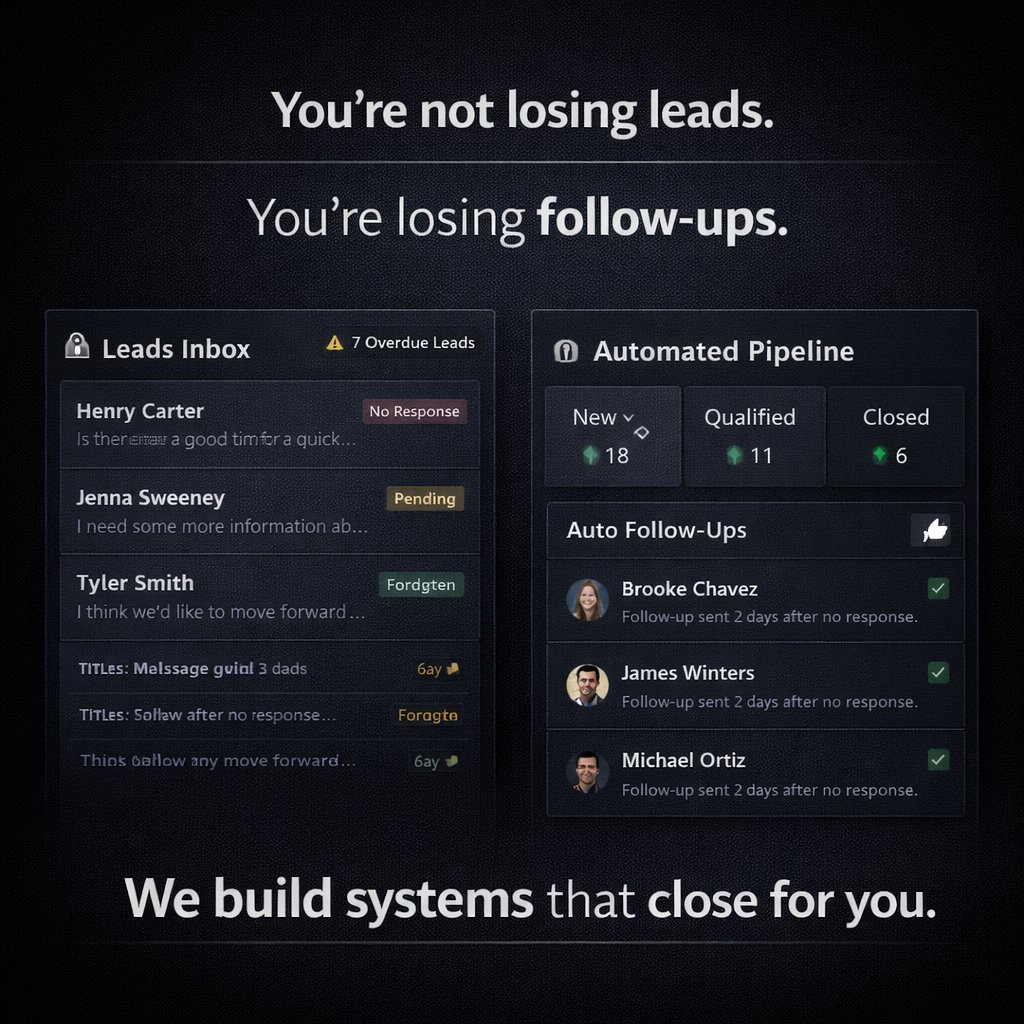
Most consultants don’t have a lead problem.
They have a follow-up problem.
Leads come in…
And then:
– No structured pipeline
– No automated follow-ups
– No visibility on deal status
So opportunities die quietly.
We build internal systems that:
• Track every lead automatically
• Trigger follow-ups based on behavior
• Move deals through a structured pipeline
• Give you full visibility on what’s closing and what’s stuck
This isn’t another CRM.
It’s a system that actually moves deals forward.
If you’re manually chasing leads, you’re leaving money on the table.
Comment “LEADS” and we’ll show you how it works.
Most modern AI models scale by increasing size. LFM2-24B from @liquidai explores a different direction — focusing on adaptive processing and more efficient reasoning systems. In this short breakdown, we look at: • What the model is • How it differs from standard transformer approaches • Why efficiency and architecture matter in real-world systems This series is focused on explaining AI models from an engineering perspective — without hype.