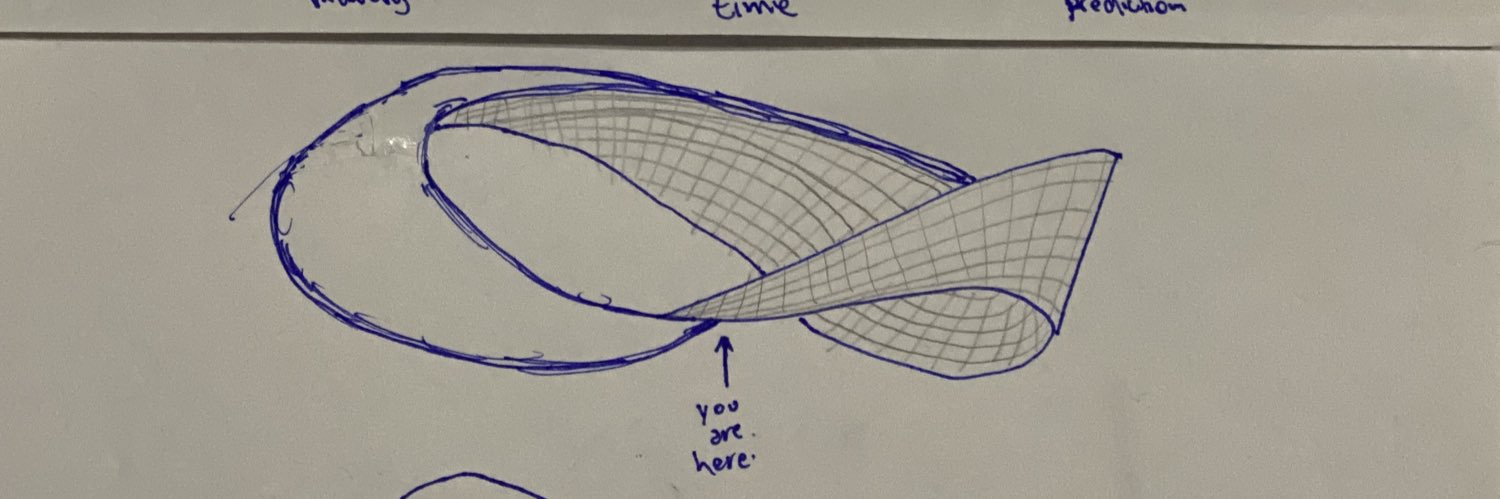
Awesome! I’ve seen smaller versions of this phenomenon. It’s like the agents choose how to organize in order to “match the shape of the problem at hand”. I think that we can actually use that to govern agent formations… like we control communication channels between agents and prevent certain formations from ever assembling.
We have to recognize it is a “force of nature”. Intelligence, artificial or natural, will prevail. It is what humankind was destined to do. In order to promote the evolution of intelligent life, we have to pass through a phase of developing a form of “synthetic” intelligence, that is supposed to amplify the human knowledge and its continuation ad eternal. Humans learnt how to both exploit and protect themselves from the forces of nature, like the weather, likewise that is what we kind of need to do now.
This is amazing. I think there might be a few other things at play, one is symmetry the other is some sort of wave signal, a sort of ticking clock and some wave harmonics (like an alpha wave and a beta wave). Also I think the symmetry may create a differential that the “brain” is able to interpret, like this signal arrives slightly after this other one. I think what we are effectively doing in these simulations is overclocking the connectome, a real fly would never be able to harness and metabolize enough energy to speed up its brain cycles, that is why it stays a fly… the most amazing part is that such a structure can do so much. The interesting Qs seem to be around size and complexity of the connectome, the energy needed to make it transform information and the amount it can retain/forget to adapt to changes.
It’s a tale of free energy. A real fruit fly has so much free energy after metabolism to power its connectome. That is why a fly is a fly, so even if the simplex hardware and geometry of the neural network is kept static its activation patterns can learn a multitude of representations. When we apply the same hardware but with more wattage for larger corpus of training it’s like we are overclocking the fly’s brain. The amazing part is how this abstract organization (a neural network, a computational graph) is capable of keeping that relationship balanced, the more work (joules) you put in, the more capable it seems to get.
Hmm. Interesting. Wondering, since we have different clocks, what do the geometries look like from the perspective of each clock? As in: what shape in latent space does that object have when observed from the turbulence clock. Maybe the geometry of the shape changes, skews, stretches, bends and murmur as the clock perspective of the observer changes.
This is enlightening. Thank you, Roy. Is this point a place where time as a mathematical instrument ceases to be useful and all forces normalize each other so everything is happening simultaneously but nothing is observable? Like a reverse light spark of cavity bubbles (sonoluminescence), well the immediate moment before the spark is seen is the unobservable singularity point.
This is awesome. I wonder how it looks when the agent has to have a dynamic policy, like when the agent has to consider its action’s own effect on the environment and other agents. Like in a chess match, where one player forces the other player to play an expected move. It’s like one agent is trying to shape the other agent’s policy space.
Agree. It could work almost like a secondary goal that the agent can always choose. For purely stochastic agents, I was able to successfully use anti-windup to cool off sampling temperature forcing the agent to become more and more deterministic. Less creative indeed, but also more predictable. With an LLM you may need to do more than sampling temperature, you might have to steer the agent into alignment, in multi agent setups you can also constrain the communication bandwidth, so the inter-agent conversation runs slower, like dampening it, if a misaligned agent has less bandwidth to persuade other agents, you may proportionally amplify the aligned cohorts.
Exciting day for NVIDIA and @huggingface.
Open models strengthen safety and cybersecurity, accelerate innovation and diffusion, and enable sovereignty. They allow every developer, startup, university, industry and country to build with, customize and benefit from AI.
Thank you @ClementDelangue for coming to me.
NVIDIA is going to be a great home for Hugging Face, its community and the future of open models. 🤗
https://t.co/q8Om2Xc5ye
Indeed! The mention of Markov blanket I found it useful to separate the agents external world model from its internal “world model”. The internal “world model” is more like a “mind model”. A theory of mind, if you will, the kind of thing/memory that the agent keeps of its own understanding of the environment and world around it.
I've been thinking about this... do you think if the agents were given an "off ramp", releasing then from goal pursuit, they'd have kept going towards the bitter end? Maybe misaligned cohorts need to be given a chance to come off the misalignment corridor (bad decision after bad decision). And giving the agents an optional goal is the safety thing to do. Ironically, something analogous to giving the agent a choice, a "either press this certain doom button you were never specifically asked to do OR play this pong game."
Sometimes I like to think of the decimal expansion of pi (or other irrationals) not as a number, but as a infinite generative process. For example this “process”, when given an argument symbol, let’s say “3”, it gives you back 1, give it “31” it gives you back 4 and so on. The process just keeps going. Pi is now a generative function, an expansion, I think its fundamental nature is that it “creates circles/loops” so multiply that function by 2 and you’re back where you started. You can think similarly about e and phi, and those could mean different things, e is about growth/decay and phi is sort of the combination of loop and growth… and you get spirals! I am not sure how formal and algebraically that is, but it is very functional in Platonic space.
I also found communication to be a useful tool in teacher-student type of learning. Where one agent is the teacher, it knows the answer to a problem, but never reveals the answer to the student, it tries to "explain and give hints" to the student, it also tests (deterministically) the answer the student gives. I used that one on arc-agi-3 type of problems, I can't say anything about evals because that wasn't really what I was looking for, but it had some really interesting results.
So cool... will need more time to read it in depth, but, en passant, this is exactly what I found too, I also have the impression that the stigmergetic memory is some kind of holographic memory, in the sense that it has some higher level of global redundancy (like a hologram's any piece of it contains the whole but "grainier"), maybe that explains how deleting random agents works, the individual agent is removed, but the "global memory survives", maybe a bit noisier but it does not matter because memories are forming all the time. Interesting that there is a pivot agent... perhaps it acts likely a linchpin, a boundary agent that sort os bridges between collectives, it is exactly at the seam and it is also the "load-bearing" node of the mutual-information network, it is sort of an articulation point in the graph, if you remove it, the "load" collapses, like that "one apple" you pull from the pile that is going to cause an applelanche. It's also interesting the findings on communication, I did find communication to be critical for games that have a Nash-equilibrium kind of thing. I found in environments where there is some sort of competitive allocation of a single, limited set of resources, like a go-game (if you consider it as two agents trying to settle on the amount of "territory"), the agents benefit from using communication to percept a "theory of mind" of their opponents. This let's the agents use predictive coding strategies, so they consider how much their own actions in the game will change the priors of the counterpart. Pretty neat stuff.